
AMD Core Counts and Bulldozer: Preparing for an APU World
- Posted in
- CPUs
The New Way to Count Cores
Henceforth AMD is referring to the number of integer cores on a processor when it counts cores. So a quad-core Zambezi is made up of four integer cores, or two Bulldozer modules. An eight-core would be four Bulldozer modules.
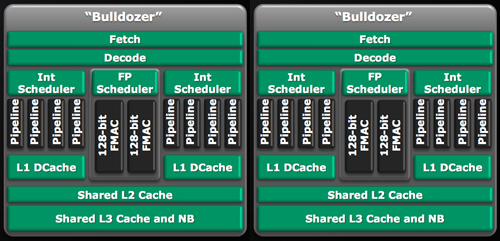
A hypothetical quad-core Bulldozer. Presumably the L3 cache would be shared by both modules.
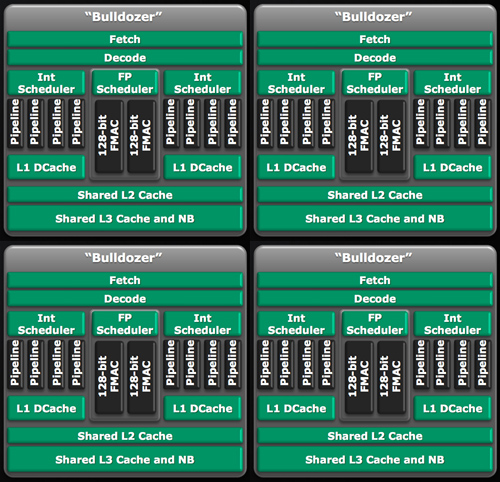
A hypothetical eight-core Bulldozer. Presumably the L3 cache would be shared by all four modules.
It's a distinct shift from AMD's (and Intel's) current method of counting cores. A quad-core Phenom II X4 is literally four Phenom II cores on a single die, if you disabled three you would be left with a single core Phenom II. The same can't be said about a quad-core Bulldozer. The smallest functional block there is a module, which is two cores according to AMD.
Better than Hyper Threading?
Intel doesn't take, at least today, quite aggressive of a step towards multithreading. Nehalem uses SMT to send two threads to a single core, resulting in as much as a 30% increase in performance:
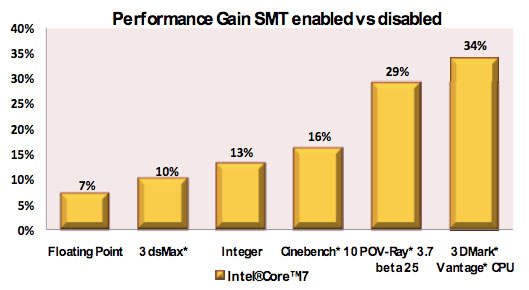
The added die area to enable HT on Nehalem is very small, far less than 5%.
AMD claims that the performance benefit from the second integer core on a single Bulldozer module is up to 80% on threaded code. That's more than what AMD could get through something like Hyper Threading, but as we've recently found out the impact to die size is not negligible. It really boils down to the sorts of workloads AMD will be running on Bulldozer. If they are indeed mostly integer, then the performance per die area will be quite good and the tradeoff worth it. Part of the integer/FP balance does depend on how quickly the world embraces computing on the GPU however...
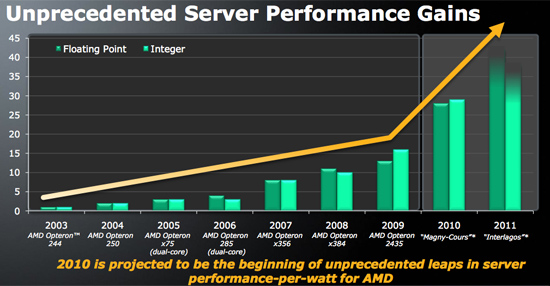
According to AMD's roadmaps, Zambezi will use either 4 or 8 Bulldozer cores (that's 2 or 4 modules). The quad-core Zambezi should have roughly 10 - 35% better integer performance than a similarly clocked quad-core Phenom II. An eight-core Zambezi will be a threaded monster.
No GPU, for Now
The first APU from AMD will be Llano, but based on existing Phenom II cores. The move to a new manufacturing process combined with the first monolithic CPU/GPU is enough to do at once, there's no need to toss in a brand new microarchitecture at the same time.
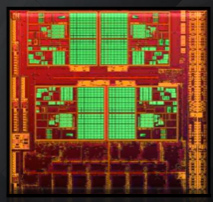
AMD did add that eventually, in a matter of 3 - 5 years, most floating point workloads would be moved off of the CPU and onto the GPU. At that point you could even argue against including any sort of FP logic on the "CPU" at all. It's clear that AMD's design direction with Bulldozer is to prepare for that future.
In recent history AMD's architectural decisions have predicted, earlier than Intel, where the the microprocessor industry was headed. The K8 embraced 64-bit computing, a move that Intel eventually echoed some years later. Phenom was first to migrate to the 3 level cache hierarchy that we have today, with private L2 caches. Nehalem mimicked and improved on that philosophy. Bulldozer appears to be similarly ahead of its time, ready for world where heterogenous CPU/GPU computing is commonplace. I wonder if we'll see a similar architecture from Intel in a few years.
Originally published at https://www.anandtech.com/show/2881 (Wayback Machine).