
MSI P55-GD65 - Mid-Range P55 for the Masses
- Posted in
- Motherboards
There's really no other way to say this: MSI’s P55-GD65 performs almost exactly the same as any other P55 motherboard in every single benchmark we ran.
Application tests, game tests, LAN tests, even USB, Firewire, and SATA controller performance was virtually identical across the board. We've known for a while now that motherboards of a given generation all perform the same, but there's honestly no more to it than that.
We've included a wealth of application, gaming and peripheral performance data for you to see for yourself, but honestly, features, overclocking potential, support, and price point are what matter here.
The biggest difference between the boards, from a performance standpoint, actually surfaces in power consumption:
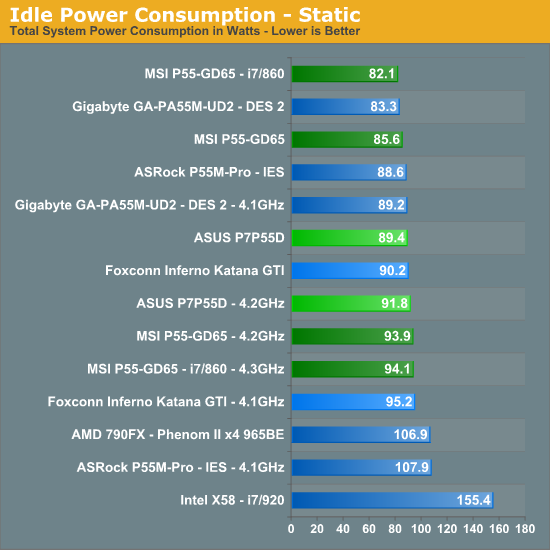
At idle the MSI P55-GD65 draws the least amount of power with the Core i7/860, while the Core i5/750 draws right over 2W more than the micro-ATX based Gigabyte board. Why the 860 setup draws less power is something we are still working on, but even manually setting the voltages the same resulted in a similar 2W~3W difference. When the 750 is overclocked, it draws slightly more power than the ASUS P7P55D board which features a voltage offset option in the BIOS, allowing it to idle at 1.088V instead of the 1.352V on the MSI board. The load numbers favor the MSI board across the board.
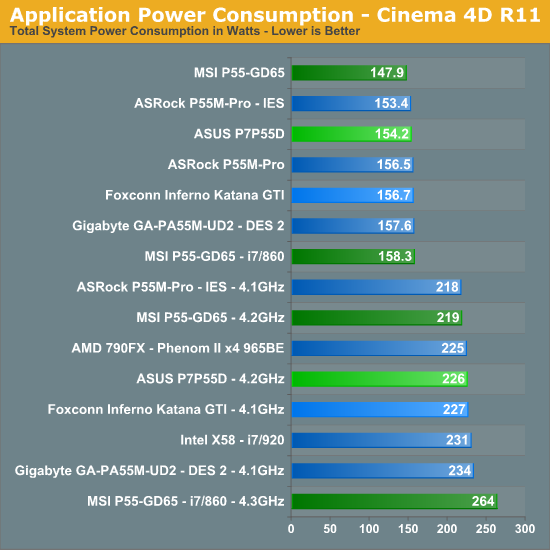
Application/Gaming Performance
We're presenting all of the application/gaming performance data without commentary because, as we mentioned before - there's no real appreciable performance difference between these three boards. All of the boards were run with the Core i5 750 and we've included the Phenom II X4 965 BE as well as the i7 860, 870 and 920 purely for reference. Please check our Lynnfield launch article to see how well this processor performs against a variety of CPUs.
In many of our tests, the Core i5 750 is the same speed or faster than the Phenom II X4 965 BE. The lack of Hyper Threading prevents it from being a runaway success. In other cases, the Phenom II X4 965 is faster - and by a large degree.
Intel was very careful to disable HT on the 750, without it, there would be no reason to spend the extra money on the Core i7 860. Just as it was with Bloomfield, $284 is the sweet spot for Lynnfield if absolute performance is a requirement. Now for the benchmarks.
Originally published at https://www.anandtech.com/show/2853 (Wayback Machine).