
OS Mobility Explored
- Posted in
- Laptops
Internet Battery Life, Round 2
We were a bit concerned with some of the Internet battery life results, so we decided to retest all of the systems using different websites. We felt that variance in the content of the webpages we used originally, even with repeated testing, might have skewed some of the results, so we switched to websites that present content more consistently. This time, we selected Yahoo!, MSN, the main YouTube page (no videos actually playing), and the Facebook login page (representing a simple web page, though logging in on Facebook makes it a lot more complex). The Yahoo! page is active while the other three are in tabs and their content is not visible. Here are the results for both systems.
[Drum roll…]
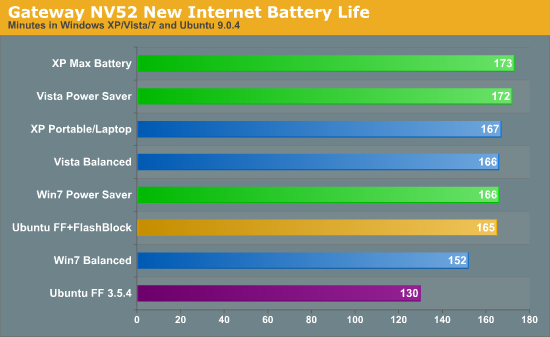
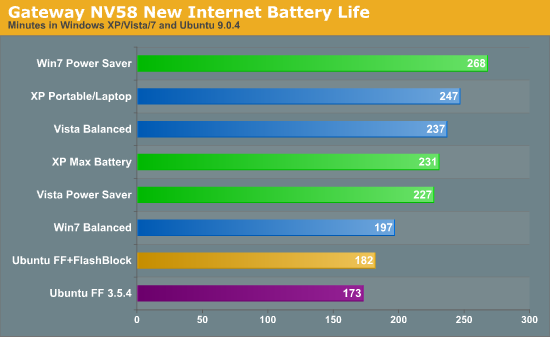
Okay, we're not finished yet, since we're still running some of these tests on the laptops. We'll update this page as we complete additional tests, so check back during the week. You can see what we mean when we say the results were inconsistent, however, as the placement of certain OSes is very different from our original Internet tests. On the NV52, all of the Balanced battery results are a lot closer to the Power Saver results this time, with the largest difference coming in Windows 7 at 9%. That isn't entirely out of sync with what we would expect, since Flash content may result in the CPU running at higher speeds without the limits imposed by Power Saver. However, Windows 7 suddenly drops to the back of the pack and we again have to question the results. [Queue yet another retest.] Ubuntu still shows a 27% boost in battery life by using FlashBlock, but that's less than the 44% boost shown originally. That makes sense, considering we aren't using sites with nearly as much Flash content. We will update the charts with Vista + Firefox results later this week and rerun the Windows 7 tests just to be safe.
The NV58 results aren't any better at clearing things up, since this time Windows 7 has a huge lead in its Power Saver result but trails by a significant amount in the Balanced test. So despite using sites that appear to be more consistent at first blush, we're afraid that there's still variability and we need to run more tests. Another interesting aspect is that Ubuntu hardly shows any difference between Firefox and Firefox + FlashBlock on the NV52, garnering a scant 5% increase in battery life. At least XP and Vista generate relatively consistent results, which is more in line with what we would expect. Of course, expectations are frequently wrong, which brings us to round three….
Originally published at https://www.anandtech.com/show/2840 (Wayback Machine).