
Memory Scaling on Core i7 - Is DDR3-1066 Really the Best Choice?
- Posted in
- Memory
The Test
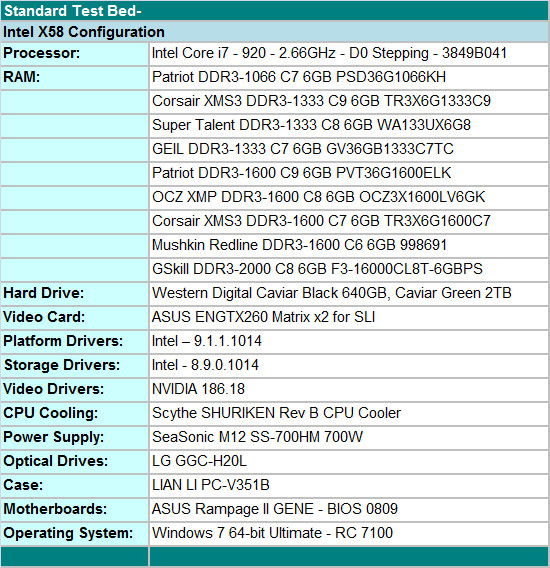
We decided to build an i7 uATX system for testing today. We certainly had our pick of various components for a memory test bed with the EVGA Classified, Gigabyte X58 Extreme, and DFI UT X58 boards coming to mind along with higher end video card and storage selections. In the end, we decided taking a practical approach to the component selection would serve us better in showing memory results on a system considered mid-range in the i7 world from a performance viewpoint. We will follow up shortly to see what differences occur in memory performance when utilizing an SSD, different memory/board timings, and additional benchmarks with Virtualization routines.
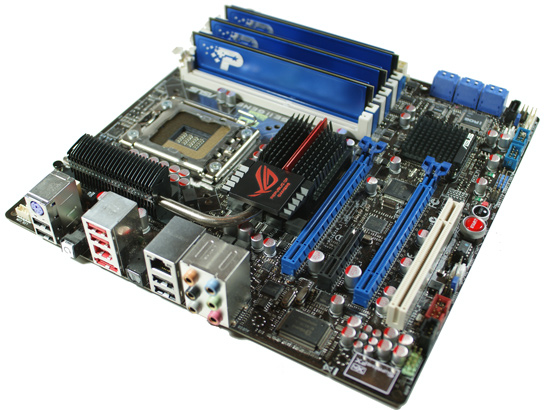
We settled on the ASUS Rampage II GENE as our motherboard choice based on the available feature set and BIOS options. You could certainly cost reduce this system and utilize the excellent MSI X58M motherboard. Our processor choice was easy as the Core i7 920 is the best selling i7 product and represents what most users currently pair with an X58 board.
We selected the ASUS ENGTX260 video card for GPU duties. It is a non-reference design that offers improved thermals and acoustics over the standard NVIDIA GTX 260 216 designs. The WD Caviar Black 640GB is our hard drive of choice for primary storage purposes with the WD Caviar Green 2TB drive as a logical choice for backup duty. LG’s GGC-H20L Blu-ray playback capable drives fills in for optical duties.
We purchased several 6GB kits for memory duties. We set the BIOS to the advertised settings for each kit on the primary timings and left the sub-timings on auto in the BIOS. Of course, those who like to play around in the BIOS could certainly improve upon our synthetic results but overall, we found very little if any differences in actual applications when tuning the sub-timings.
We chose the Scythe SHURIKEN Rev B CPU Cooler for air-cooling duties. This cooler features a low profile design with quiet operation and good cooling characteristics, which is perfect for a base SFF setup. For the more performance oriented crowd we highly suggest the Thermalright AXP-140 with a Thermaltake 140mm fan. We are currently testing this combination for a uATX shootout and it works well.
Our standard power supply is the excellent SeaSonic M12 SS700HM 700W modular unit. This power supply also works for SLI/CF testing since it supports the necessary PCIe connectors. LIN LI’s PC-V351B turned out to be an excellent choice for this setup although our loaded system was cramped for space. We had to complete some creative engineering for all the cooling systems to work properly while taming cable management obstacles. We utilized the ASUS VH242H 23.6" 1920x1080 LCD monitor for display duties. Finally, we have dropped Vista 64-bit and moved to Windows 7 Ultimate 64-bit for our testing today - it just works better.
Our software choices represent a wide variety of applications and we selected 64-bit versions of the program where applicable to ensure full access to our 6GB memory configuration. Unless otherwise noted, we run each benchmark three times and average the results for our score. We clear the prefetch folder between each test run, defrag, and then reboot when switching to a new benchmark. Our programs are updated to the latest release from the supplier. Turbo mode along with HT is enabled on the Core i7 920 and power management is set to balanced for testing.
Originally published at https://www.anandtech.com/show/2792 (Wayback Machine).