
Memory Scaling on Core i7 - Is DDR3-1066 Really the Best Choice?
- Posted in
- Memory
Even though our DDR3-2000 kits were not cooperating with us, we were able to run a few benchmarks to determine which memory setting would be ideal at our 3.8GHz (19x200) processor speed. We arrived at this clock speed, as it is a free overclock with only VTT needing to be increased to handle our particular memory speeds and timings. We will take a look at other overclocked speeds and memory settings in the near future.
Everest 5.02.1765
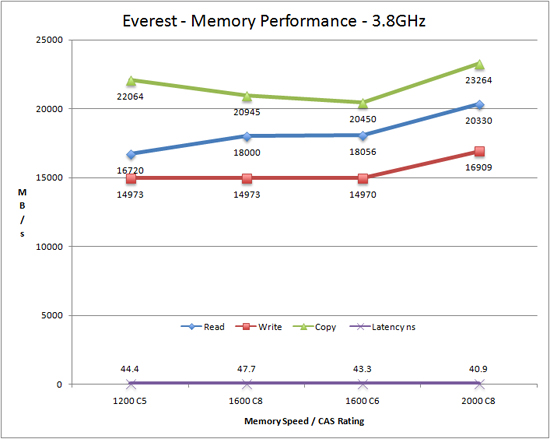
Going from 1250 C5 to 2000 C8 nets a 5% improvement in memory reads, 21% in writes, 13% in copy speeds, and 8% in latency. Interestingly enough, 1200 C5 provides excellent results compared to 1600 C8 and our application benchmarks reflect this fact.
AutoCAD 2009 x64
We utilize AutoCAD 2009 x64 and the Cadalyst Labs benchmark.
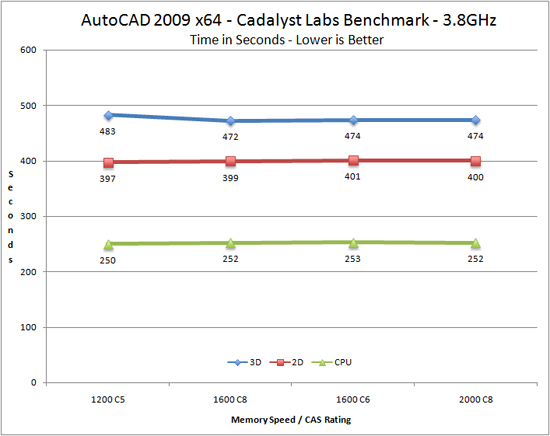
Just like our stock clock results, the 3D scores are respond better to the slower memory speeds. Once again, decreased latencies and greater bandwidth generally resulted in improved 2D and CPU scores.
3ds Max 2009 x64
We utilize a rather large mental ray image and track the time it takes to render it.
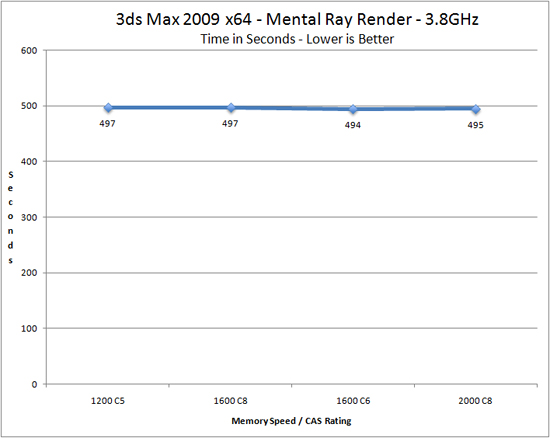
In our stock test we measured a 3% increase in performance (19 second reduction) moving from DDR3-1066 C7 to DDR3-1600 C6. In our overclock test the 2 second difference between 1200 C5 and 2000 C7 is minimal as clock speed is king at this point.
LightWave 3D 9.6 x64
We time the rendering of a single frame from an office building animation. The time to render the full scene is approximately four and a half hours.
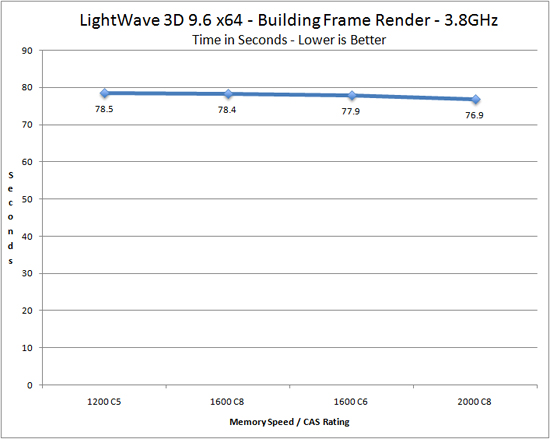
The stock test revealed a 6% advantage for DDR3-1866 C7 over DDR3-1066 C7. The overclock test indicates a 2% advantage for 2000 C8 compared to 1200 C5.
WinRAR 3.9b3 x64
This benchmark compresses our AT workload consisting of a main folder that contains 954MB of files in 15 subfolders. The result is a compressed file approximately 829MB in size.
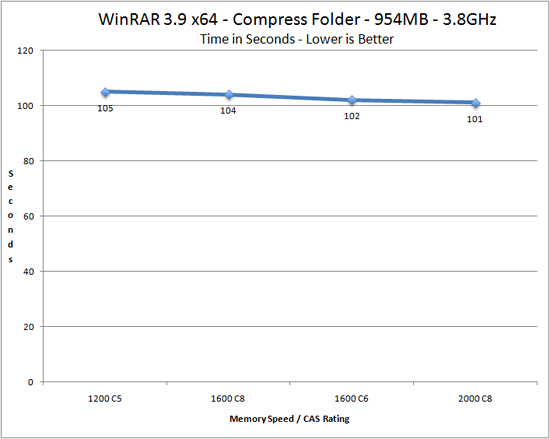
In our stock tests, going from DDR3-1066 C7 to DDR3-1866 C7 resulted in a 20% decrease in processing time. With our processor overclocked to 3.8GHz, this benchmark provides a 4% increase in performance when moving from 1200 C5 to 2000 C8.
MainConcept Reference 1.61
We set our profile to iPOD HQ NTSC and then transcode a 651MB 1080P file to a iPOD friendly 34.7MB file.
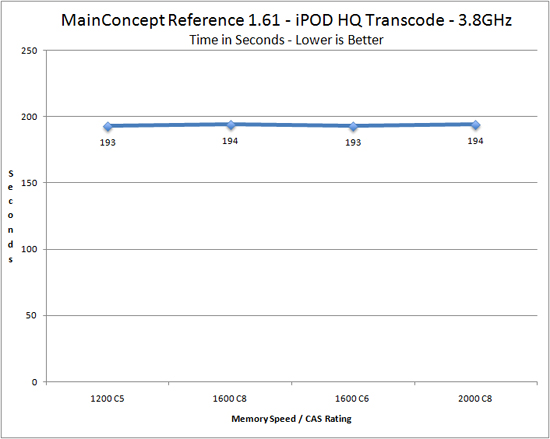
Our stock test showed a 3% improvement in performance when scaling from DDR3-1066 to DDR3-1866. Overclocking our system resulted in a .05% variation in the score with our two low latency settings performing ever so slightly better.
Originally published at https://www.anandtech.com/show/2792 (Wayback Machine).