
Overclocking Extravaganza: GTX 275's Complex Characteristics
- Posted in
- GPUs
Core Overclocking
After G80 hit (the first NVIDIA GPU to employ a separate clock domain for shaders), silent shader clock speed increases were made with any core clock speed increase. At first this made sense because NVIDIA only exposed the ability to adjust core and memory clock and the shader clock was not directly adjustable by the end user. Of course, we went to some trouble back then to try our hand at BIOS flashing for shader overclocking. After NVIDIA finally exposed a separate shader adjustment, they still tied core clock and shader clock to some degree.
Since the middle of last year, NVIDIA's driver based clock speed adjustments have been "unlinked," meaning that the shader clock is not affected by the core clock as it used to be. This certainly makes things a lot easier for us, and we'll start by testing out core clock speed adjustment.
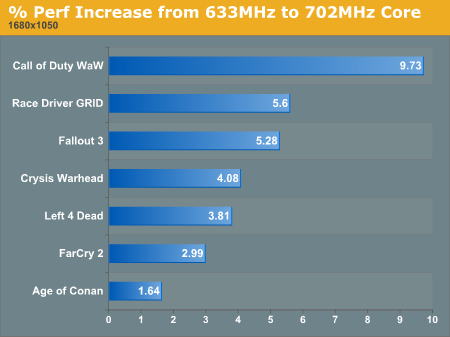
The maximum core clock we could hit on our reference GTX 275 was 702. Try as we might, we just could not get it stable beyond that speed. But it's still a good enough overclock for us to get a good handle on scaling. We know some people have GTX 275 parts that will get up toward 750 MHz, so it is possible to get more speed out of this. Still, we have an 11% increase in core clock speed which should net us some decent results.
1680x1050 1920x1200 2560x1600
Call of Duty edges up toward the theoretical maximum but drops off up at 2560x1600 which is much more resource intensive. Interestingly, most of the other games see more benefit at the highest resolution we test hitting over 5% there but generally between 2 and 5 percent at lower resolutions. FarCry 2 and Fallout 3 seem not to gain as much benefit from core overclocking as our other tests.
It could be that the fact we aren't seeing numbers closer to theoretical maximums because there is a bottleneck either in memory or in the shader hardware. This makes analysis a little more complex than with the AMD part, as there are more interrelated factors. Some aspects of a game could be accelerated, but if a significant amount of work is going on elsewhere, we'll still be waiting on one of the other subsystems.
Let's move on to the last independent aspect of the chip and then bring it all together.
Originally published at https://www.anandtech.com/show/2778 (Wayback Machine).