
AMD's Six-Core Opteron 2435
- Posted in
- IT Computing
Rendering: 3ds Max 2008
Operating System: Windows 2008 Enterprise RTM (64 bit)
Software: 3ds Max 2008
Benchmark software: Build in timer
Typical error margin: 1-2%
We used the "architecture" scene which is included in the SPEC APC 3DS Max test. All tests were done with 3ds max's default scanline renderer, SSE enabled and we rendered at HD 720p (1280x720) resolution. We measured the time it takes to render 10 frames from 20 to 29 with SSE enabled. We recorded the time and then calculated (3600 seconds * 10 frames / time recorded) how many frames a certain CPU configuration could render in one hour. All results are reported as rendered images per hour, higher is thus better.

We used the 32-bit version of 3ds Max 2008 on 64-bit Windows 2008 RTM. The 64-bit version of 3ds Max was a bit slower (especially when we used the Scanline Renderer). All CPU configurations are dual, unless when we indicate otherwise.
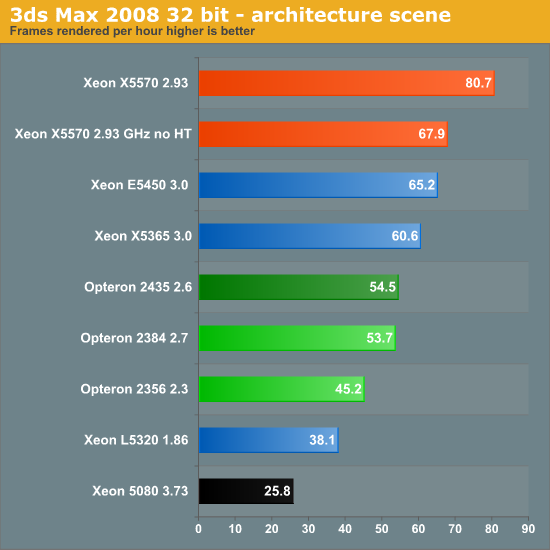
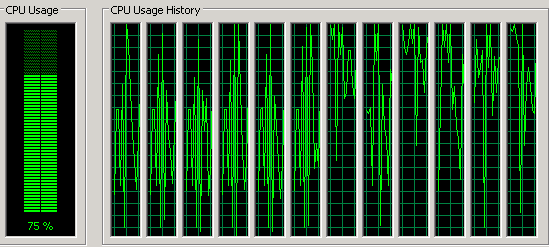
We wrote “Some applications do not like core counts that are not a power of 2”. Well, here you have another example. The extra cores of AMD “Istanbul” are close to useless. The Xeon x55xx series outperform the hex-core by almost 50%. The 3DS Max scanline render simply does not know what do with the 12 cores presented. CPU usage went from 50 to 80%:
We are sure that there are probably more efficient render engines out there, but it is simply not a market the AMD six-core should cater to. Nehalem-based Xeons are simply way too powerful for this kind of application. Render engines scale almost perfectly with clockspeed. So if cost is your main concern, consider the Xeon E5520 at 2.26 GHz, the cheapest CPU that still supports HT. We will test this one soon, but we expect it to deliver 67 frames per hour, which is still more than 20% better than any Opteron.
Originally published at https://www.anandtech.com/show/2774 (Wayback Machine).