
Real-world virtualization benchmarking: the best server CPUs compared
- Posted in
- IT Computing
Caches, Memory Bandwidth, or Pure Clock Speed?
We currently only have one Xeon 55xx in the lab, but we have four different CPUs based on the AMD "K10" architecture. That allows us to do some empirical testing to find out what makes the most impact: larger caches, faster memory, or mostly clock speed?
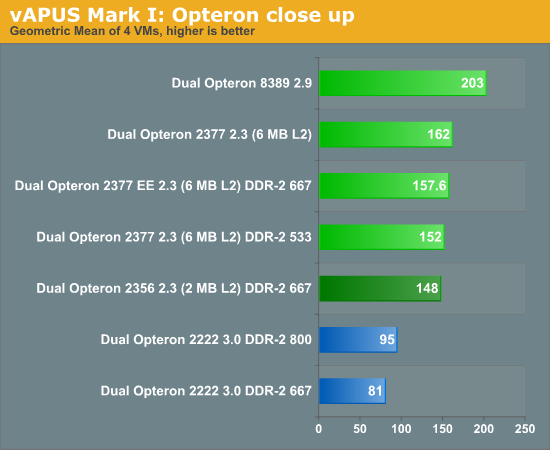
Every bit of extra clock speed seems to benefit our test. Bandwidth has a smaller effect. Even if we reduce the bandwidth of the Shanghai Opteron by one third, the score only lowers by 6%. Given that we only run four VMs this seems reasonable. Shanghai got three times as much L3 cache, a faster L3 cache, DDR2-800 instead of DDR2-667, and lower world switch times. The Opteron 2377 2.3GHz allows us to test at the same clock speed: the Shanghai Opteron is about 9.5% faster clock-for-clock than the Barcelona chip. If we run both chips with the same memory, the Shanghai Opteron is 6.5% faster. That's a small difference, but the Opteron EE promises much lower power consumption (40W ACP, 60W TDP) than the Barcelona chip (75W ACP, 115W TDP).
Notice that the Dual Opteron is a lot more bandwidth sensitive: improve bandwidth by 20% and you get 14% higher performance. Four VMs are fighting for only 4x1MB of cache, while running on the dual "Shanghai" Opteron each VM in theory has two 512KB L2 caches plus a 3MB chunk of L3.
Originally published at https://www.anandtech.com/show/2770 (Wayback Machine).