
Gateway P-7808u: to Quad or Not to Quad?
- Posted in
- Laptops
Subjective Evaluation
If we ignore pricing, our overall opinion of the P-7808u is actually quite good. It performs well, in both games and applications, and surprisingly enough battery life isn't all that bad - at least for a gaming notebook. The only people likely to be unhappy with the performance offered are gamers that "need" more than 60 frames per second at maximum detail in the latest and greatest titles.
As always, the first thing we did after booting up the laptop was to remove all the extra software that we didn't want. That 60 day trial to Symantec Norton 360 2009? Gone! I suppose it might keep you safe if you don't know how to avoid downloading malicious programs, or if you don't like to update Windows on a regular basis, but personally I've never had an issue with my computers getting infected (unless I do something stupid). Regardless, performance is slower when running antivirus and/or firewall software, so for testing purposes it has to go. After removing the unnecessary applications and utilities, the system boots quicker, but plenty of processes remain. All of these are accepted tools, however, mostly involving drivers for the various pieces of hardware (touchpad, audio, GPU, Bluetooth, WiFi, etc.)
In day-to-day use, the P-7808u almost feels like the exact opposite of the Dell Studio XPS 16. Performance in most areas improves, and gaming performance in particular is substantially better than the Studio XPS 16. However, where we absolutely loved the LCD on the Dell laptop, the P-7808u display leaves us wanting. It's reasonably bright, but that brightness applies to both whites as well as blacks. The contrast ratio was noticeably bad, even without any testing. Set this laptop next to the Dell Studio XPS 16 and you'll most likely be sorely tempted to give up any gaming performance in order to get the improved display. If Gateway (or anyone else for that matter) is looking to do a more substantial revision to the P-series FX laptops, we would love to see a 16" chassis that includes a high-end GPU and the Seiko Epson RGB LED LCD! Even if companies want to go with lower resolution LCDs, please - please! - stop using these cheap, 200:1 contrast ratio LCDs. $50 or more for a better LCD is something over 90% of our readers said they would like to see.
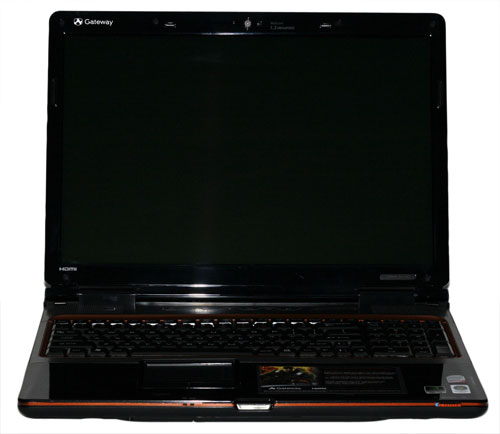
Besides the downgraded LCD, we don't have many serious complaints. One area that we have been generally pleased with on FX notebooks is the keyboard layout. You get a full size keyboard and number keypad, and the location of the keys makes sense. Most of us prefer to have the Fn key inside of the Ctrl key in the bottom left corner, but Anand is the exception, preferring the Gateway layout. (I can't tell you how many times I pressed Fn+C for "copy" instead of Ctrl+C….) Ultimately, though, the keyboard has a good feel and is as comfortable to use as any notebook we've tested. You also get a rather large palm rest, which helps with the overall feel of the keyboard. Gateway could add some extras like LED backlighting on the keyboard, but that's not strictly necessary and provided costs are kept reasonable, we're perfectly happy with the current design.
Stability and reliability during testing were good for the most part. Towards the end of testing, however, we started to have some odd crashes. Windows would simply quit responding. The mouse would work, but nothing else was responsive and we had to force shutdown the laptop (i.e. hold in the power button for several seconds). We could still ping the laptop through the network, and sounds would play as well (i.e. close the lid and you hear the "device disconnected" sound; open the lid and hear the "device connected" sound). However, even pressing CTRL+ALT+DELETE failed to make the laptop respond, along with any other keyboard shortcuts. Stability problems are a huge concern for anyone spending a lot of money on a laptop, and at $1700 the P-7808u is not cheap.
We delayed our review a little bit longer to try to get at the bottom of the sudden instability - the first several weeks of testing went without a hitch. Over the weekend, we were able to determine that the problems were caused by the Western Digital 500GB hard drive. We could boot up the system and use it, sometimes for hours, but periodically the hard drive would just stop responding, at which point we had to force shutdown the system. Over the past few days, this began occurring more frequently until the system became unusable. We purchased a 500GB Seagate hard drive, cloned the original drive onto it using Clonezilla (an extremely handy, fast, and free disk imaging/cloning utility that I highly recommend), and all of our instability issues complete disappeared. We can't really fault Gateway for the instability, ultimately, since it was caused by the hard drive failing. A small percentage of computer components inevitably fail, typically within the first few weeks of use, and that's most likely what happened with the Western Digital hard drive.
Subjectively, the Gateway P-7808u provides a reasonable cost gaming notebook. If you're in the market for that sort of system, it's definitely worth a look. However, as we already mentioned, we actually prefer some of the past Gateway FX laptops to the P-7808u because they provided a better combination of price, features, and performance. Starting with the original P-6831, Gateway seemed to get the idea that building a cost-effective gaming notebook means spending more money on the GPU and less money on the CPU. The fastest processor in the world won't do you any good if your graphics chip isn't up to the task. Conversely, a reasonable GPU with one of the "slower" CPUs can help keep prices in check while still providing a good gaming experience. NVIDIA loves it when we say stuff like that, but it's absolutely true: gaming systems (particularly laptops) need a good graphics chip first and foremost.
The P-7808u still offers good gaming performance, but the use of a nearly $400 quad-core processor - which won't benefit the vast majority of games - makes it rather unbalanced. Couple that with an LCD that regresses to what we saw over a year ago in the P-6831 and we have to admit we're a little concerned Gateway is going backwards. At the very least, they are doing what most other companies do when it comes to gaming laptops: they provide more power than you need in the CPU department at the expense of GPU power, resulting in lower overall game performance and a higher price. Instead of a quad-core CPU, we would rather see a more meaningful upgrade in the GPU department - something like the GTX 260M with a P8600 CPU would be far more compelling.
Originally published at https://www.anandtech.com/show/2748 (Wayback Machine).