
Nintendo's Development Secrets, Cloud Gaming & new Killer NIC - GDC '09
- Posted in
- Trade Shows
Miyamoto’s World
Miyamoto draws his inspiration from observation. He looks at other humans and watches how they interact, what they enjoy doing, etc... When he sees an activity that people enjoy he focuses on why they find that activity so entertaining. He thinks about things that most people just glaze over; most people know when they’re having fun, they don’t focus so much on why they’re having fun. He analyses himself and others in order to discover new ways to develop games that capture the fun people already know how to have. Miyamoto draws his inspiration from the life around him; he doesn’t sit down to make a game, he looks at what he and others enjoy in life and uses that to spark the innovation.
Iwata gave two examples; the first was when Miyamoto got a new garden, Pikmin shortly followed. And when Miyamoto got a new dog? Nintendogs came about.
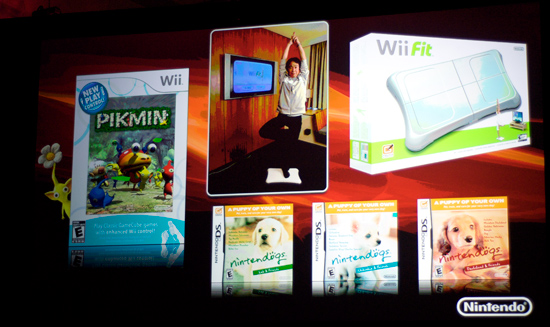
With the idea in mind, Miyamoto uses basic personal communication to start talking about it. He grabs a very small team and doesn’t do anything formal, they just talk. Miyamoto is all about personal communication, and that’s what happens here.
The next stage is to take this small team and begin prototyping the game. There’s no need for polish here, or anything other than the core concept of the game. As an example, this was the original prototype of Wii Boxing:
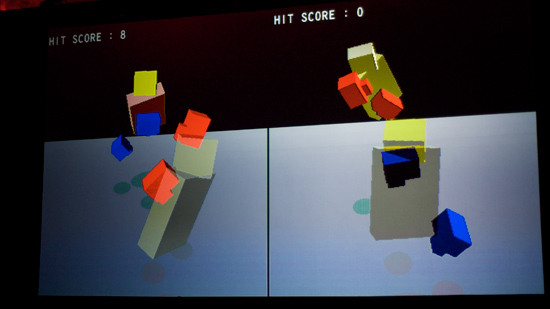
It’s not particularly attractive. There are no impressive shaders being used here. Miyamoto simply wants to test the basic mechanics of the game to see if it’ll be fun. The prototype stage is only concerned with the simple idea itself; don't worry about extraneous details - just core gameplay.
These small prototyping teams are sometimes only one developer large. There are often multiple projects in the prototype stage at the same time. This prototype stage can sometimes last as long as two years; not every concept ever makes it out of this stage, but Miyamoto never throws away the work that’s been done. While a prototype game or feature may not be used for the current project, it may come in handy somewhere down the line. Iwata said that he often times saw prototypes show up in games further down the line in ways you’d never expect.
It’s impossible to know what will be fun without trying it first. Miyamoto employs extensive use of trial and error in his prototyping stages, but that’s the beauty of not building fancy prototypes. If the concept doesn’t work, there’s not much extraneous work lost - it was simply a learning experience.
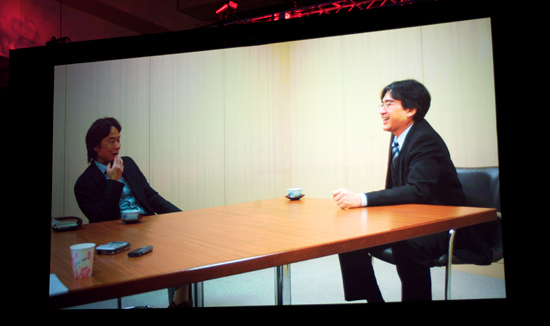
Miyamoto (left) and Iwata (right)
When a prototype succeeds, then and only then can the game get to a planning stage. This is where the documents come out and we start seeing some structure. With the core gameplay already defined, the next stage is mass production where the actual game is put together. The approach is very front loaded; if the core gameplay is done properly thanks to a well executed prototyping phase, building the rest of the game can go smoothly and according to schedule.
While the mass production stage is usually predictable, sometimes it does yield surprises. One of Miyamoto’s traits is that he never gets angry with his team when things don’t go according to plan. Mistakes are made and instead of a yell-fest, Miyamoto will even go as far as to personally help get things back on track. Iwata talked about it like someone turning a table upside down; Miyamoto helps pick up the pieces and put it back in order, rather than complain about the mess that was just made.
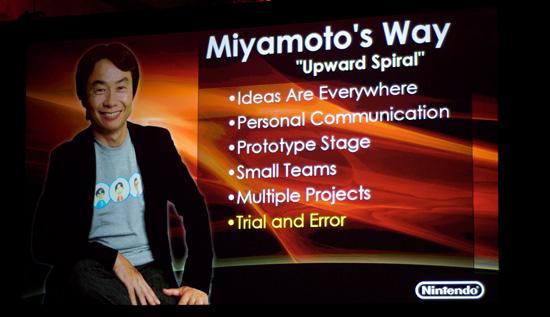
Because of Miyamoto’s aggressive focus on the prototyping stage, a game never needs to be restarted from scratch once it’s at the mass production phase. The prototype stage produced a well defined core concept. Sometimes ideas need to be dropped from the title because they don’t work out, but as I mentioned before, Miyamoto saves the ideas and can reuse them in later completely unrelated projects.
Iwata spoke of the “Death Spiral” in game development. Game developers face financial pressure to get games out on time; the developers rely on game sales to fund both current and future projects, so without that revenue stream there’s no hope for game development to continue. The financial pressure leads to less time to work on and perfect a game, which then leads to poor quality and poor sales. The spiral continues downwards until the developer can no longer remain competitive in the industry.
Iwata himself saw this death spiral first hand, as his previous job as a developer left him with 2 days to ship a title that needed months worth of work. Iwata sacrificed the quality due to sales pressure and eventually had to help restructure his company (HAL Laboratory) for bankruptcy. A much younger Iwata blamed finances alone for his employer’s failure as a game developer, but today Iwata believes that it has just as much to do with talent and approach to game development. His change in perspective is thanks to one man in particular: Shigeru Miyamoto.
According to Iwata, it’s Miyamoto’s methodical yet youthful approach to game development that gives him, and thus Nintendo, the edge. Iwata’s goal was to share one of Nintendo’s secrets success with the game developers in the audience. I just liked knowing how someone as significant as Miyamoto goes about his job.
Originally published at https://www.anandtech.com/show/2741 (Wayback Machine).