
SSD versus Enterprise SAS and SATA disks
- Posted in
- IT Computing
More RAID 5
The Random 66% read + 33% write is still the most interesting scenario, as it mimics an OLTP database.
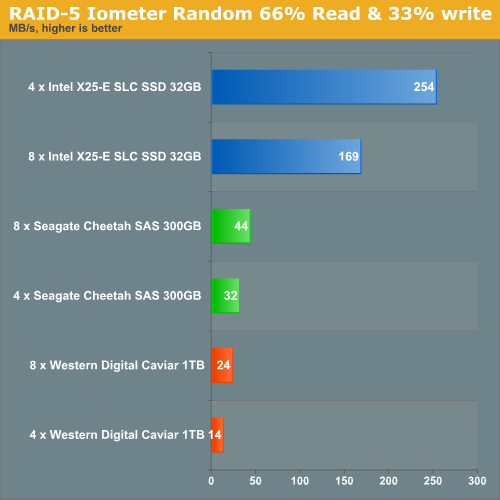
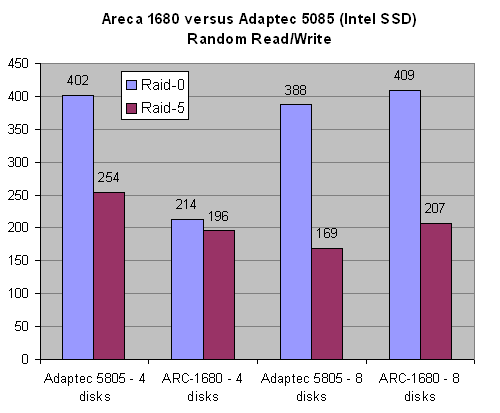
While it is true that the Adaptec shows some bad scaling in RAID 0, both controllers fail to show any decent performance increase with more than four disks in RAID 5. This only confirms our suspicion: the SLC drives are capable of reading and writing at blazing speed, so the RAID controller is swarmed by the massive amount of reads per second that need to happen for each write. As the amount of reads for one write that need to happen on the eight drive array is more than twice the amount on the four drive array, performance decreases. This is not an issue with the magnetic disks, as they are performing the same task at much lower speeds and thus require much less reads per second. We may assume that the RAID controller is holding back the SSD array, but proof is better than conjecture. We attached the four drives to each controller and made the Xeon at 3.33GHz the RAID controller (i.e. software RAID in Windows 2003):
| RAID 5 with Eight X25-E SSDs | ||
| One IOP348 controller and Hardware RAID |
Two Controllers and Software RAID |
|
| Sequential Read | 688 MB/s | 1257 MB/s |
| Sequential Read/Write | 221 MB/s | 257 MB/s |
| Random Read/Write | 169 MB/s | 235 MB/s |
Once we use the Xeon as the storage processor, the bottleneck is gone (or at least less narrow). Sequential read performance is twice as high as with four disks, and although the scaling of random read/write performance is nothing to write home about (19%), at least it is not negative anymore.
Should we blame Adaptec? No. The bandwidth and crunching power available on our Adaptec card far outstrips the demands of any array of eight magnetic disks (the maximum of drives supported on this controller). You might remember from our older storage articles that even the much more complex RAID 6 calculations were no problem for the modern storage CPUs. However, the superior performance of the Intel X25-E drives makes long forgotten bottlenecks rear their ugly head once again.
Originally published at https://www.anandtech.com/show/2739 (Wayback Machine).