
Intel's 32nm Update: The Follow-on to Core i7 and More
- Posted in
- CPUs
Enter the 32nm Lineup
Instead of Havendale in Q4, we’ll get Clarkdale and Arrandale. These are both dual-core, quad-thread processors, and both have on-package graphics. The CPU cores will be built on Intel’s 32nm process and in fact, they will be the first Westmere CPUs shipping into the market.
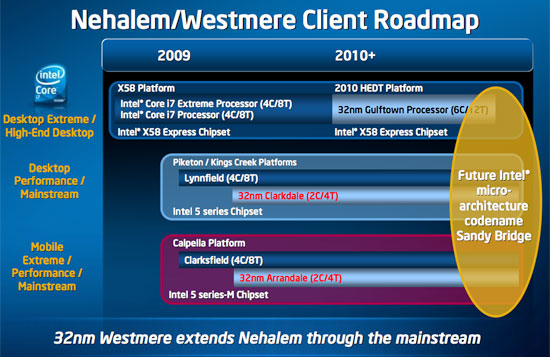
Now note that the dual-core market is the largest slice of the processor pie. Intel must be incredibly confident in its 32nm process to start shipping it into these demand markets first. Remember that both 65nm and 45nm initially launched on the high end desktop, but 32nm is making its debut in mainstream notebooks and desktops. The 32nm ramp is going to be a good one folks.
| Segment | Manufacturing Process | Socket | Processor | Cores | Threads | Release Date |
| High End Desktop | 32nm | LGA-1366 | Gulftown | 6 | 12 | 1H 2010 |
| Mainstream Desktop | 32nm | LGA-1156 | Clarkdale | 2 | 4 | Q4 2009 |
| Mobile | 32nm | mPGA-989 | Arrandale | 2 | 4 | Q4 2009 |
| 4S Server | 32nm | LGA-1567 | ??? | ? | ? | 2010 |
| 2S Server | 32nm | LGA-1366 | ??? | ? | ? | 2010 |
| 1S Server | 32nm | LGA-1156 | Clarkdale | 2 | 4 | 2010 |
Clarkdale/Arrandale have 32nm CPUs but their on-package GPUs are still built on Intel’s 45nm process; these are the GPUs that were supposed to be used for Havendale! It won’t be until 2010 with Sandy Bridge that we see a 32nm CPU and 32nm GPU on the same package.
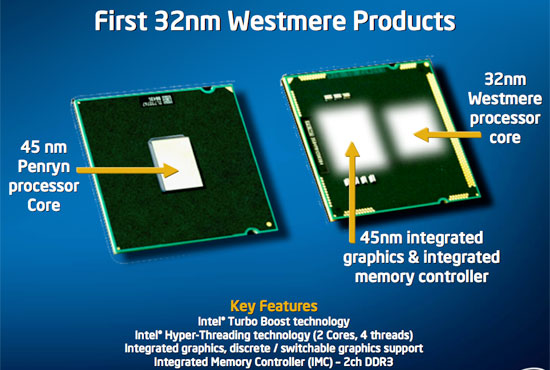
A side effect of the Clarkdale/Arrandale architecture is that the memory controller is now located on the GPU and not the CPU, although both are still on package and should still be quite low latency.
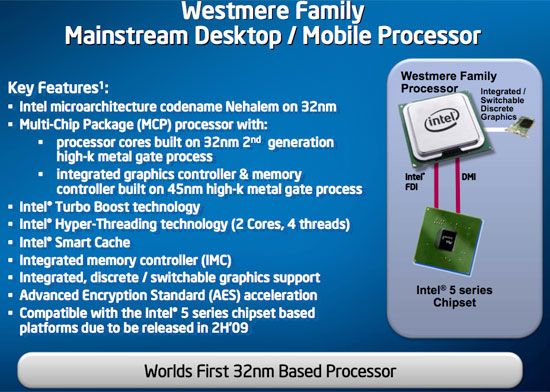
Keep following; if you want a quad-core Westmere, your only option will be in the LGA-1366 socket with Gulftown. Core i7 will get replaced with a six-core, twelve-thread processor in early 2010. There won’t be a 32nm quad-core part on the desktop until the end of 2010 with Sandy Bridge.
Originally published at https://www.anandtech.com/show/2722 (Wayback Machine).