
CrossFireX and the Phenom II X4 940 – Competitive or Not?
- Posted in
- Motherboards
Crysis Warhead
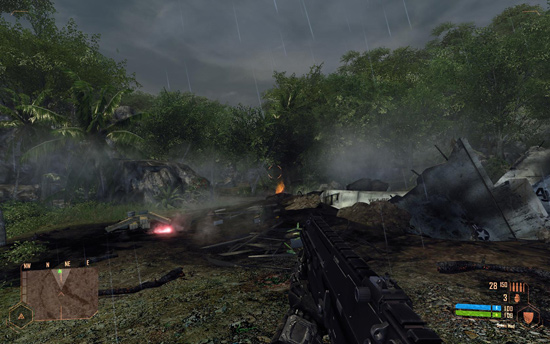
Crysis Warhead is an update to the original game with a storyline that takes place on the other side of the Island during the same time-period as the first. The game features an enhanced and optimized version of the CryEngine 2 but is still a resource monster. We set the graphics options to Gamer, DX10, and 2xAA and play back a timedemo that covers the Ambush level. We have to admit at these settings that the game looks fantastic during action scenes and game play is acceptable.
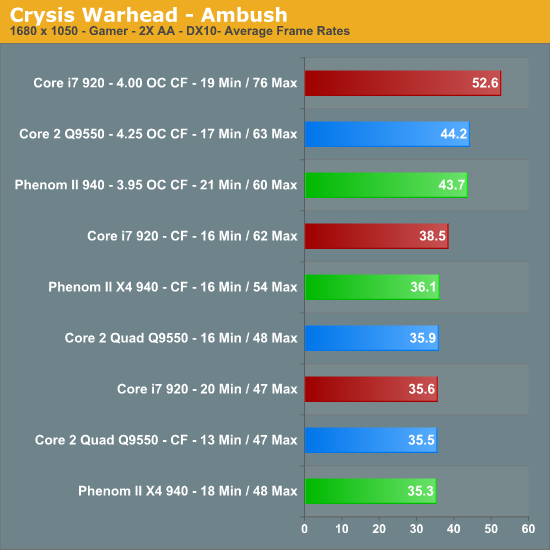
At 1680x1050, all three platforms are clustered together in single card and CrossFire configurations. We also see why a single GPU card can be a better value than a dual GPU solution at this resolution in certain games. It is not until we overclock that we notice some separation between the platforms with the i7 taking a decent lead, but its minimum frame rates do not improve compared to a single card setup. However, our Phenom II setup offers the best minimum frame rates when overclocked and actually offers a slight improvement over its single card scores.
Adding a second card for CrossFire operation improves average frame rates by 2% and minimum frame rates decrease 12% for the Phenom II. The Intel Q9550 has a decrease of 1% in average frame rates and 19% in minimum frame rates. The Core i7 average frame rates improve by 8% and minimum rates decrease by 20%. Overclocking our processors resulted in a 22%~36% improvement in average frame rates with the Core i7 benefiting the greatest.
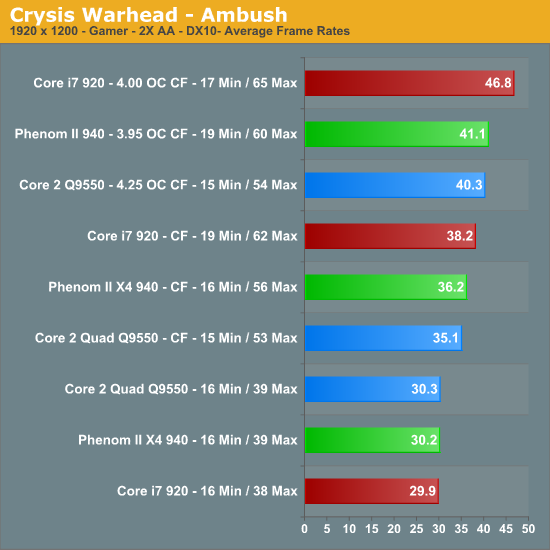
Our 1920x1200 test follows a similar pattern with all three solutions equal in single card testing and CrossFire showing a slight advantage to the i7. The Phenom II is slightly ahead of the Q9550 when overclocked, though it is at a 7% clock speed disadvantage. We have noticed CryEngine 2 will respond to improved memory bandwidth and latencies as we clock up the processors. The i7 holds a 14% advantage in average frame rates while the Phenom II once again impresses us with the best minimum frame rates when overclocked. However, not having a 20fps minimum frame rate is a disappointment with our multi-GPU setups. The NVIDIA 260/285 solutions scale better in SLI than the ATI HD 4870 products. We hope that ATI can improve their drivers for this game.
Adding a second card for CrossFire operation improves average frame rates by 20% but minimum frame rates do not change for the Phenom II. The Intel Q9550 has an improvement of 17% in average frame rates and a decrease of 6% in minimum frame rates. The Core i7 average frame rates improve by 27% and minimum rates increase 18%. Overclocking our processors resulted in a 14%~22% improvement in average frame rates with the Core i7 benefiting the most.
After playing through the several levels on each platform, we thought the Phenom II 940 offered a better overall gaming experience in this title than the Intel Q9550 based on smoother game play. It is difficult to quantify without a video capture, but player movement and weapon control just seemed to be more precise. Of course, if you have the funds, we would recommend the i7 platform for best possible performance.
Originally published at https://www.anandtech.com/show/2715 (Wayback Machine).