
Far Cry 2 Dissected: Massive Amounts of Performance Data
- Posted in
- GPUs
Testing with AnandTech's Custom Demo
Our custom ~1200 frame demo is more stressful than the RanchSmall test. It doesn't feature any fire and AI is disabled. The sequence is partly running through some trees and partly running through a field. We designed the test to try and mirror some of the aspects of gameplay the built in demos didn't cover well. Because we wanted to run without AI, we didn't engage in any firefights, but this does a good job of showing another side of Far Cry 2 performance.
Aside from playing through much of a game before we test, we also like to test a few different internal benchmarks to get a feel for the numbers. Obviously we can't run everything before we commit to testing, but we try and do what we can. When using built in benchmarking tools, we also tend to favor our own tests just to avoid the possibility that a graphics chip maker would optimize for our benchmark. We don't see that as a large problem in the industry today (though it has happened before), but it's better to be safe when you can to try and maintain objectivity. And thus this will be the test we favor going forward with Far Cry 2.
With the exception of our 2560x1600 test, the Radeon HD 4870 1GB leads all single GPU configurations including the GeForce GTX 280. At 2560x1600 the 280 pulls ahead by a little more than 5%, but the fact that the 4870 is much cheaper and puts up that hard of a fight in this test is quite impressive. On the other hand, except at the lowest resolution the Radeon HD 4870 512MB card trails the GeForce GTX 260. As we saw with the built in tests, the extra 512MB of RAM makes a huge difference in Far Cry 2 with RV770.
The Radeon HD 4850 leads the slightly more expensive GeForce 9800 GTX, while the 9800 GT carries the slight advantage over the Radeon 4830. The Radeon 4670 crushes it's direct competitor (the 9600 GSO) and matches the performance of the more expensive 9600 GT at playable resoluitons. As with our other tests, while the now sub $80 4670 is capable of low res play with Ultra High quality DX10, spending less money means that you will need to drop the settings down to Very High or High quality (though you really shouldn't need to go lower than that).
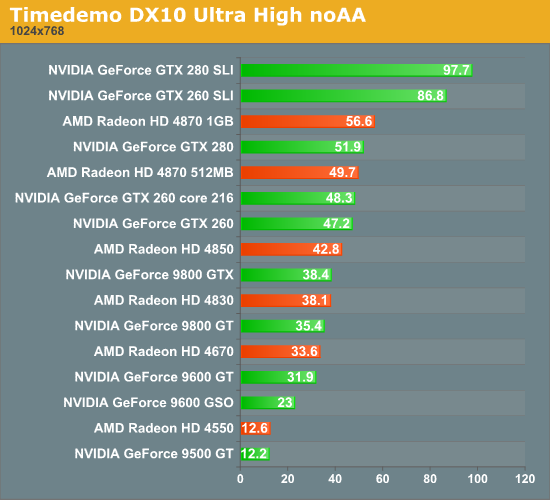
The cheapest playable card at 1024x768 with these settings is the Radeon HD 4670.
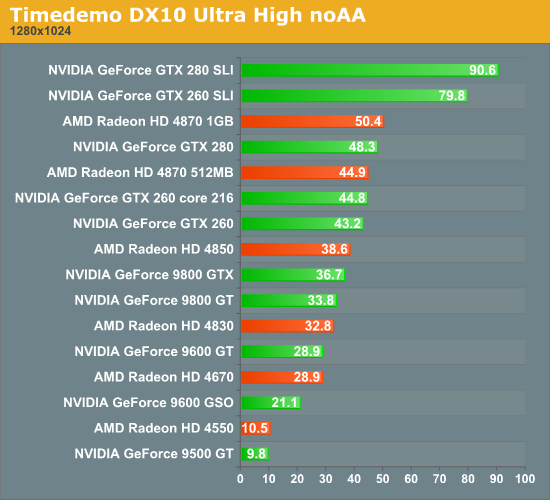
The cheapest playable card at 1280x1024 with these settings is the Radeon HD 4670.
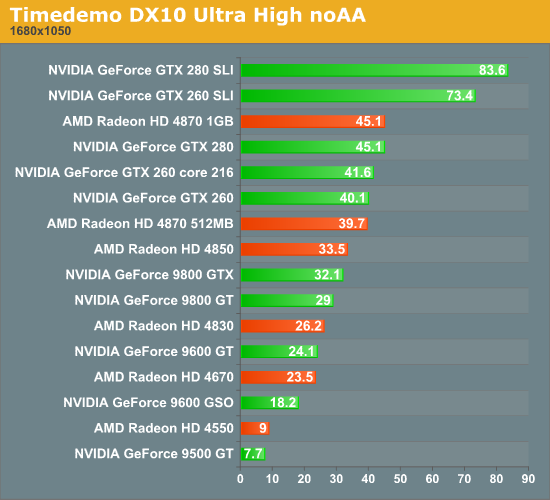
The cheapest playable card at 1680x1050 with these settings is the GeForce 9800 GT.
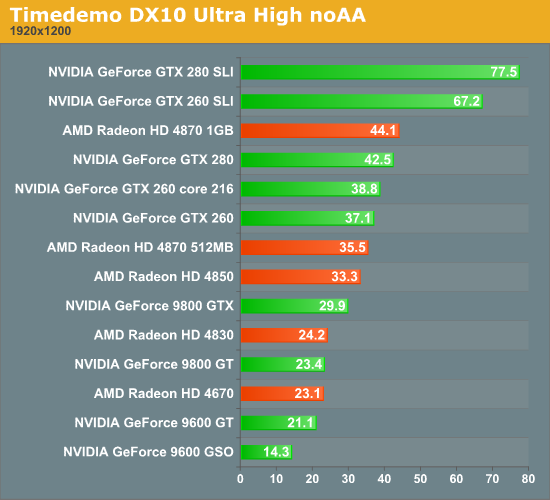
The cheapest playable card at 1920x1200 with these settings is the Radeon HD 4850.
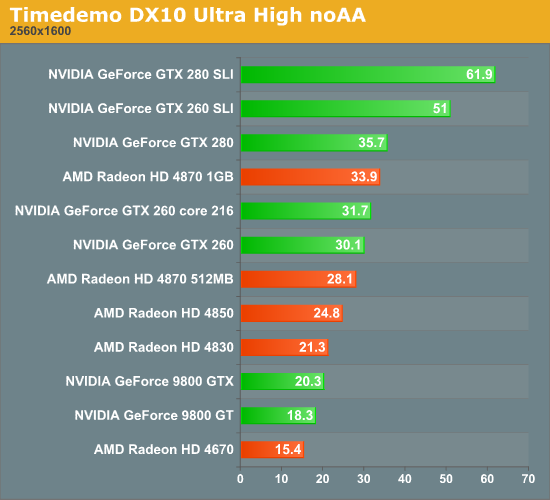
The cheapest playable card at 2560x1600 with these settings is the GeForce GTX 260.
Originally published at https://www.anandtech.com/show/2673 (Wayback Machine).