
Enermax Revolution 85+ High Efficiency PSU
- Posted in
- Cases/Cooling/PSUs
Temperatures, Fan Speed, and Acoustics
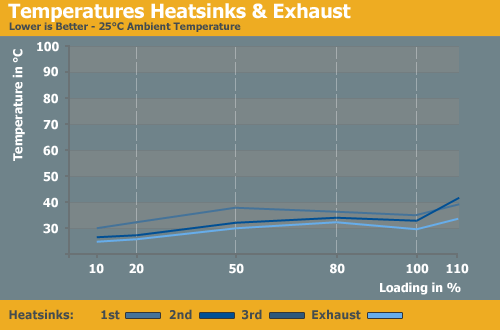
The high efficiency means that this power supply needs to dissipate less heat, which is icing on the cake. The temperatures on both heatsinks are so low that you could practically run this PSU fanless. Once we hit 100% load, temperatures start to increase, but we don't expect very many users to come anywhere near that point. What's interesting is that fan speed begins to ramp up faster than temperatures, and in fact the temperature graphs drop between the 80% and 100% load marks. Still, better safe than sorry. As for the exhaust temperature, it's very close to the heatsink temperatures, so the heatsinks and fan are doing a good job of getting heat out of the power supply.
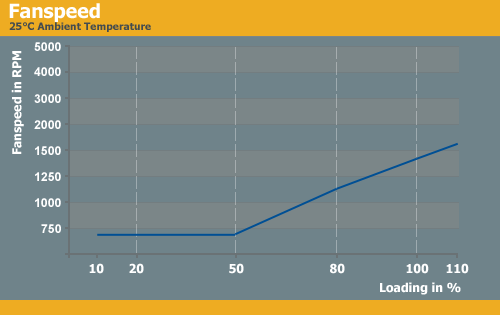
As we saw in the temperature graph, fan speed begins to ramp up at around a 500W/50% load. It spins at 750 RPM up until the 50% mark, at which point fan speed ramps up linearly until the maximum 1500-1600 RPM at 100% load.
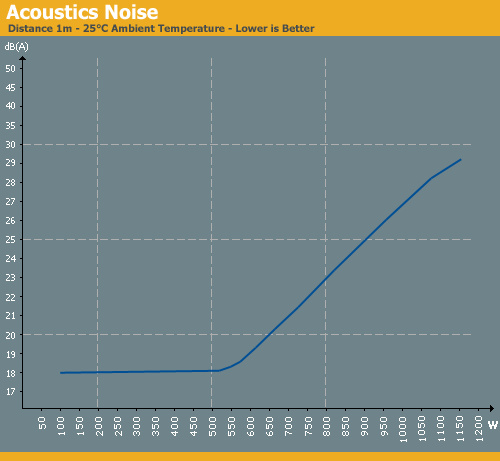
Noise levels for the first half of the graph are extremely low, but unfortunately noise increases rapidly with fan speed beyond that point. This is a real pity, since the heatsinks aren't even that hot and it certainly would be possible to run the fan at a lower speed. The starting point of 18dB(A) is not something you will even notice, and we couldn't hear any ticking noises either (something we have seen in non-PWM controlled fans). However, the final output of 29dB(A) definitely doesn't qualify as being silent. The good news is that you can use this power supply up to a load of around 800W and still have an acceptable amount of noise, which is sufficient for even triple SLI systems -- and those will create plenty of noise just from the graphics cards. Truthfully, for a unit delivering over 1100W of power, 29dB(A) is not at all something we would call a poor result.
Originally published at https://www.anandtech.com/show/2662 (Wayback Machine).