
BenQ E2200HD and E2400HD - 1080P FullHD LCDs
- Posted in
- Displays
Color Accuracy
Imaging professionals definitely like to have accurate colors, and the best way of assuring that your display shows the proper colors is to use a colorimeter and calibration software. However, not everyone has access to such tools and many users are unwilling to spend over $200, so we test before and after calibration. (Put more accurately, we calibrate the monitors and then tweak the created profile back to an uncalibrated level so that we can evaluate the performance of the display in its default state.) For calibration, we target a white level of 200 nits -- anything more than that is too bright in our opinion. We also do a second calibration targeting a white level of 100 nits, which would be useful when working on material that will end up in print form. Before we get to the results, here are the display settings we used on the test LCDs. We let the LCDs stabilize for at least one hour before performing measurements. We will compare results with the Dell 2408WFP, which so far has achieved the best overall color accuracy of any LCD we have tested.
| LCD Brightness and Contrast Settings | ||
| Standard Calibrated (~200 nits) | Calibrated for Print (~100 nits) | |
| BenQ E2200HD | 65 Brightness, 50 Contrast "Normal" (95-95-95 RGB) |
20 Brightness, 50 Contrast "Normal" (95-95-95 RGB) |
| BenQ E2400HD | 73 Brightness, 50 Contrast "Normal" (94-94-91 RGB) |
30 Brightness, 50 Contrast "Normal" (94-94-91 RGB) |
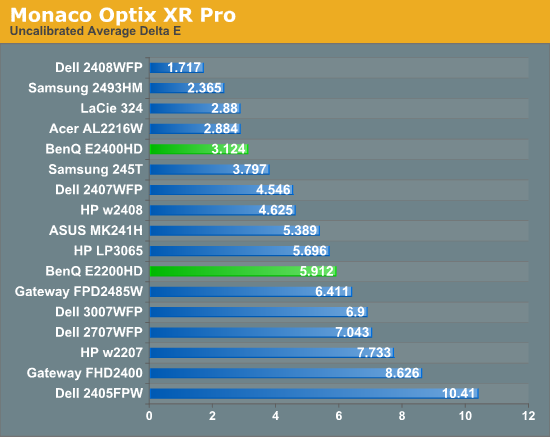
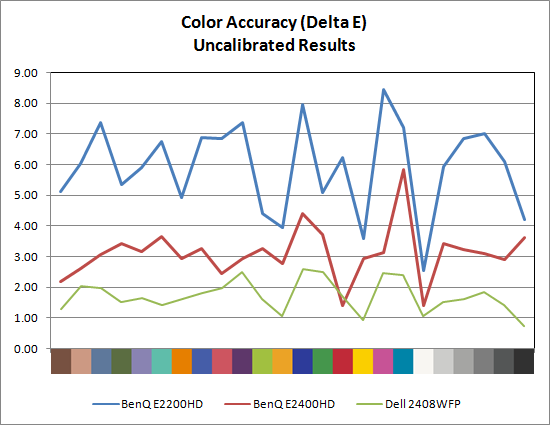
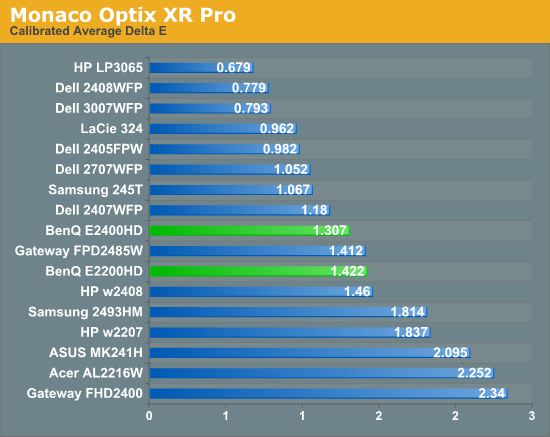
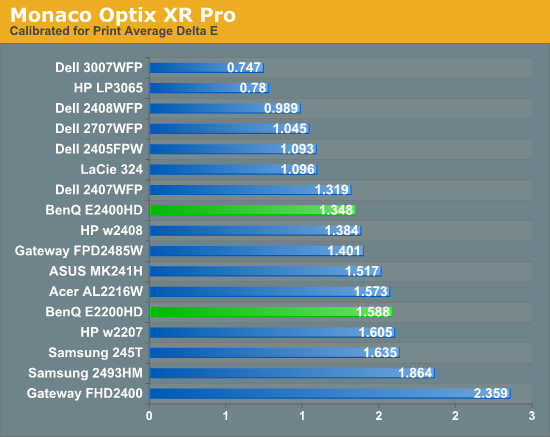
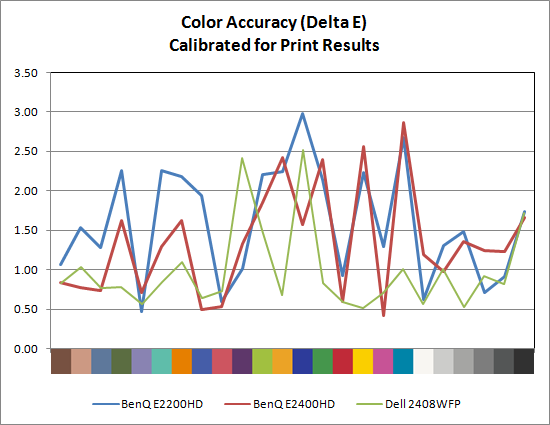
Starting with the uncalibrated results, it's pretty easy to see why we feel calibration tools are necessary for imaging professionals. This is not to say that you can't be happy with inaccurate colors -- your eyes will compensate, and some people prefer warmer (redder) or cooler (bluer) tones. However, if you're doing work with images or video, it is important that what you see on your display matches as much as possible what others will see on their displays. Of the LCDs we've tested, four are able to achieve an average Delta E of less than 3.0 without calibration (according to Monaco Optix XR Pro). The BenQ E2400HD falls just short, but is close enough that very few people would mind. The Dell 2408WFP is still in a class of its own, with an uncalibrated Delta E of 1.72 -- a score that's better than several of the LCDs after calibration!
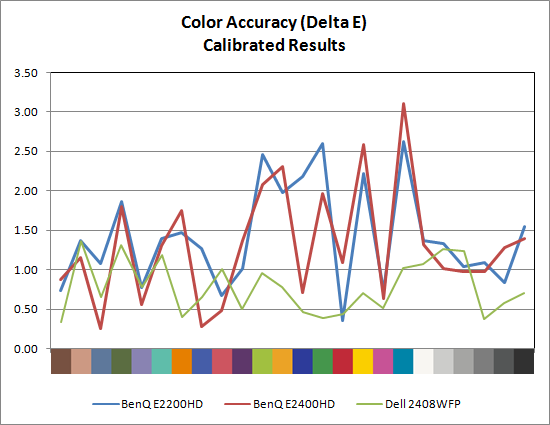
With calibration, all the scores improve substantially, but anyone serious about color accuracy is probably going to want an average Delta E of around 1.0 or less post-calibration. So far, only S-PVA and S-IPS panels achieve that goal, with the E2200HD and E2400HD falling just short. Switching to appropriate "printing" settings causes a few minor changes, but the S-IPS panels still maintain a clear lead over any other LCD.
Originally published at https://www.anandtech.com/show/2659 (Wayback Machine).