
The Dark Knight: Intel's Core i7
- Posted in
- CPUs
Turbo Mode: Gimmicky or Useful?
I refuse to make any further references to the Turbo buttons on PCs from the 80s and early 90s in this section :)
Intel's Core 2 processors have historically been quite overclockable, however most users don't overclock and thus they get no benefit from the added headroom in Intel's chips. Enthusiasts obviously benefit and get the performance of the best CPUs at much lower price points thanks to overclocking, but the rest of the world has all of this untapped power sitting under their heatsinks.
Varying clock speed according to system demands and temperature is nothing new, but it's predominantly done in the downward direction. At idle periods CPU clock speeds are dropped, when temperature limits are reached the same also happens, but why not boost clock speed when conditions are ideal?
This is exactly what Intel's Turbo mode does. Originally introduced on mobile Penryn, Turbo mode simply increases the operating frequency of the processor if conditions are cool enough for the CPU to run at the higher frequency. On mobile Penryn we only saw a frequency jump if one core was idle, but with Nehalem's Turbo mode all four cores can overclock themselves if temperatures are cool enough.
Each Nehalem can run its four cores at up to 133MHz higher than the stock frequency (e.g. 3.33GHz in the case of the 3.2GHz 965 model), or if only one core is active then it can run at up to 266MHz higher than stock (3.46GHz up from 3.2GHz).
I measured the impact of Nehalem's Turbo mode on the top bin Core i7-965, which runs at 3.2GHz by default but can ratchet up to 3.33GHz or 3.46GHz depending on whether the workload is single or multi-threaded:
| POV-Ray 3.7 | 3dsmax 9 SPECapc CPU Rendering Composite | x264 HD Benchmark (Pass 1 / Pass 2) | iTunes WAV to MP3 Convert | iTunes WAV to AAC Convert (Single Threaded) | |
| Intel Core i7-965 (3.2GHz, Turbo OFF) | 4017 PPS | 17.1 | 82.7 fps / 30.4 fps | 27.1 seconds | 34.1 seconds |
| Intel Core i7-965 (3.2GHz, Turbo ON) | 4202 PPS | 17.6 | 85.8 fps / 31.6 fps | 26.4 seconds | 32.8 seconds |
| Performance Advantage | 4.6% | 2.8% | 4.6% | 4.1% | 3.8% |
At best we should see a 4ish % increase in performance and the fact that POV-Ray shows us something greater than that tells us that Turbo mode works (and we're within the 1 - 2% margin of error of the test). Surprisingly enough, all of the multi-threaded tests had no problems using Turbo mode to their benefit giving us a 3 - 4% increase in performance thanks to the corresponding increase in clock speed. The AAC iTunes test is important as it is single-threaded, but despite the larger increase in clock speed performance didn't seem to improve any more.
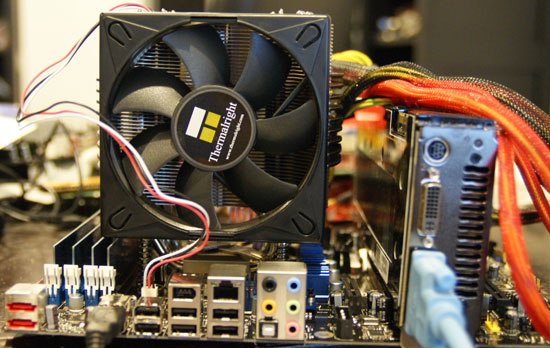
Our Turbo testbed
Now these tests were conducted on an open-air testbench with an aftermarket cooler by Thermalright, we wondered what would happen if we used a retail Intel HSF and stuck the Core i7 in a system with a Radeon HD 4870 and a 1200W PSU. The CPU actually ran a lot warmer and Turbo Mode never engaged, pretty much as expected.
With Nehalem it may be worth investing in one of these oversized heatsinks, even if you're not overclocking, you'll get a couple of extra percent in the performance department if you can keep the cores cool.
Originally published at https://www.anandtech.com/show/2658 (Wayback Machine).