
An Introduction to Virtualization
- Posted in
- IT Computing
When Are Hypervisors a Good Solution?
As much as these companies' publicity campaigns might be trying to sell their products off as the only solution you'll ever need, we are here to give you an objective view of where they are useful.
Hypervisors are a great solution for situations where hardware vastly outperforms the software's needs. Using a "bare metal" hypervisor, every VM is able to make use of the hardware, without being influenced by the others. For a company looking to consolidate a number of varying servers (mixing for example Windows systems with Linux-based systems), using a hypervisor would be the logical step. The big downside of this technology is that each virtual machine needs to run a full operating system to support itself, making the collective resources spent on running these operating systems a rather large bite out of the hardware's total pool.
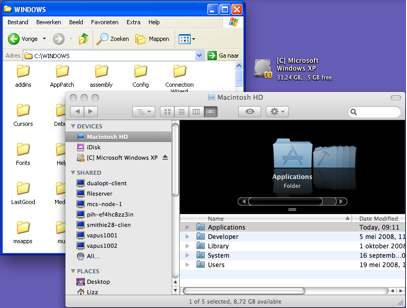
Windows and OS X living peacefully together; it's all possible with software hypervisors…
This also seems to be the main problem when using a software-based hypervisor. While this platform does succeed perfectly in offering most of the VM's guest OS functionality, in performance-based environments the cost of running an extra OS on top of an existing one can make the entire solution a bit bloated for constant use. Nonetheless, the ability to run a completely sand-boxed environment has caused many developers to use hypervisors as their software's playgrounds. Much in the same way, since Apple made the switch to Intel-based hardware, software hypervisors have allowed users of OS X to virtualize a Windows system without actually having to set up a multi-boot system. This goes a long way in proving that they are a very solid solution when actual functionality is more important than raw performance.
Originally published at https://www.anandtech.com/show/2653 (Wayback Machine).