
The IGP Chronicles Part 3: NVIDIA's GeForce 9300
- Posted in
- Motherboards
USB, Networking and Storage Performance
Our USB transfer speed tests were conducted with an OCZ Rally 2 Turbo 4GB Flash Drive and USB 2.0/FireWire based Maxtor OneTouch II external hard drive. In our first test, we transfer a 602MB file folder containing 444 files of various sizes. In our second test, we transfer a 1.90GB file folder containing 17 different files.
USB Performance
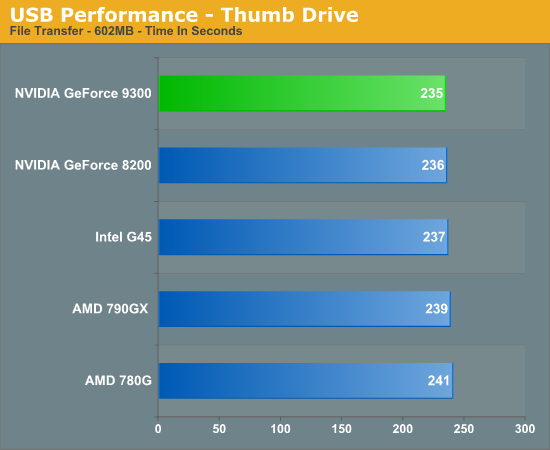
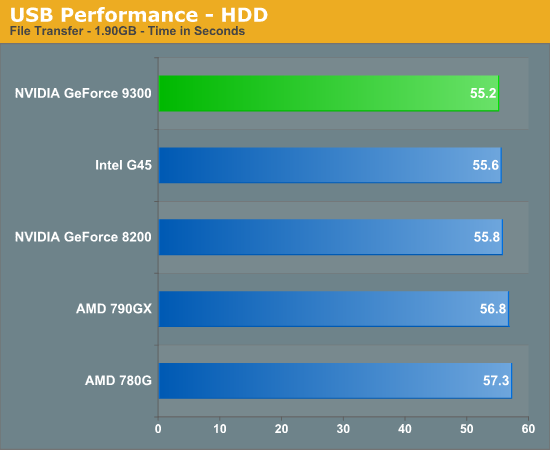
NVIDIA chipsets have always performed well in our USB tests and once again hold a slight edge over the Intel and AMD offerings. The improved USB performance from the AMD SB700/750 Southbridges almost close the gap with the NVIDIA and Intel offerings.
Ethernet Performance
The current motherboard test suite includes LAN performance measurements. All of these boards utilize PCI or PCI Express based Gigabit controllers with the only difference being the supplier of the core logic. The Windows 2000 Driver Development Kit (DDK) includes a useful LAN testing utility called NTttcp. We used the NTttcp tool to test Ethernet throughput and the CPU utilization of the various Ethernet Controllers used on the Intel motherboards.
We set up one machine as the server; in this test, an Intel system with an Intel CSA Gigabit LAN connection. Intel CSA has a reputation for providing fast throughput and is a logical choice for our Gigabit LAN server.
On the server side, we used the following Command Line as suggested by the VIA whitepaper on LAN testing:
Ntttcpr -m 4,0,‹server IP› -a 4 -l 256000 -n 30000
On the client side (the motherboard under test), we used the following Command Line:
Ntttcps -m 4,0,‹client IP› -a 4 -l 256000 -n 30000
At the conclusion of the test, we captured the throughput and CPU utilization figures from the client screen.
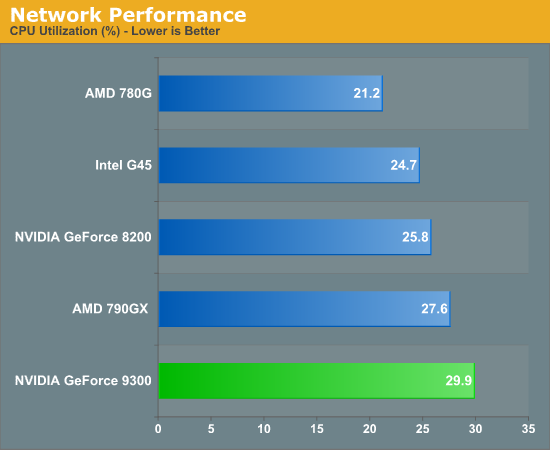
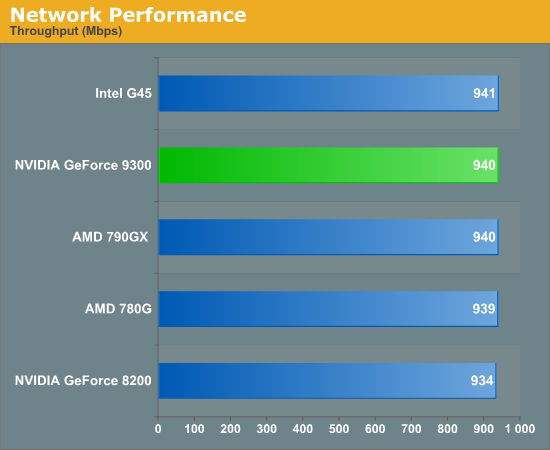
Our network throughput test indicates how well a particular controller design from Realtek, Marvell, NVIDIA, or Intel performs instead of being indicative of true chipset performance. This also holds true for the CPU utilization results, though this test can also be influenced to certain degree by the BIOS code and chipset interconnect design.
PCMark Vantage
PCMark Vantage is the latest benchmark available from Futuremark, and it is only for use with Windows Vista. Similar to the venerable PCMark05 in its makeup, Vantage modernizes the criteria and test methodology to reflect what users may encounter when running the new Windows OS and current applications. The total benchmark is roughly 87% reads and 13% writes in nature. We run each test five times per drive, producing a median score that we use for comparison in our charts. We utilize AHCI settings for each board.
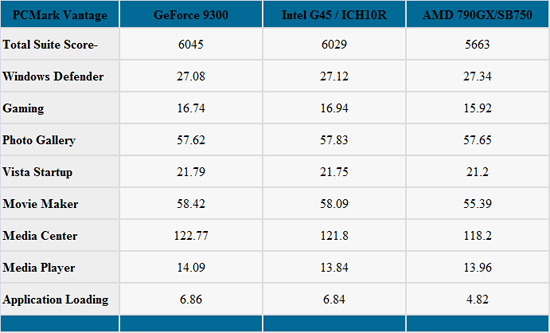
NVIDIA chipsets generally provide excellent performance, albeit at the cost of stability at times, and our tests reveal a controller that is slightly better in performance than the Intel ICH10R. Really, it is a toss-up between the two controllers. The AMD SB750 trails slightly due to an AHCI implementation that is not as robust as the current NVIDIA or Intel offerings. However, it would be very difficult to discern any performance differences between these controllers in actual application work.
As we noted earlier, we had a few issues with AHCI settings and our Sony BDU-X10S BD drive along with some random slowdowns when transferring large amounts of data (Update- Latest BIOS/Firmware/Drives solved this problem). We have not and do not expect to notice any data corruption problems that crept up during the 780i/790i launch, which were eventually fixed by NVIDIA. Our Intel G45 board also had difficulties with the same Sony BD drive but the AMD SB700/750 have not been affected.
Originally published at https://www.anandtech.com/show/2642 (Wayback Machine).