
Intel Xeon 7460: Six Cores to Bulldoze Opteron
- Posted in
- IT Computing
SAP SD
The SAP SD (Sales and Distribution, 2-tier internet configuration) benchmark is an extremely interesting benchmark as it is a real world client-server application. We decided to look at SAP's benchmark database. The results below are 2-tier benchmarks, so the database and the underlying OS can make a big difference. Unless we keep those parameters the same, we cannot compare the results. The results below all run on a Windows 2003 Enterprise Edition and MS SQL Server 2005 database (both 64-bit), and each "2-tier Sales & Distribution" benchmark was performed on SAP's "ERP release 2005".
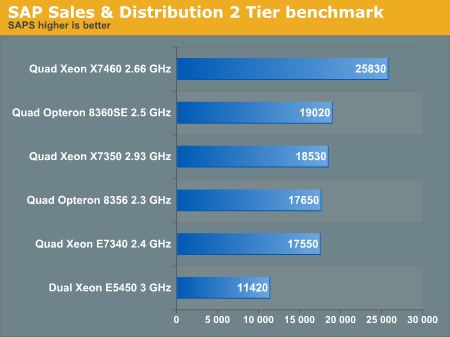
In our previous server-oriented article, we summed up a rough profile of SAP S&D:
- Very parallel resulting in excellent scaling
- Low to medium IPC, mostly due to "branchy" code
- Not really limited by memory bandwidth
- Likes large caches
- Sensitive to Sync ("cache coherency") latency
AMD has held the performance crown in SAP S&D since the launch of the 8360SE at 2.5GHz, but the Intel six-core monster overpowers the latest quad-core Opteron. The huge cache, less cache coherency traffic between the sockets, and two extra cores make the new Xeon close to invincible. Even AMD's 45nm Opteron (Shanghai) will most likely not be able to outperform the Intel behemoth: the increase in L3 cache and small IPC improvements will probably not be able to negate the effect of two extra cores for Dunnington.
Until AMD starts shipping its 6-core products at the end of 2009, Intel will have a firm grip on the ERP and high-end database market. The SAP benchmark confirms that for this type of workload, the Xeon 74xx platform is close to unbeatable. However, we need to look at more than the high-end database market. What about virtualization?
Originally published at https://www.anandtech.com/show/2625 (Wayback Machine).