
Silverstone ST45NF Nightjar
- Posted in
- Cases/Cooling/PSUs
Efficiency, PFC and Temperatures
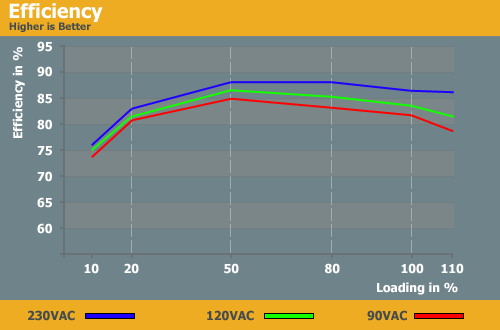
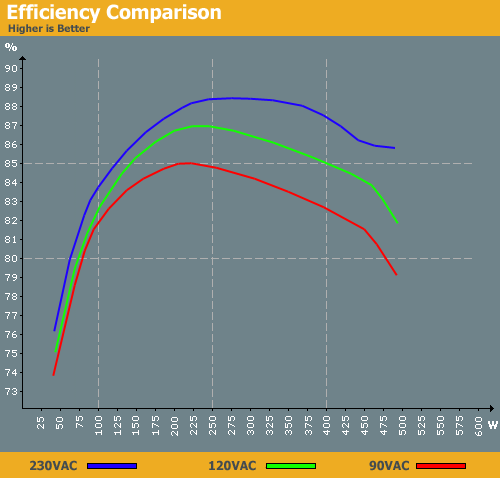
Using 230VAC, the Nightjar delivers efficiency of 88% from 225W to 375W. It then drops to 86%, which is still an excellent result. As the graph shows, the efficiency isn't as good with lower input voltages; optimal efficiency is obtained with loads of at least 100W, and the range of maximum efficiency is not the same as long as with 230VAC. Of course, even with loads of 50W to 75W it still manages at least 80% efficiency; while 88% might be more desirable, we are only talking about a difference of ~5W. What's the point in reaching 88% efficiency at 250W if you only need 50W?
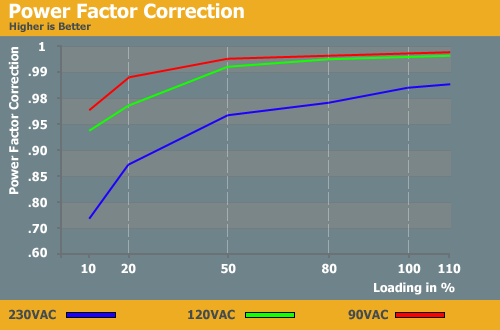
The power factor correction looks good with lower input voltages, but we have seen much better results for 230VAC.
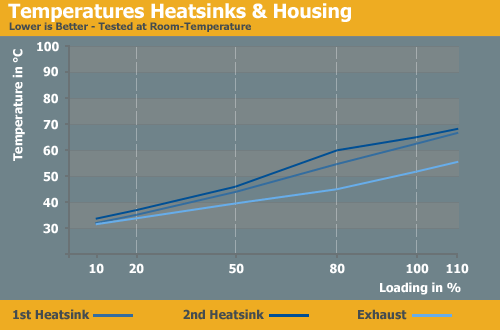
This unit does not have an exhaust temperature, which is why we attached the diode we normally use to measure the exhaust temperature to the power supply casing to measure the outside temperature. After loading the power supply for a while, we eventually reach a temperature that would allow us to cook an egg on the surface, but in fairness we have also seen hotter temperatures with some fan-cooled power supplies.
The outside surface reaches up to 58°C with 30°C ambient temperature. That's definitely not a bad result, and seeing the two heatsinks top out at 70°C makes us confident of its power supply's ability to run in systems with a single fan. However, temperatures are still increasing as we put an additional load on the PSU, and a higher ambient temperature would definitely result in higher PSU temperatures. We would be extremely hesitant to run such a power supply in a system where the ambient case temperature can reach 50°C or higher -- at least not without additional case fans, which defeats the purpose of the fanless power supply. Silverstone agrees with this, as they state the power supplies designed to operate in a 30°C ambient temperature.
Originally published at https://www.anandtech.com/show/2597 (Wayback Machine).