
Nehalem - Everything You Need to Know about Intel's New Architecture
- Posted in
- CPUs
Further Power Managed Cache?
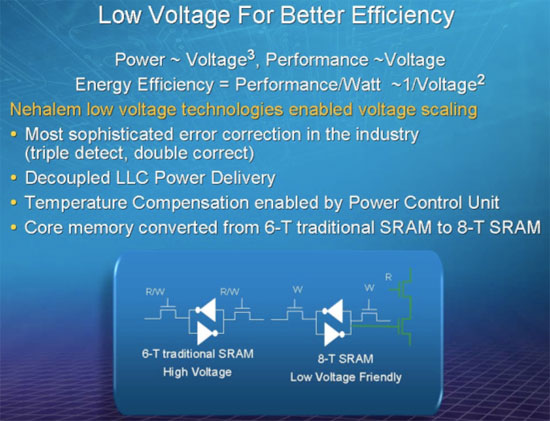
One new thing we learned about Nehalem at IDF was that Intel actually moved to a 8T (8 transistor) SRAM cell design for all of the core cache memory (L1 and L2 caches, but not L3 cache). By moving to a 8T design Intel was able to actually reduce the operating voltage of Nehalem, which in turn reduces power consumption. You may remember that Intel’s Atom team did something similar with its L1 cache:
“Instead of bumping up the voltage and sticking with a small signal array, Intel switched to a register file (1 read/1 write port). The cache now had a larger cell size (8 transistors per cell) which increased the area and footprint of the L1 instruction and data caches. The Atom floorplan had issues accommodating the larger sizes so the data cache had to be cut down from 32KB to 24KB in favor of the power benefits. We wondered why Atom had an asymmetrical L1 data and instruction cache (24KB and 32KB respectively, instead of 32KB/32KB) and it turns out that the cause was voltage.
A small signal array design based on a 6T cell has a certain minimum operating voltage, in other words it can retain state until a certain Vmin. In the L2 cache, Intel was able to use a 6T signal array design since it had inline ECC. There were other design decisions at work that prevented Intel from equipping the L1 cache with inline ECC, so the architects needed to go to a larger cell size in order to keep the operating voltage low.”
Intel states that Nehalem’s “Core memory converted from 6-T traditional SRAM to 8-T SRAM”. The only memory in the “core” of Nehalem is its L1 and L2 caches, which may help explain why the L2 cache per core is a very small 256KB. It would be costly to increase the transistor count of Nehalem’s 8MB L3 cache by 33%, but it’s also most likely not as necessary since the L3 cache and the rest of the uncore runs on its own voltage plane as I’ll get to shortly.
Originally published at https://www.anandtech.com/show/2594 (Wayback Machine).