
Gateway P-7811 FX: We've Got Upgrades
- Posted in
- Laptops
Mobility Marathon
Cranking out the fastest performance in applications or games is one measure of a good notebook, but honestly it's not the standard by which many users select their laptops. For many, size and weight as well as battery life are going to be the more important areas when purchasing a laptop. Hopefully it's already obvious that the Gateway P-series FX laptops are not going to be great candidates when it comes to size, and battery life is also generally disappointing. Some of the lower-end models ship with integrated graphics and can offer reasonably good battery life, but they're still a very large chassis to lug around. What's more, the battery protrudes about an inch and a half out the rear of the chassis, making the laptop seem even larger. You will definitely want to pay attention to your choice of carrying case if you want to use it with the P-series; we have a couple 17" notebook bags that can't hold these notebooks (even with the battery removed).
Returning to the question we want to answer, does the switch to DDR3 and a P8400 - both of which lower power requirements - have a noticeable impact on battery life and power requirements? Of course, the lower power CPU and memory may be offset by a more power hungry GPU in some cases, but as long as you're not running a 3D application we expect the P-7811 to surpass the previously tested FX notebooks.
Power Requirements
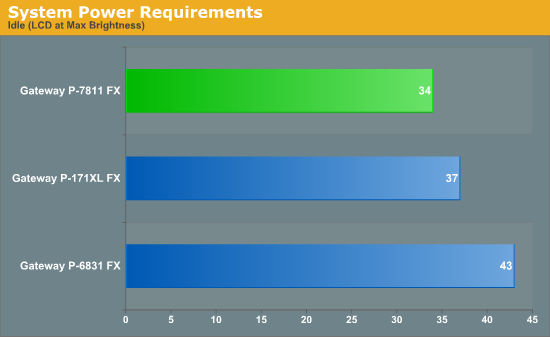
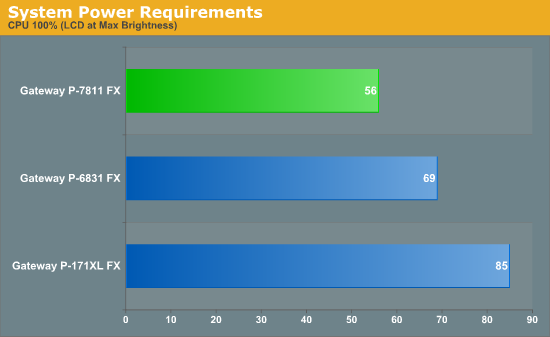
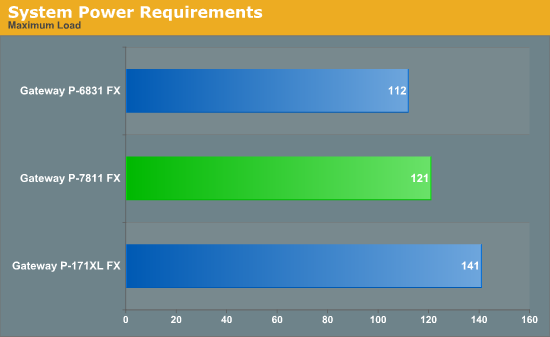
Power draw (measured at the outlet) does indeed drop with the P-7811 relative to the P-6831. The P-171XL really wasn't in the running, given the second hard drive and X7900 CPU. Particularly in the 100% CPU load test, we see a massive benefit from the P8400 and DDR3; the P-7811 uses 13W less than the P-6831 (a 23% difference). In the maximum load test, where we tax both the CPU and GPU, the 7811 does use 9W more than the 6831; that's somewhat expected, however, as you can't generate a maximal GPU load without a faster CPU. In gaming power draw (not shown) the two systems are pretty much tied.
Battery Life
Of course, power requirements when a laptop is plugged in don't necessarily reflect power requirements when a laptop is on battery power. Hardware can provide better performance when plugged in and better battery life when in power saving mode, and the 9800M and P8400 should both provide such an advantage. For our battery life testing, we have now switched to running all laptops at around 100 nits brightness. Differences between displays and brightness adjustments mean we are not always at exactly 100 nits, but the range is 90-110 nits in all cases. If you choose to run your LCD at maximum brightness, you may lose anywhere from 10 to 60 minutes depending on the laptop - the latter is mostly for ultra-mobile options while the former is for gaming notebooks.
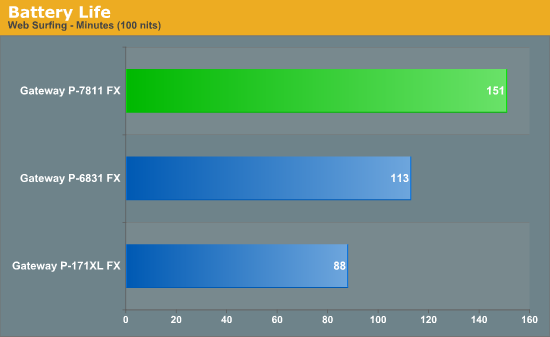
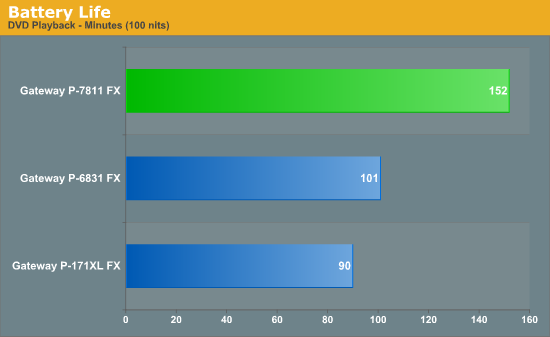
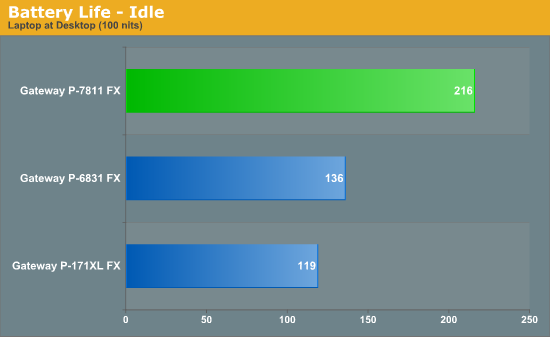
In terms of battery life, the P-7811 shows some significant improvements over the 6831 and 171XL. Clearly, the DDR3 and 25W TDP processor are doing their job, with P-7811 battery life improving by up to 58% over the lower performing P-6831. Our three test scenarios test DVD playback, web surfing (using the wireless adapter), and a best-case idle benchmark where we simply unplug the laptop and let it sit. Keep in mind that even light use of the laptop should reduce the battery life from our idle scenario, so it is purely a high water mark.
With the P8400 (and Centrino 2) offering improved deep sleep states over the previous Santa Rosa refresh, the largest improvements are found in the idle test. DVD playback improves by an equally impressive 50%, and Internet surfing improves by 34%. Two and a half hours of battery life for movies or surfing is certainly nothing exceptional compared to some laptops, but for a gaming laptop it's actually one of the best results we've seen.
Originally published at https://www.anandtech.com/show/2585 (Wayback Machine).