
Kingwin RVT-9225: Budget priced cooling results in budget performance
- Posted in
- Cases/Cooling/PSUs
Overclocking
Some users buy aftermarket coolers to quiet down their system, but many are seeking performance gains in the area of overclocking. In the days of shoddy Intel HSFs, a quality aftermarket cooler could equal double-digit percentage gains. As we've mentioned previously, Intel's current incarnation is quite good, but gains can still be significant. Let's see how the RVT-9225 stacks up. Again, the same processor and settings are used for all cooling tests for consistency.
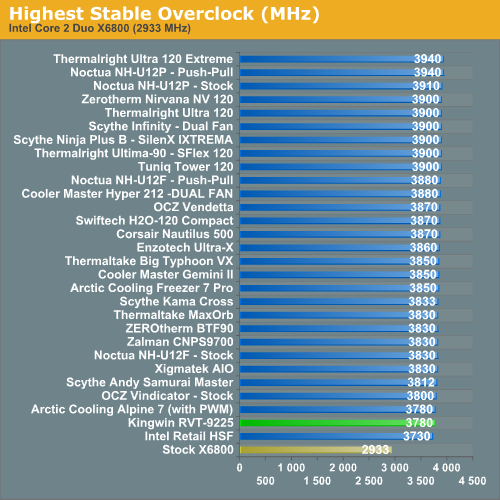
The Kingwin RVT-9225 just barely scrapes a lead over the Intel unit with a maximum stable speed of 3.78GHz. This is disappointing, particularly as the noise level is so much higher than the competing units.
Performance Scaling
Performance scaling is shown below - keep in mind that lower is better in this case. As mentioned the maximum overclocks top out at 3.78GHz, but we file this under "3.83GHz" (rounding up).
 |
Again, we see what seems to be a theme: the RVT-9225 tracks the Intel unit almost exactly. It only ekes out a slight win at 3.33GHz.
Load conditions are a good indicator of cooling performance, and as we've said in the past, a flatter line here is better versus a steep slope (indicating that the cooler cannot effectively handle the load it's being presented with).
 |
There's no real news here. We see almost a mirror image of the Intel retail HSF, with a slight win at 3.33GHz only.
Originally published at https://www.anandtech.com/show/2570 (Wayback Machine).