
Nikon Announces the D700: Second Full-Frame Nikon
- Posted in
- Digital Camera
D700 Compared to D3
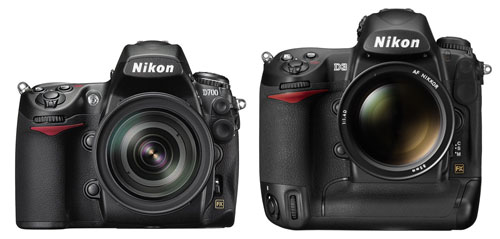
The D700 is much more compact than the D3. By moving the D3 sensor to a D300 body and removing the integrated battery grip of the D3, Nikon has reduced the height and weight of the D700 substantially compared to the D3. The D700 is also 40% lower in cost - $3000 versus $5000.
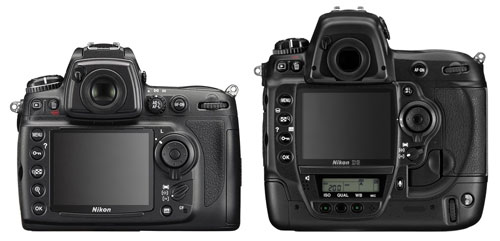
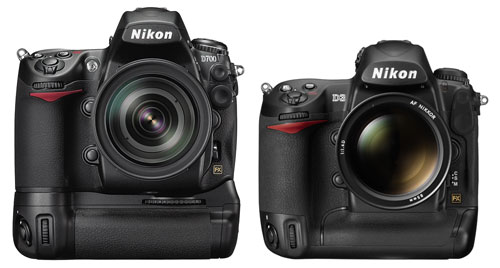
The MB-D10 Multi-Power Battery Grip that was introduced with the D300 also fits the D700. Adding the MB-D10 brings the shooting speed as high as 8 fps, which is the same as the Nikon D300 with the Battery Grip. This is just a bit lower than the 9fps with the D3.
To be completely fair the D700 plus grip is taller than the D3 with the integrated power grip. However, you do have the option with the D700 of leaving the grip off when 5 frames-per-second is enough speed. That is not an option with the D3 as you always have the added size and weight of the integrated grip.
Other differences are a 95% viewfinder compared to a 100% viewfinder on the D3. There is also a 5:4 ratio shooting option on the D3 which is missing on the D700. The D700 does retain the ability to mount all APS-C Nikon lenses, just like the D3, and shoot in a crop-sensor mode. This is in stark contrast to Canon EF-S lenses for their APS-C models which will not even mount on the Canon 5D or 1Ds models.
Nikon is using the D300 shutter, or one rated at the same life as the D300, in the D700. This means a rated shutter life of 150,000 actuations for the D700, compared to a rated 300,000 actuations for the D3. With most prosumer models with a rated life of 50,000 or 100,000 the rated life for the D700 still puts it in Pro company.
Originally published at https://www.anandtech.com/show/2560 (Wayback Machine).