
Sigma SD14: Quick Look at a Quirky Wonder
- Posted in
- Digital Camera
Evolution of the SD14
It
is impossible to talk about the specifications, controls, and features of the SD14
without comparing it to the cameras that came before it - the Sigma SD9 and SD10.
Sigma has really refined the SD14. The area that stands out most in the new design is the viewfinder.
The SD9 and SD10 used the old Sigma 35mm viewfinder with dotted lines to show the
new view of the 1.7x sensor. It was almost laughable that their marketing referred to this as some
special form of sports finder where you could see what was outside the frame and
moving into it. The SD9 and SD10 were so slow no one would ever
even consider using them for action photography, so it was all too clear that Sigma
was just recycling an existing 35mm viewfinder.
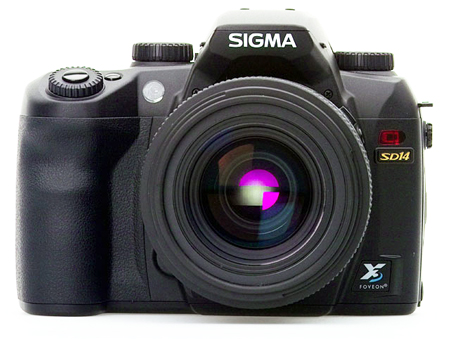
Interestingly enough the SD14 viewfinder is quite decent. It is a pentaprism (not a pentamirror) and reasonably bright, with 98% horizontal and vertical coverage. This is better coverage than the 95% of the 40D for example, but the Canon 40D has a better .95x magnification compared to the .9x of the SD14. However, compared to the earlier SD10 magnification of .77x the new SD14 viewfinder is dramatically improved. Sigma also claims the viewfinder is high eyepoint, which makes it easier for eyeglass wearers to use. The eyepoint spec is 18mm, which is the same as the Nikon D3.
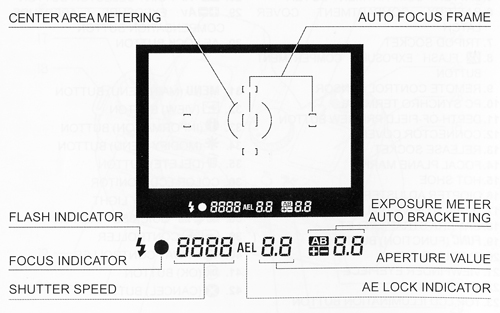
This is also the first Sigma SD with five AF points. The earlier SD9 and SD10 had a single-point AF module that looks about the same as the 15-year old SA300N. The five focus points are spread widely across the frame, which significantly increases the AF frame coverage on the SD14.
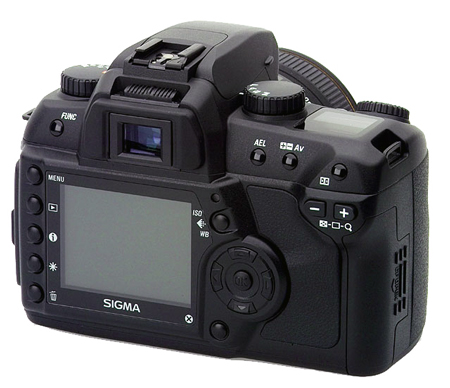
There is also an easy-to-adjust diopter correction on the top of the viewfinder, a real depth-of-field preview button on the left side of the lens mount, and the first built-in pop-up flash in the Sigma SD series. These are nothing special at the original selling price of $1699, but with Cameta and Amazon recently selling the SD14 body for less than $600 they are really standout features at the new price point.
There are also updates that are not so obvious in the SD14, such as USB 2.0 instead of 1.1 and a dramatically improved shutter with a rated life of 100,000 actuations. The new shutter tops out at 1/4000 instead of 1/6000 like the SD10, but a year in the field is proving the new shutter doesn't disintegrate and shred small pieces in the sensor chamber. This was a complaint some had with the SD10. The new shutter is also very quiet - much quieter than the earlier models - and frankly one of the quietest shutters we have found in any camera in its class. That is a welcomed improvement.
This is also the first Sigma SD to use a rechargeable Lithium battery. The earlier models used AA batteries or the CR-V3 variant. Thankfully the new battery is an easy-to-find and reasonably priced NP-400, a battery that is also used in the Minolta 7D/5D, and the Pentax K20D/K200D/K10D. Pentax calls their battery the D-Li-50, Sigma calls it the BP-21, and Minolta called the battery the NP400. Whatever they call it, all three batteries are interchangeable, which makes it easy to find reasonably priced replacement batteries.
Our early experience with battery life was extremely poor. This also appears to be related to the early CF compatibility issues we experienced. After charging to a different brand of CF card that worked better on the SD14 we fired off about 300 shots before depleting the battery. Battery life is better than we first thought, but it is not in the same league with Canon and Nikon CMOS sensors. It is probably a good idea to carry a spare battery or two if you plan a lot of shooting. Note that some users claim battery life does improve after the battery is "conditioned" in the Sigma charger.
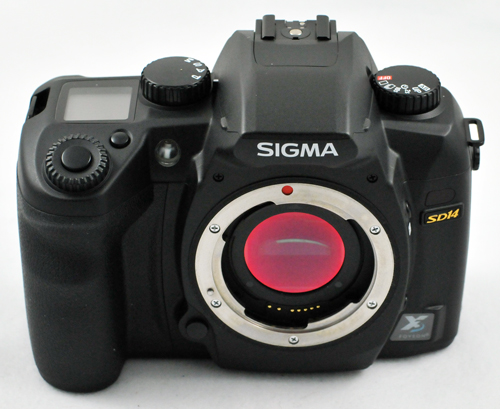
As seen on previous SD cameras, Sigma mounts a sensor protector just behind the lens mount to keep dust away from the sensor. The reddish-pink filter inside the lens mount is also the Infrared filter. This makes the SD14 uniquely suited for digital IR photography since the filter is easy to remove without any special tools. The SD14 without this filter is sensitive to both IR and visible light, and by using an IR filter you can make the SD14 sensitive to IR only. The word among IR enthusiasts is that there is nothing better on the market for IR photography than the SD14, and that option is there if you choose.
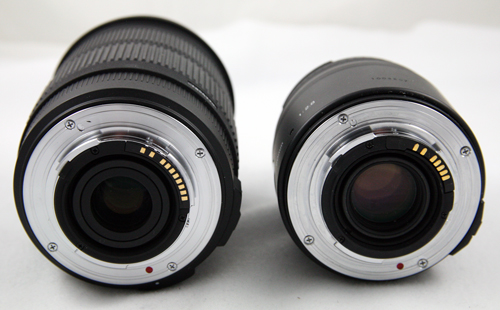
Sigma uses the Sigma SD all-electronic lens mount, and can only natively mount Sigma lenses. Many photographers do not realize the Sigma mount is all-electronic like the Canon mount, and it has been in existence for more than 15 years. Here you see a very new 18-200mm OS (Optical Stabilized) Sigma lens mount beside a 15+ year old Sigma 50mm Macro lens. The 50mm Macro works perfectly on the new SD14. In fact, the Macro was used for most of the sample images at the end of this review.
Lenses for the SD14 are only available from Sigma, but the current Sigma lens catalog shows 39 lenses available in Sigma SD mount, and there are additional lenses that were made in Sigma mount that have been discontinued over the years. The lens multiplier is 1.7x, just slightly more than the Canon 1.6x, which means the equivalent 35mm focal length is the focal length times 1.7x. That means a 50mm normal lens behaves like an 85mm portrait lens on the SD14.
It is a little more work to find Sigma mount lenses for sale, but Amazon, Cameta, and B&H usually have a decent variety. Sigma also makes their most interesting new lenses, such as the new 18-200mm f3.5-6.3 OS available in Sigma mount. That lens on the Sigma, as with the Nikon 18-200mm VR, is quite a match. It provides a 35mm equivalent of 31-340mm in a single lens with up to four stops of added speed thanks to the new Sigma dual-motor OS.
You can also find Sigma-mount lenses for sale on eBay, sometimes at bargain prices. The Sigma-mount 35mm lenses will fit the new SD14 and they are often very cheap if you are trying to build a quality system on a shoestring.
Originally published at https://www.anandtech.com/show/2538 (Wayback Machine).