
NVIDIA 780a: Integrated Graphics and SLI in One
- Posted in
- CPUs
Integrated Graphics Performance & GeForce Boost
As expected, AMD's 780G manages to outperform NVIDIA's integrated graphics steadily across the board:
| AMD 780G | NVIDIA 780a/GeForce 8200 | % Performance Advantage (AMD) | |
| Half Life 2 Episode Two (10x7) | 43.1 | 30.2 | 42.7% |
| Microsoft Flight Simulator X (10x7) | 24.6 | 21.4 | 15.0% |
| Company of Heroes (10x7) | 29.4 | 19.4 | 51.5% |
| Unreal Tournament 3 (10x7) | 22.9 | 16.8 | 36.3% |
| Crysis (10x7 LowQ) | 20.3 | 16.9 | 20.1% |
Once again, although this comparison matters more for the nForce 730a and GeForce 8200 motherboards, NVIDIA's mGPU just doesn't compare to AMD's.
The performance advantage ranges from 15% to just over 50%, and the only surprising part here is that AMD doesn't do better given the theoretical advantage it holds over NVIDIA. As we mentioned before, it's doubtful that many will buy a nForce 780a board and use its integrated graphics to play games but the AMD performance advantage holds true for 750a and GeForce 8200 platforms as well. For a company that has been criticising Intel's integrated graphics performance as of late, we would expect nothing short of the best scores here.
If the mGPU performance of the nForce 780a (or any of the other new NVIDIA chipsets) isn't enough, you can simply toss in a low end discrete GPU (dGPU) and NVIDIA's latest drivers will enable GeForce Boost. GeForce Boost is nothing more than SLI but between a mGPU and dGPU. Given how slow the mGPU is, GeForce Boost will only actually improve performance with a low-end dGPU and thus NVIDIA only supports GeForce Boost with either a GeForce 8400GS or GeForce 8500 GT.
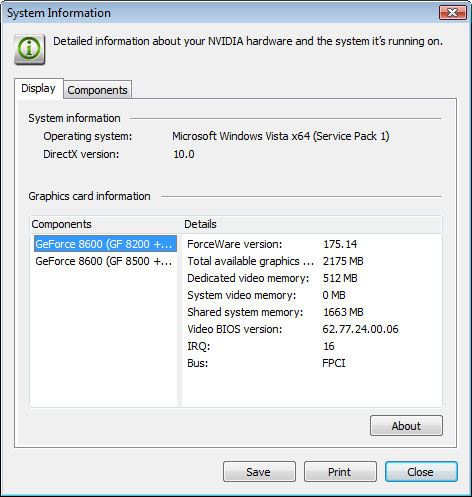
With GeForce Boost enabled, the display driver also comes up with a new name for the mGPU + dGPU combo. If you combine a nForce 780a with a GeForce 8400GS you get a GeForce 8500 and if you pair the 780a with an 8500 GT the driver will report the mix as a GeForce 8600.
| NVIDIA 780a + GeForce 8400 GS | Half Life 2 Episode Two | MS Flight Simulator X | Company of Heroes | Crysis | Unreal Tournament 3 |
| mGPU alone | 30.2 | 21.4 | 19.4 | 16.9 | 16.8 |
| dGPU alone | 41.2 | 39.6 | 38.7 | 20.3 | 21.4 |
| mGPU + dGPU (GeForce Boost) | 50.3 | 39.6 | 45.5 | 30.1 | 22.2 |
| % Increase due to GF Boost | 22.0% | 0.0% | 17.6% | 48.3% | 3.7% |
With a GeForce 8400 GS we actually see decent scaling from a dGPU to the GeForce Boost mode. The added performance is large percentage-wise but in raw numbers it's nothing huge. You're basically getting a smoother gaming experience with GeForce Boost enabled, at least in those games where bridgeless SLI is supported.
| NVIDIA 780a + GeForce 8500 GT | Half Life 2 Episode Two | MS Flight Simulator X | Company of Heroes | Crysis | Unreal Tournament 3 |
| mGPU alone | 30.2 | 21.4 | 19.4 | 16.9 | 16.8 |
| dGPU alone | 47.5 | 35.3 | 48.6 | 24.8 | 33.1 |
| mGPU + dGPU (GeForce Boost) | 47.7 | 37.8 | 49.3 | 26.3 | 27.3 |
| % Increase due to GF Boost | 0.0% | 7.0% | 1.4% | 6.0% | -17.5% |
GeForce Boost does next to nothing with an 8500 GT and in the case of Unreal Tournament 3, performance actually decreases. Of course it's a safe bet that future driver updates will improve scaling and performance from GeForce Boost.
AMD supports a similar technology with its 780G:
| AMD 780G + Radeon 3450 | Half Life 2 Episode Two | MS Flight Simulator X | Company of Heroes | Crysis | Unreal Tournament 3 |
| mGPU alone | 43.1 | 24.6 | 29.4 | 20.3 | 22.9 |
| dGPU alone | 51.6 | 30.2 | 36.8 | 23.3 | 28.5 |
| mGPU + dGPU (Hybrid CrossFire) | 61.4 | 37.3 | 54.3 | 31.4 | 32.7 |
| % Increase due to Hybrid CF | 19.0% | 23.5% | 47.6% | 34.8% | 14.7% |
Originally published at https://www.anandtech.com/show/2521 (Wayback Machine).