
NVIDIA 780a: Integrated Graphics and SLI in One
- Posted in
- CPUs
Final Words
NVIDIA's chipsets have almost always been pretty decent (if not excellent with the nForce4 for AMD), their only issues were usually price and a lack of any compelling features to justify the added cost. SLI was always the biggest selling point of NVIDIA's platforms but with the nForce 780a (and its new lineup of chipsets in general), NVIDIA is attempting to bring more value to the table.
Honestly the biggest attraction to the nForce 780a SLI platform is its support for HybridPower, which will finally allow gamers to build machines that are both high performance and are efficient on power usage. Thankfully you aren't limited to the 780a for HybridPower support as these motherboards won't come cheap. Our ASUS M3N-HT Deluxe board will carry an introductory price of $249, something we are not used to seeing in the current AMD market sector.
Whether or not this price tag is worth the premium over the nForce 750a SLI boards is up for debate. It's not really in our opinion as we do not believe the current AMD processor series is capable of the required computational power needed to support 3-way SLI or Quad SLI configurations. This is not a knock against NVIDIA as AMD has the same problem with Quad CrossFire; it just reflects the current state of the processor offerings from AMD.
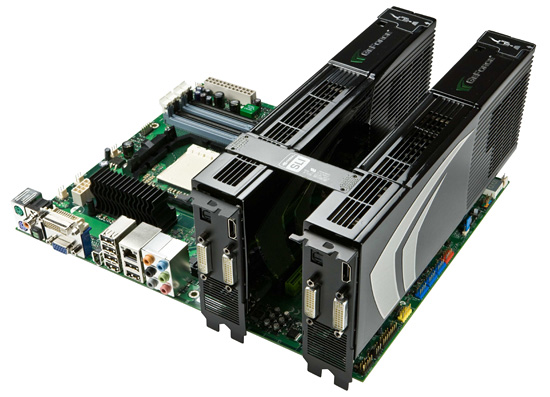
HybridPower is clearly in its infancy, the lack of dual-link DVI support from the mGPU means that owners of 30" displays can't enjoy the benefits until the next generation of NVIDIA chipsets come out. We would like to see eventual automated switching between HybridPower modes, not to mention a reduction in switch time for multi-GPU setups, but we'll take what we can get as a starting point. The list of GPUs that support HybridPower will hopefully continue to grow as NVIDIA would be doing its customer base a disservice by reserving the feature for only its highest end graphics cards.
Then there's the plain fact that what we're looking at here is an expensive Socket-AM2+ chipset, and while AMD can be competitive at lower price points, at the very high end of the market there's simply no reason to go with anything non-Intel right now. With Intel's G45 chipset due out later this summer, we would much rather see an Intel solution from NVIDIA shipped quickly as the combination of a mGPU with H.264 decode acceleration and HybridPower could be enough to actually make NVIDIA's platforms competitive in the Intel space.
Looking to the future, we wonder what will happen to NVIDIA's chipset business. Giving every chipset integrated graphics is a good move, but is it possible that it is too little, too late? Nehalem will begin shipping this year and next year we should start to see models with integrated graphics, leaving NVIDIA with SLI as the only thing it has to bring to the table once again. Losing on the integrated graphics performance front to AMD is also troublesome. Surpassing Intel's IGP performance is nothing to crow about for a GPU manufacturer; it's the competing GPU manufacturers that you have to beat, and here NVIDIA falls short. We want to see NVIDIA raising the bar for mGPU performance relative to AMD, not lowering it.
Originally published at https://www.anandtech.com/show/2521 (Wayback Machine).