
IGP Power Consumption - 780G, GF8200, and G35
- Posted in
- CPUs
Flight Simulator X Test
Whether playing Solitaire since the Windows 3.0 days or flying around your favorite locale in the longest running series on the PC, casual gaming on the PC is an activity just about everyone with a PC has done at one time or another. Our test today consists of a flight around the Honolulu harbor area and is something all three chipsets can handle, with the appropriate settings and resolutions. The actual winner is the 780G chipset, but what we are concerned about is how many dollars your electric company will collect when you relax and play a game.
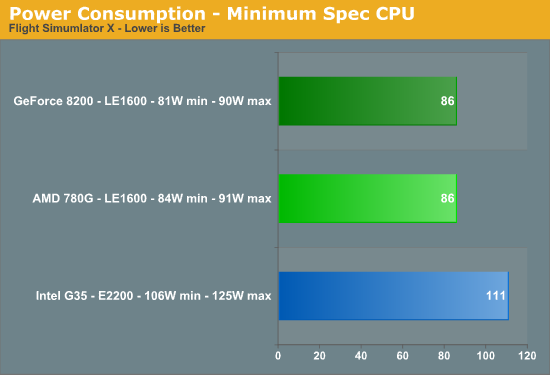
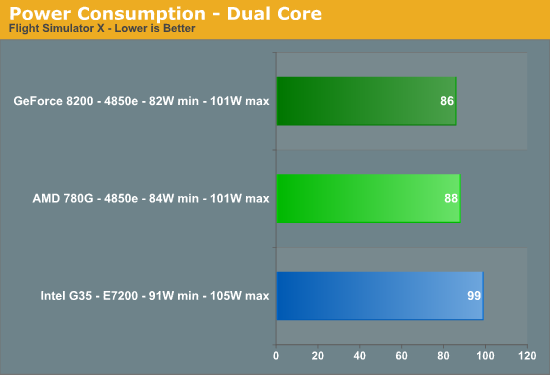
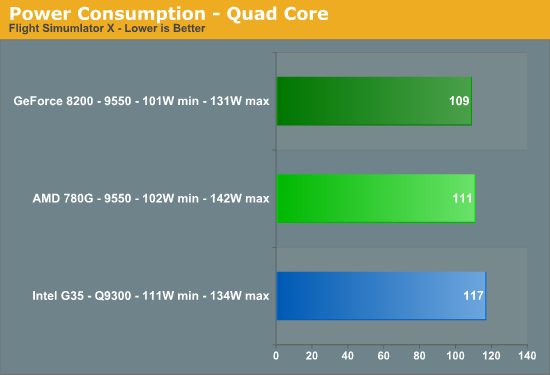
We listed minimum and maximum voltages during our six-minute trip around the harbor, but the charts show the average. The current version of Flight Simulator X with the Acceleration Pack is fully multi-core aware and provides a workout for both the CPU and GPU as you crank up the settings. Our AMD LE1600 is a single-core CPU so the voltage variations are not as great compared to the multi-core CPUs. This processor stayed near the 100% utilization level during FSX testing, although frame rates did not seem to suffer that much at our 1024x768 medium settings.
The results are closer this time around between our two AMD platform chipsets. The GeForce 8200 once again finishes slightly in the lead but our upcoming gaming tests will show it following in the footsteps of the AMD 780G. The results are a tie between the AMD chipsets but a 25W advantage over G35 with the low-end processors, a 2W and 13W improvement with the dual cores, and a soft landing with 2W and 8W differences between the quad cores.
First Thoughts
We told you it would be a short article. However, we think the results today should provide a better indication to each platform's power requirements with a variety of CPUs likely to end up in these boards and applications that tend to stress those same processors. Unless the next NVIDIA driver set increases power consumption, then we have a surprise winner between the latest IGP chipsets from the big three. The next question we will answer is performance per watt and those results are likely to lead us down another path.
The power bill savings alone are not that large, of course. Running 24/7, 365 days per year, a 10W power difference works out to 87.6 kWh of energy over the course of a year. At a rate of 10 cents per kWh, that would work out to less than a dollar per month. In the bigger picture, however, the 5W to 25W difference between chipsets or platforms can be far more meaningful. If you want a silent - or at least very quiet - PC, every watt saved can be meaningful. Cooler running chipsets can also avoid the need for "noisy cricket" fans or monstrous cooling configurations. All other things being equal, we would definitely prefer less power-hungry components.
Originally published at https://www.anandtech.com/show/2505 (Wayback Machine).