
Xigmatek NRP-HC1001 and NRP-HC1201 Power Supplies
- Posted in
- Cases/Cooling/PSUs
Efficiency
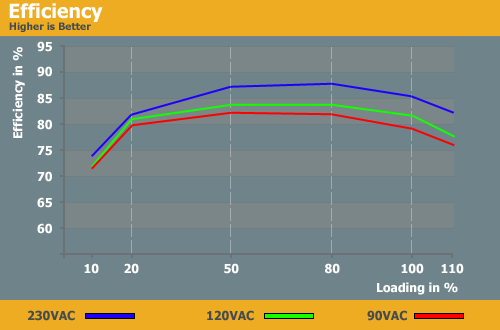
We are including two different graphics of efficiency. The first shows the efficiency at the load percentages and the second shows the efficiency at the different wattage outputs. The second one gives users a better comparison to other power supplies. If you know the amount of power your system requires, you can look up that load in the table below and see what efficiency the power supplies will provide.
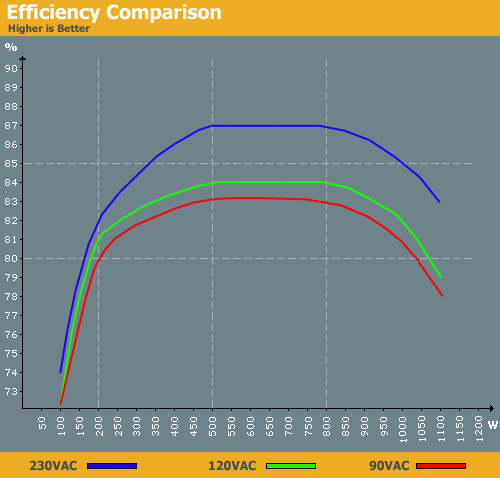
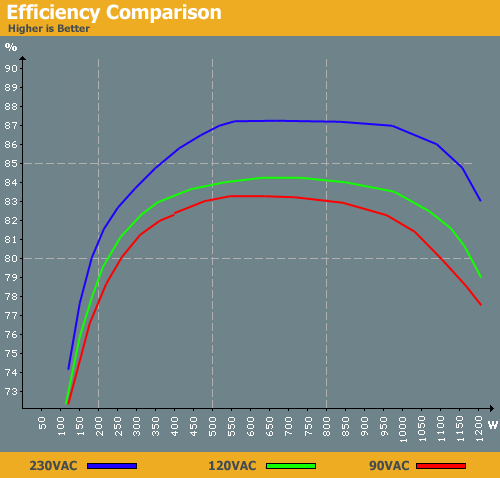
Not long ago a power supply company came to us and urged us to use the 80Plus table to load the power supplies instead of the ATX norm. The 80Plus table only looks at 20%, 50% and 100% of load which is quite narrow minded in our opinion and not really useful for our range of tests at all. An important factor is left out and that it where most system run, most of the time: around 10% of their maximum output in idle mode (at least on larger PSUs). Even though both calculation tables both look similar, we will still stick to the ATX norm which just makes more sense.
The efficiency of these two models is very good and the graphs show that users with a huge power usage will benefit most in energy savings. From 500W upwards, power output on these two units reaches an efficiency of 87% at 230VAC. In the US and other locations that use 115VAC, these units still run with a maximum efficiency of up to 84% over a large range of load. For users that run at less than 500W of load (most of the time), these power supplies won’t make much economic sense since you can buy a unit with a lower output rating and save a lot of money.
Power Factor Correction
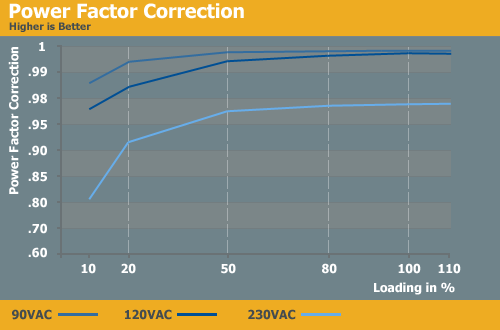
As always the power factor correction is much better with lower input voltage. This unit covers more than .99 (PFC) even with the lower loads. People in Europe need to be happy with an average result of .98 (PFC) tops.
Fan Speed and Acoustics
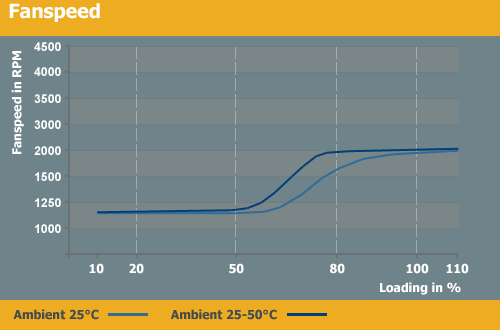
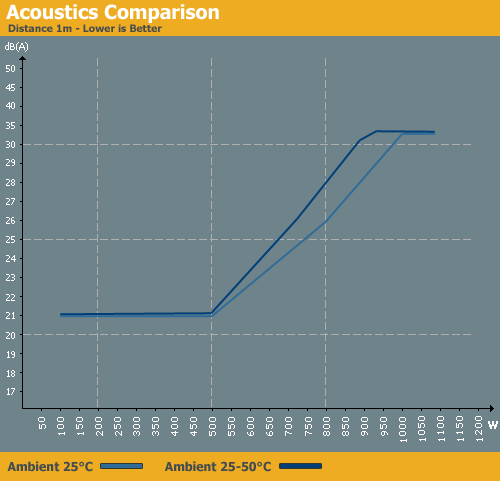
Both of the units are clearly audible while running even at the lowest load, or in fact with no load at all. The fan runs with a minimum of 1200RPM, which should not be necessary as a minimum. The noise levels therefore start at 21dB(A), but listening to the fan it seems much louder than that. With increased loads, the fan quickly starts to spin faster past the 50% load mark, and beyond 650W it's quite loud. The highest result we measured was 33dB(A) with a fan speed of 2000RPM. That's still a reasonable result but again we have to add that the sound coming from the power supply seems much louder than the 33dB(A) we’ve heard before from other units.
Originally published at https://www.anandtech.com/show/2501 (Wayback Machine).