
Sony A350: Full-Time Live View at 14.2MP
- Posted in
- Digital Camera
Resolution, Sensitivity and Image Quality
Sony likely wanted to scoop the industry with the 14.2MP resolution of the entry A350. That plan probably got scrapped by the 14.6MP Samsung CMOS sensor used in the prosumer Pentax K20D. While the A350 doesn't gain bragging rights as the highest res sensor south of $8000 it is still mighty close at 14.2MP. It is also the highest resolution sensor to be found in any current or announced entry-level DSLR.
Pentax went to great lengths to emphasize the greater size of their photoreceptor sites that made sensitivity more akin to the Sony/Nikon 12MP sensor. Pentax also emphasized the expanded sensitivity of their 14.6MP sensor with ISO options to 6400. Sony makes no special claims for the 14.2MP sensor in the A350, but the new sensor still has the option of ISOs to 3200.
We've already discussed how the A350 is easy to use with the best Live View you can find in a DSLR these days. The big remaining question, then, is whether the 14.2MP sensor really makes any difference in image quality.
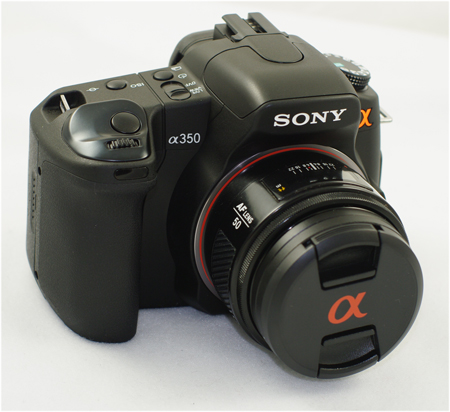
To answer that question we considered that the most revealing test of sensitivity, noise, and resolution is low tungsten light typical of home interiors. The selected scene was not chosen to be pretty but to be revealing of sensitivity, noise, and image quality. It is a shot of my office stacked with motherboards and other review equipment taken with a standard 50mm f1.4 lens.
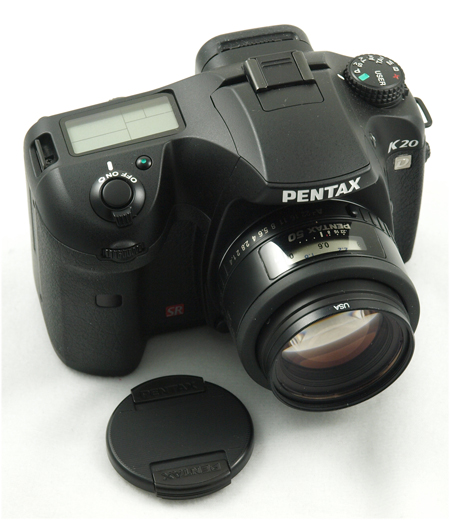
We found the APS-C 14.6MP CMOS sensor in the Pentax K20D to be excellent in sensitivity with well-controlled noise. The sensor size and resolution is roughly comparable to the A350, but the camera is much more expensive, uses a CMOS sensor rather than CCD, and it is targeted at the prosumer rather than entry-level. For those reasons, we included the Pentax K20D in these comparison tests.
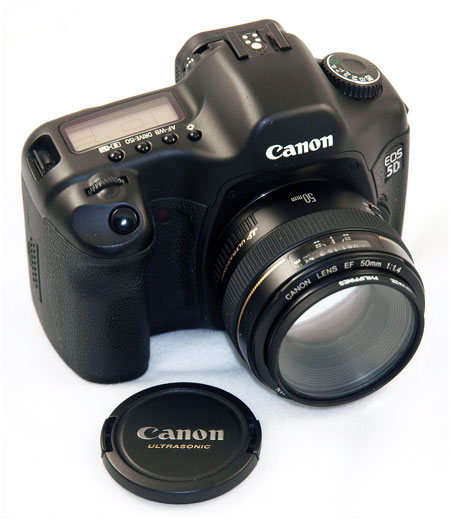
The Canon 5D is justifiably famous for its incredible resolution with the full-frame 12.2MP CMOS sensor. The larger size sensor creates larger photo sites and the larger pixels are more sensitive to light than smaller APS-C sensors. The larger sensor size means the pixel size is more like an 8MP APS-C than a 12.2MP sensor. That makes for a good comparison to these two 14+MP sensors.
All images used a 50mm f1.4 lens (Pentax 50mm f1.4, Sony/Minolta 50mm f1.4, Canon Ultrasonic 50mm f1.4). Aperture Priority was used with a fixed aperture of f4 at all ISOs on all three cameras. Shots were taken using a tripod and remote shutter release to prevent shake. High ISO Noise Reduction used the lowest level of high ISO NR that could be selected in each camera. White Balance was manually set to Tungsten on each camera and the only light source is a 100W tungsten bulb. These harsh test conditions should make image noise as severe as you will likely see in each camera short of time-exposure darkness. Images were captured in JPEG format so they could be displayed and downloaded without the requirement for post-processing software.
Originally published at https://www.anandtech.com/show/2491 (Wayback Machine).