
NVIDIA's 790i Arrives: SLI Rides Again
- Posted in
- CPUs
Will NVIDIA's 3-way SLI Make us Stand Up and Beg for More?
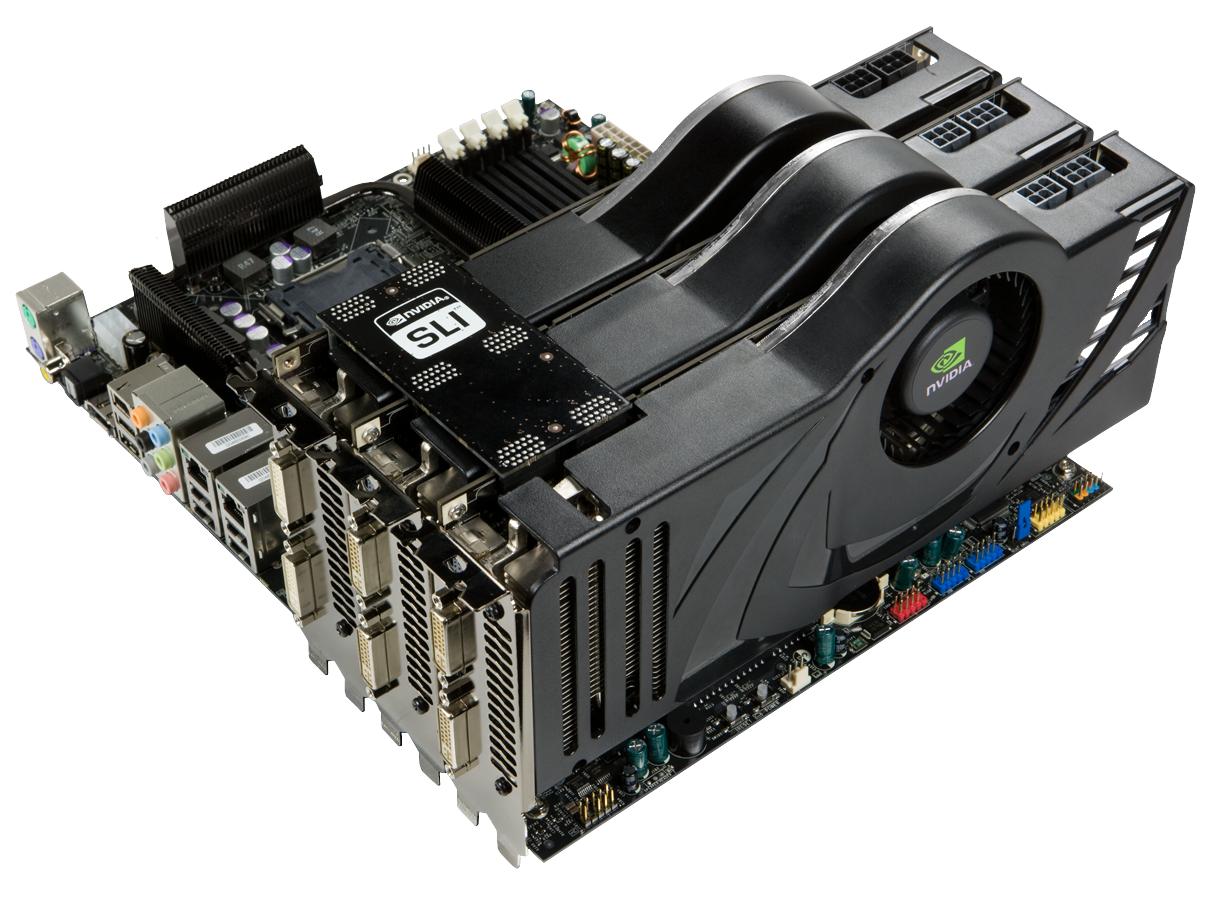 Fitting three NVIDIA GeForce 8800 Ultras in an nForce 790i board is quite easy. That is until your better half sees the next month's credit card statement. |
As of today, the ability to team more than two NVIDIA graphics cards for accelerated, parallel 3D game rendering requires some very specific hardware - namely no fewer than three GeForce 8800GTX or GeForce 8800 Ultra cards and either a 680i-, 780i- or 790i-based motherboard with the appropriate number of mechanical x16 PCIe expansion slots. System chassis and power supply requirements are no small potatoes either. A big case with plenty of cooling is a must and 1000W (or larger) PSUs become the standard when you decide to move up to play in these leagues. GPU overclocking takes on a completely new twist when you starting playing with this sort of power.
We decided to get a little creative and built a 790i-based system that included water-cooling on both the CPU and all three MSI 8800GTX cards. Full-coverage GPU blocks from EK Waterblocks were our components of choice, and going with 3/8" ID Tygon tubing meant we could use the shorter "stubby" barbs we would need if we wanted to have any hope of fitting things together so closely. In the end, our loop contained one D-tek FuZion CPU waterblock, three EK full-coverage GPU waterblocks, a single 2x120mm radiator from Cooler Master, a combination reservoir/pump also from Cooler Master, two inline thermal sensors, and about three feet of 3/8" ID and 5/8" OD clear tubing.
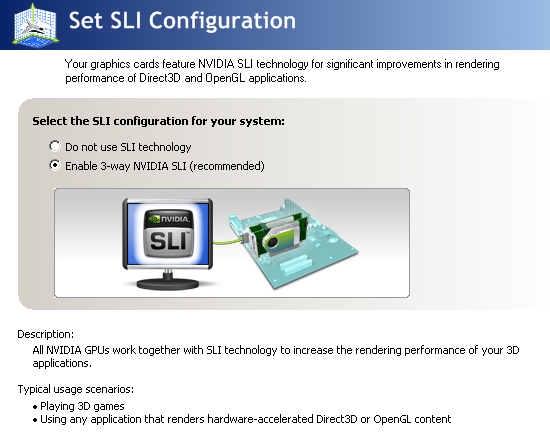
Yes, please.
Sure, our temperatures are not going to end up being that great, but we fit everything in a single case quite nicely and we only needed two medium-speed fans to cool the radiator and nothing else. At least our hearing would be safe. Check the sections on real-world gaming results to see how these cards stacked up against single and SLI GeForce 8800GTS 512MB (G92) configurations.
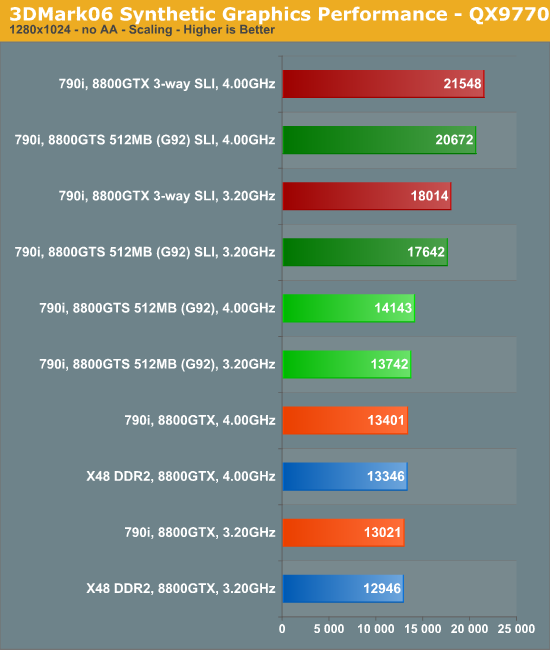
NVIDIA's 790i platform just barely manages to edge out Intel's X48 when it comes to single-card 8800GTX general graphics performance. Of course, this may have more to do with the slight advantage 790i has with the use of DDR3 over the DDR2 in the X48 board than anything else. Not surprisingly, the 8800GTS 512MB (G92) cards overtake the older 8800GTX cards quite easily. Keep in mind that we ran all of the GPUs at their stock speeds, as advertised by NVIDIA on their official company website. This removes any chance for performance variation due to different vendor's default clocks and allows us to test the cards as NVIDIA originally intended for them to be run.
NVIDIA's 3-way SLI shows only minor gains over a similarly configured 8800GTS (G92) SLI system - at 3.2GHz on our Intel QX9770 we only managed to outrun the pair of G92s by about 500 3DMarks. While the G92-based cards may have a core, shader, and memory clock advantage, the 3-way setup starts to pull away a little more as we ramp our quad-core CPU all the way to 4.0GHz. This suggests that the tri-SLI setup is starved for additional processing power, and more advanced architectures and higher computing speeds will be needed if we are ever going to experience the true potential this technology.
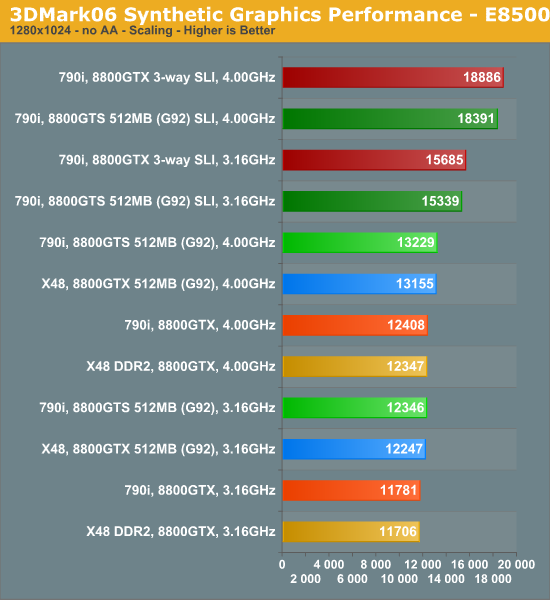
Gains with 3-way SLI were smaller with our E8500; multithreaded driver optimizations may play a role in this. Since we know the 790i is quite capable of fully utilizing a 45nm or 65nm quad-core CPU, picking one up is any easy choice if you've got the cash and are looking for maximum performance.
Originally published at https://www.anandtech.com/show/2482 (Wayback Machine).