
NVIDIA's 790i Arrives: SLI Rides Again
- Posted in
- CPUs
Synthetic DDR3 Memory Read, Write, and Copy Performance
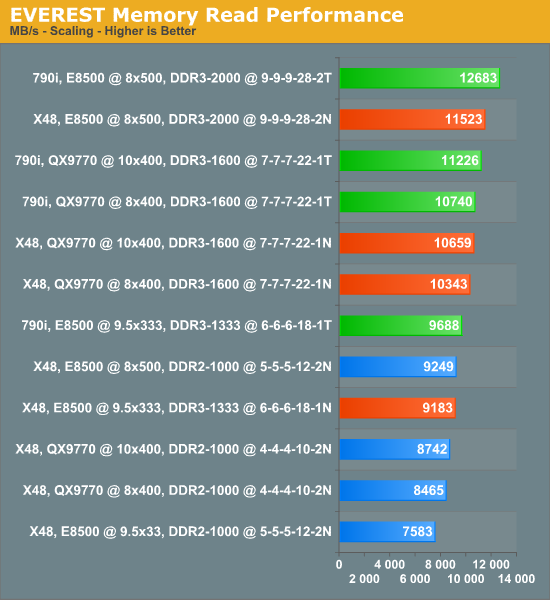
Our testing was completed linked 'n' synced - that is, our DDR3 memory was run at a 2:1 ratio with the FSB as this consistently provided the best results and made 790i highly competitive with Intel X48 chipset, pulling way ahead when clocked to DDR3-2000 speeds; something that can be done nearly automatically thanks to EPP 2.0 profiles with SLI-ready memory modules.
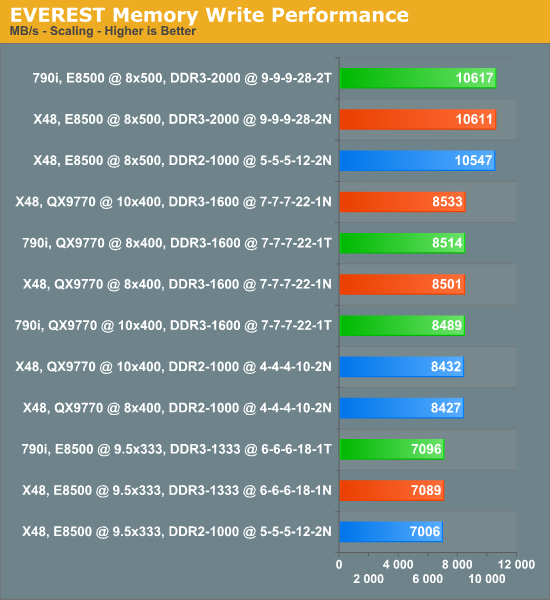
Read memory speeds aren't everything though - a delicate balance must be maintained between read and write performance if a chipset is going to be a winner. Again, we see 790i slightly outpacing X48, once more at 500MHz FSB. Other than that, we see 790i just about matching X48 head-to-head when it comes to memory write bandwidths. This is to be expected though as write performance is all about achieving maximum FSB. The problem with this is that some chipsets can leave a lot of read performance on the table if you tune solely for write speeds.
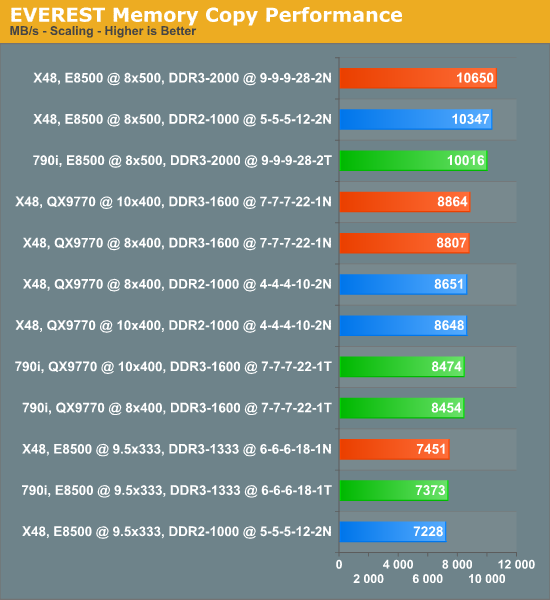
Memory copy benchmarks are unique in that they provide a great indication of just how well a memory controller balances the importance of read versus write performance. A chipset certainly cannot facilitate good copy speeds if either reads or writes are low. The memory controller must first read the data from memory before it can write it back to memory (this is the basis of a copy operation) and a bottleneck with either brings everything to a crawl. From this chart, we can conclude that Intel's X48 chipset is somewhat better than 790i when it comes to prioritizing these requests. So much so in fact that 500MHz FSB with an E8500 on X48 appears to outclass 790i by a healthy 6%.
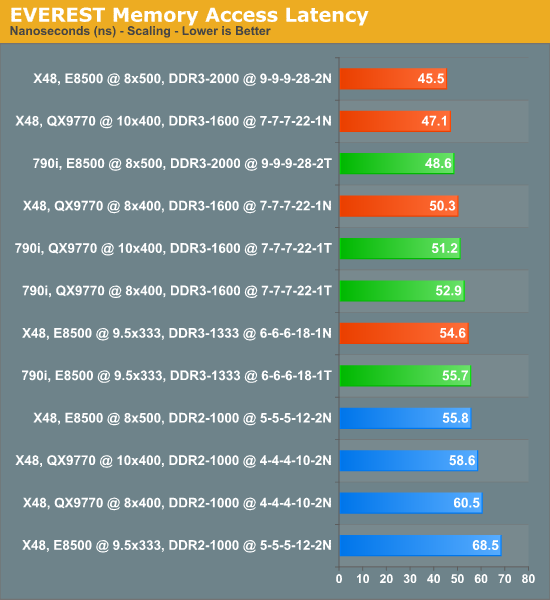
Low memory access latency and high memory read bandwidths go hand-in-hand. Low latencies are important because they characterize just how well the memory controller handles random memory access requests - that is, sequential read requests that cross memory bank boundaries and/or are not necessary in the same physical column as the prior read. For this reason, tests that stress a memory controller's ability to access memory in a highly random manner are especially dependant on access latencies. Even though 790i far exceeds X48 in sequential read performance, according to our results X48 may have a slight advantage when the requests become more randomized.
Originally published at https://www.anandtech.com/show/2482 (Wayback Machine).