
Intel X38 Tango - Is High FSB Overclocking Worth It?
- Posted in
- CPUs
CALWI waltzes off into the sunset
The second factor for determining a system operating point is to find the optimum memory CAS setting known as "CALWI". Further technical insight into "CALWI" performance tuning is available here.
We have already determined that our optimum field of operation is between 440-470FSB at tRD settings of 6 using this motherboard. Now we need to look at how CAS settings and memory speed scaling affects memory CAS (Column Address Strobe) latency. Actual CAS latency is measured in nanoseconds (ns), and it should come as no surprise that lower values mean faster performance.
As always, this performance will come at the expense of both your wallet and increased component memory voltages (depending on how good your memory actually is in most cases). The graph below uses the CALWI equation to plot CAS latency values at various FSB rates and also shows the minimum VDimm required for stability at a given CAS latency:
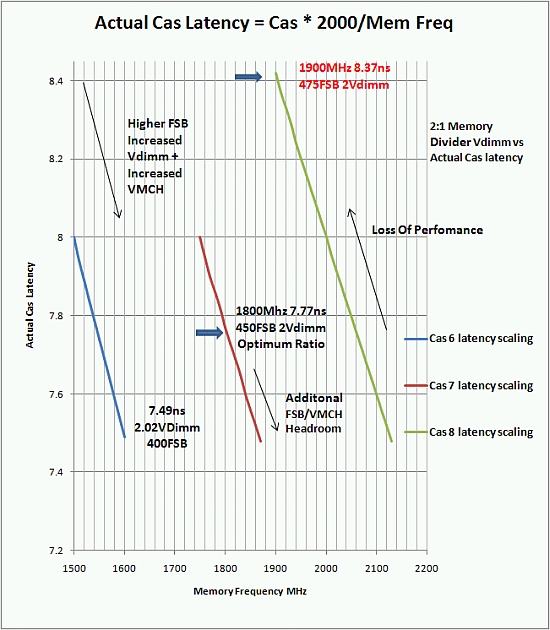
Since we are aiming for an FSB speed in the region of 450FSB (to maintain a low and stable tRD cycle time), using the 2:1 memory divider ratio gives us a memory speed of 1800MHz - absolutely perfect for CAS 7 at 7.77ns with 2V on the memory. Should we wish to get a little adventurous and shoot for higher FSB rates, we can get closer to a CAS latency of 7.5ns while staying under 2.1V on the memory modules, but this is not recommended for 24/7 operation. Using any other memory divider at 450FSB places the memory speed too low, negating the benefits of DDR3 memory.
This leads us to ask why some memory vendors are releasing memory modules binned at CAS 9 DDR3-1900 as "performance" memory. You can use the equation above to work out that CAS 9 at DDR3-1900 gives us a pitiful 9.47ns - which we would hardly call "performance" memory. As things stand in the chipset business right now, CAS 9 does not make a good dance partner, unless you like a slow Waltz with your partner stepping on your toes.
The ugly aspect of high FSB overclocking rears its head again at 500FSB. If we use the 2:1 memory divider ratio, we end up with a memory speed of 2000MHz. This requires a minimum of CAS 8 (not stable yet at this speed) to operate and requires a Command Rate of 2N, bringing additional performance loss - two kicks in the shin. Using the next best divider brings us to a memory speed of 1600MHz. If we care about overall performance, we do not want to be stuck with a tRD of 7 and a memory setting of CAS 6, with little potential for additional scaling.
CAS 8 is quite ugly too. In order to achieve anywhere near the latency of CAS 7 at 1800MHz (7.77ns), we need a memory speed in the region of 2060MHz at CAS 8:
8 X 2000 / 2060 = 7.76ns
Based upon how the X38 (and X48 in early testing) chipset scales and current DDR3 memory limits, running a speed of 2060MHz is impossible at 2.0V VDimm and a safe MCH voltage. Now you can see why our chosen 440-470FSB operating point with a dual-core CPU makes perfect sense on the ASUS Maximus Extreme and other X38/X48 boards in general.
Quick Thoughts
As you can tell from the tone of this article, we care quite a bit about overall system performance, not to mention stability. Even if the gains are small, why not do things properly? What this little journey has proven to us is that the X38 (and X48 is similar) is clearly designed for optimum use at around 460FSB with higher multiplier processors.
For those who aspire to find the holy grail of 4GHz using a dual-core 45nm processor, we think the E8400 and a 9X multiplier is the sweet spot based on current test results. We will go into additional detail on the E8500 in an upcoming article that will feature "RDWI" - no, that is not a new driving while intoxicated offense, but detailed information about optimum tRD scaling windows.
In the end, we believe that a balanced and optimized platform is much more important than one that shows off high FSB speeds at the expense of performance, thermals, and stability. After all, would you rather have a balanced dance partner that can perform a variety of dances from ballet to hip-hop, or do you want someone that only looks good tap dancing after a few Red Bulls but quickly burns out?
Originally published at https://www.anandtech.com/show/2458 (Wayback Machine).