
Intel's Silverthorne Unveiled: Detailing Baby Centrino
- Posted in
- CPUs
Lower Power than Centrino
With mobile Penryn Intel introduced a new power state it calls C6. In the C6 power state the CPU is in a virtual reset state, and core voltage is very close to zero. The core clock, all of the PLLs, and caches are completely turned off. All of the state data is saved in a 10.5KB storage area, similar to mobile Penryn (but smaller since there's not as much state to save). Upon exiting C6 the processor's previous state is restored from this memory, called the C6 array. It takes around 100us to get out of C6, but the power savings are more than worth the effort - it's a similar approach of power for performance that we saw in the design of the original Pentium M processor.
Clock gating (sending the clock signal through a logic gate that can disable it on the fly, thus shutting off whatever the clock connects to) is an obvious aspect of Silverthorne's design. All Intel processors use clock gating; Silverthorne simply uses it more aggressively - the clock going to every "power zone" is gated, something that isn't the case in mobile Core 2. Each logic cluster (205 total) in Silverthorne is referred to as a Functional Unit Block (FUB) and the entire chip uses what Intel calls a sea of FUB design. Each FUB is clock gated and can be disabled independently to optimize for power consumption. The cache in Silverthorne is in its own FUB, which apparently isn't the case in mobile Core 2.
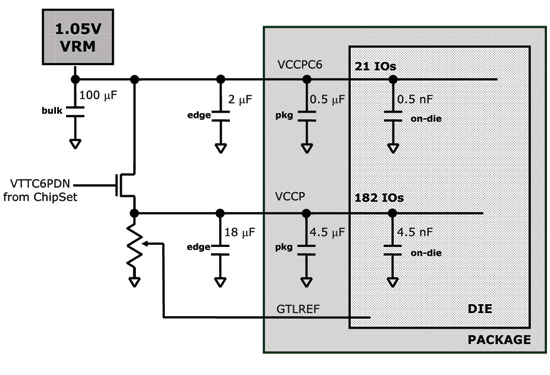
Keeping Silverthorne on life support, only 21 pins are necessary
Silverthorne uses a split power plane; in its deepest sleep state (C6) the chip can shut off all but 21 pins which are driven by the 1.05V VRM. By having two separate power planes the chip can manage power on a more granular level. While it can't disable individual pins, it can disable large groups of them leaving only 21 active when things like the L2 cache and bus interface are powered down.
Intel mentioned that Silverthorne will remain in its C6 sleep state 90% of the time. However, that figure is slightly misleading because it's only possible to remain in C6 when the CPU is completely idle. The 90% figure comes from taking into account a mobile device sitting in your pocket doing nothing most of the time. When in use, Silverthorne won't be able to spend nearly that much time in C6.
Despite the implementation of a C6 power state, Silverthorne will still lose to ARM based processors in both active and idle power. The active power disadvantage will be erased over the coming years as the microarchitecture evolves (and smaller manufacturing processes are implemented), while the idle power requires more of a platform approach. As we reported in our first Menlow/Silverthorne article:
"The idle power reduction will come through highly integrated platforms, like what we're describing with Moorestown. By getting rid of the PCI bus and replacing it with Intel's own custom low-power interface, Intel hopes to get idle power under control. The idea is that I/O ports will only be woken up when needed (similar to how the data lines on the Centrino FSB function), and what will result are platforms with multiple days of battery life when playing back music."
The final aspect of unique power management in Silverthorne falls upon its gridless clock distribution. Every single element within a microprocessor operates on the same clock, and making sure the same clock signal arrives at the exact same time across the many-mm^2 die is a difficult task. In conventional microprocessors, clock distribution is handled using a complex tree - which ends up eating over 30% of total microprocessor power. In-order designs allow the easier use of gridless clock distribution, which is a flat distribution using multiple clocks at the same time (instead of a tree/gridded design that is hierarchical).
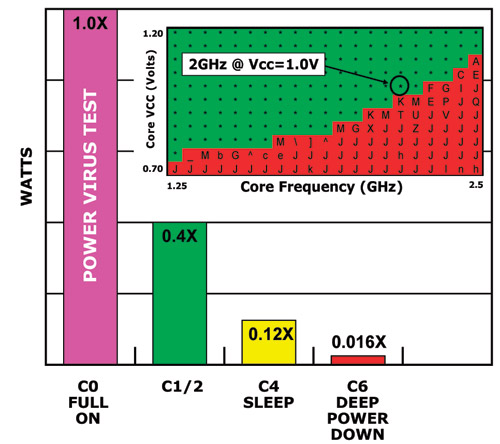
Intel is targeting 0.6W - 2.0W TDPs with Silverthorne - obviously depending on clock speeds. At 2.0GHz, running at 1.0V, Silverthorne runs at 90C and dissipates 2W. The CPU temperature alone should be an indication that this is too hot for an ultra small iPhone-like form factor, so expect to see devices that are closer to a PlayStation Portable in size and at lower clock speeds for most of them.
Originally published at https://www.anandtech.com/show/2449 (Wayback Machine).