
The Witcher: a Study in Neutrality
- Posted in
- GPUs
A Farewell to Packrats
Given how much of your inventory ends up being devoted to storing potions, ingredients, and alcohol, this is as good a place as any to discuss what else can go into your inventory. The short list includes scrolls and books (you can sell or drop these after reading); various pieces of food and weaker alcohols (you can eat/drink/get drunk, sell, or sometimes give to hungry NPCs); jewelry, clothing, flowers, and gems (sell for money, or sometimes use as part of a quest); and a few other miscellaneous odds and ends. Outside of items that may or may not be used in a quest at some point — anything used in a quest can easily be acquired later — your inventory basically ends up being used to store items that you might sell for money.
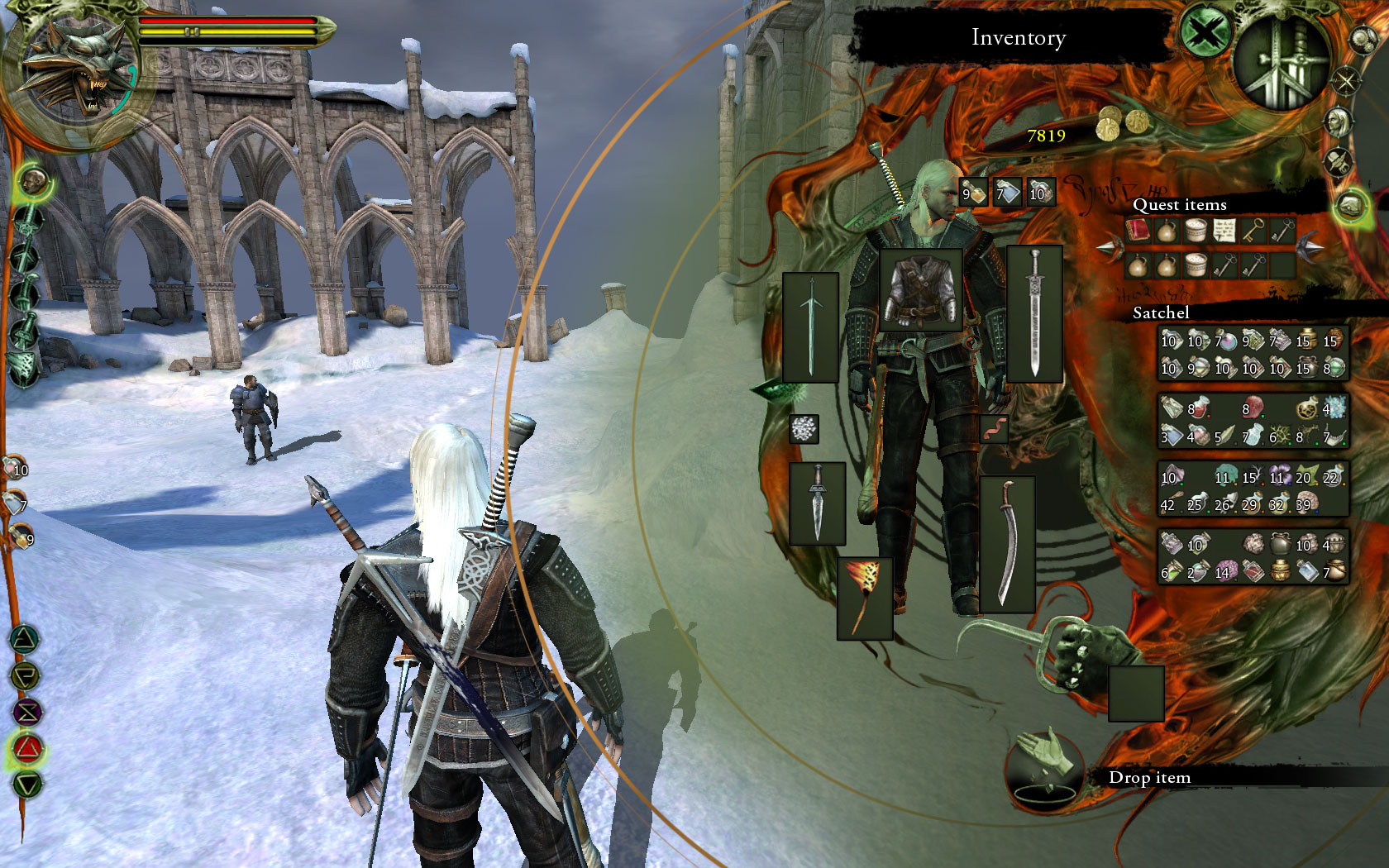 Not a lot of room, until you realize most stuff is junk you don't need |
You can't carry more than a few weapons at one time, and those that you can carry only fit in certain slots. During the course of a game, you will only wear three different pieces of armor and use perhaps half a dozen swords. For the most part, your inventory ends up being devoted to alchemy. This isn't necessarily a bad thing, provided you can overcome any latent packrat mentality. Simply pick up the few objects that you want and leave everything else behind. This is almost the polar opposite of Hellgate: London, where a vast majority of the game revolves around your equipment.
 As usual, lots of people need your help. |
Since we've now covered most of the user interface, we might as well take a moment to go through the rest of the options. Outside of inventory and character management screens, the only other noteworthy parts of the interface involve the Journal. As you would expect, the Journal keeps track of Quests. You can view just the active quests and quest stages, or if you want to look at old quests/stages you can uncheck the appropriate boxes. You can also view quests by chapter and whether they are a main quest or a side quest — very convenient. Any entries in the journal that have been updated since the last time you viewed the appropriate page will have a red exclamation point next to them.
 I didn't ever use many of the formulas |
The Formula page provides information about various alchemical formulas that you've learned. This information is actually largely redundant, as you can get the same information in the alchemy screen when you're brewing potions, and you don't actually need to manually concoct each potion. Simply click on any of the active potions (only potions where all of the ingredients are available are active), and the appropriate items from your inventory will be selected. Even less useful is the Ingredients page, which consists of one sentence descriptions of the dozens of the Ingredients you can find in the game.
 Oh, the people you'll meet… |
 The places you'll go… |
 And the indigenous life forms you'll slay. |
 Random background information |
The Characters, Locations, Glossary, and Monsters pages are all very similar and contain background information on the appropriate subject. Glossary is sort of a catchall area with details about some of the factions you encounter in the game, the history of the game world, magic, medicine, political forces, etc. There's also a tutorial page where you can reread the hints that pop up at the very beginning of the game.
At first blush, all of this may seem extremely complex and convoluted. In actual practice, the journal is mostly composed of extra information that you may or may not want to read — just like the many books that you find throughout the game. I enjoyed the extra detail and read everything, but then I did the same thing in Oblivion — and before that in the Ultima games and many other RPGs. If you enjoy that type of game, The Witcher will accommodate you; if you just want to stick to the meat of the story, you can do that as well. Outside of updating quest information (which updates the appropriate journal entry), none of the actual text that accompanies any book/scroll is required reading material. There also aren't nearly as many extraneous books as in Oblivion, where only a small fraction contained something more than background information.
Originally published at https://www.anandtech.com/show/2426 (Wayback Machine).