
NVIDIA GeForce 8800M: Fast DX10 Mobile GPUs Finally Arrive
- Posted in
- Laptops
GeForce 8800M GTS and GTX
Obviously, the big news of the day is that NVIDIA has a couple new mobile graphics chips available for notebook manufacturers. Before we get into the details, here's a quick breakdown of NVIDIA's mobile GPU offerings for the past two years. Naturally, the GeForce 8800M GTS and GTX take their place at the top of the performance totem pole.
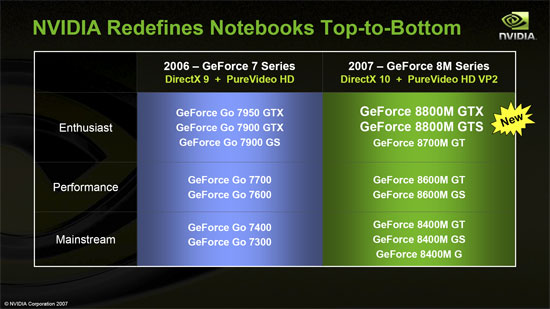
Despite the fact that NVIDIA lists the 8700M GT as an "enthusiast" part, we would be inclined to place it down a notch with the 8600M GT. The primary difference between the two parts is core clock speed, as both include 32 SPs. Similarly, we would demote the 8600M GS to a mainstream part, considering it only has 16 SPs. While all of the DX10 mobile offerings will outperform current integrated solutions, anyone interested in gaming performance should really set their sights at the 8600M GT as a bare minimum. The following list of specifications and features should make our reasoning clear.
While we wouldn't go so far as to call the 8700M GT slow, the 8800M GTX is clearly a major leap in performance. Besides having three times the number of SPs, the 8800M GTX has a 256-bit memory interface. Taking default clock speeds into account, the 8800M GTX offers 140% more fillrate, three times the pixel processing power, and twice the memory bandwidth. The 8800M GTS also has twice the memory bandwidth, but because of the reduced number of SPs it only has 60% more fillrate and twice the pixel processing power - still enough to make a noticeable difference in gaming performance.
Looking at the features chart, we can see that all of the GeForce 8M graphics chips are similar, with a few areas of differentiation. The 8400M G is the only card that lacks the newer VP2 video processing engine, while all the other GPUs should be able to handle full 1080p H.264 decoding. Maximum resolutions are also slightly lower on the 8400M cards. Note that while all of the higher-end cards are capable of supporting 2560x1600 resolution, that requires a dual-link DVI output and the inclusion of such will be up to the notebook manufacturers (unfortunately). Everything from the 8600M GT and above will also support SLI, for users that want the absolute fastest possible graphics performance in a notebook.
NVIDIA provided us with some images of the MXM (Mobile PCI Express Module) boards for the 8800M GTS/GTX. While they did not officially confirm our suspicions, it appears that the GTS variant uses the same basic chip as the GTX, only with 32 of the SPs disabled - perhaps in order to improve yields. Modules will be available for MXM3 and MXM4 (but not MXM1).
So what sort of power requirements will come with these new ultrafast mobile GPUs? Here is one more area where things have improved over the GeForce Go 7950 GTX. Maximum power use should be somewhat lower (37W compared to 44W for the 8800M GTX, and a few watts lower for the 8800M GTS), and minimum power requirements should also be lower - we were told the 8800M GTX sitting idle at the Windows desktop consumes 4.7W. VP2 will increase power requirements slightly when watching movies, but only up to around 7.2W. While the idle power consumption isn't particularly high, the fact of the matter is that battery life is extremely important for many laptop users, and battery life will still suffer compared to IGP laptop offerings.
The Holy Grail for laptops would be to have a system that can completely shut down any discrete graphics card(s) when 3D performance is not required. That would potentially allow manufacturers to create even SLI notebooks that could still offer several hours of battery life - provided you're not running any 3D applications. NVIDIA is at work on creating such a solution, which they are calling hybrid graphics. The technology is not yet finished, and there's more to it than simply shutting down the discrete graphics. Still, the idea is promising and we certainly look forward to being able to have our cake and eat it too when it comes to gaming notebooks and battery life.
Obviously, the big news of the day is that NVIDIA has a couple new mobile graphics chips available for notebook manufacturers. Before we get into the details, here's a quick breakdown of NVIDIA's mobile GPU offerings for the past two years. Naturally, the GeForce 8800M GTS and GTX take their place at the top of the performance totem pole.
Despite the fact that NVIDIA lists the 8700M GT as an "enthusiast" part, we would be inclined to place it down a notch with the 8600M GT. The primary difference between the two parts is core clock speed, as both include 32 SPs. Similarly, we would demote the 8600M GS to a mainstream part, considering it only has 16 SPs. While all of the DX10 mobile offerings will outperform current integrated solutions, anyone interested in gaming performance should really set their sights at the 8600M GT as a bare minimum. The following list of specifications and features should make our reasoning clear.
 |
 |
While we wouldn't go so far as to call the 8700M GT slow, the 8800M GTX is clearly a major leap in performance. Besides having three times the number of SPs, the 8800M GTX has a 256-bit memory interface. Taking default clock speeds into account, the 8800M GTX offers 140% more fillrate, three times the pixel processing power, and twice the memory bandwidth. The 8800M GTS also has twice the memory bandwidth, but because of the reduced number of SPs it only has 60% more fillrate and twice the pixel processing power - still enough to make a noticeable difference in gaming performance.
Looking at the features chart, we can see that all of the GeForce 8M graphics chips are similar, with a few areas of differentiation. The 8400M G is the only card that lacks the newer VP2 video processing engine, while all the other GPUs should be able to handle full 1080p H.264 decoding. Maximum resolutions are also slightly lower on the 8400M cards. Note that while all of the higher-end cards are capable of supporting 2560x1600 resolution, that requires a dual-link DVI output and the inclusion of such will be up to the notebook manufacturers (unfortunately). Everything from the 8600M GT and above will also support SLI, for users that want the absolute fastest possible graphics performance in a notebook.
 |
 |
NVIDIA provided us with some images of the MXM (Mobile PCI Express Module) boards for the 8800M GTS/GTX. While they did not officially confirm our suspicions, it appears that the GTS variant uses the same basic chip as the GTX, only with 32 of the SPs disabled - perhaps in order to improve yields. Modules will be available for MXM3 and MXM4 (but not MXM1).
So what sort of power requirements will come with these new ultrafast mobile GPUs? Here is one more area where things have improved over the GeForce Go 7950 GTX. Maximum power use should be somewhat lower (37W compared to 44W for the 8800M GTX, and a few watts lower for the 8800M GTS), and minimum power requirements should also be lower - we were told the 8800M GTX sitting idle at the Windows desktop consumes 4.7W. VP2 will increase power requirements slightly when watching movies, but only up to around 7.2W. While the idle power consumption isn't particularly high, the fact of the matter is that battery life is extremely important for many laptop users, and battery life will still suffer compared to IGP laptop offerings.
The Holy Grail for laptops would be to have a system that can completely shut down any discrete graphics card(s) when 3D performance is not required. That would potentially allow manufacturers to create even SLI notebooks that could still offer several hours of battery life - provided you're not running any 3D applications. NVIDIA is at work on creating such a solution, which they are calling hybrid graphics. The technology is not yet finished, and there's more to it than simply shutting down the discrete graphics. Still, the idea is promising and we certainly look forward to being able to have our cake and eat it too when it comes to gaming notebooks and battery life.
Originally published at https://www.anandtech.com/show/2380 (Wayback Machine).