
AMD's Phenom Unveiled: A Somber Farewell to K8
- Posted in
- CPUs
Overclocking
Given the launch frequencies, you can expect that Phenom isn't a tremendously overclockable chip.
While we were able to run our 2.4GHz chip at 3.0GHz, we couldn't get it stable. Even 2.8GHz wasn't entirely stable, but 2.6GHz was attainable for benchmarks.
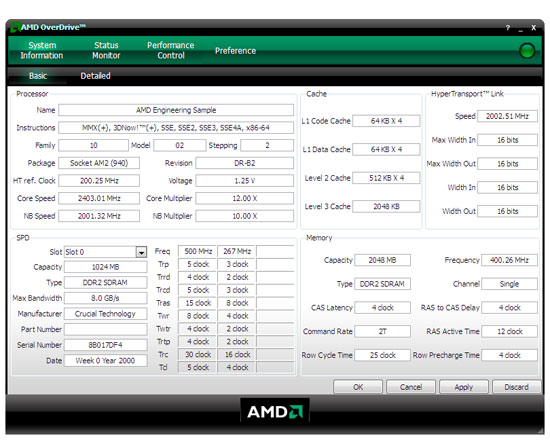
AMD's OverDrive Utility, note that it reads the memory controller as single channel because Phenom actually has two independent 64-bit memory controllers instead of a single 128-bit one. Current BIOSes and the AMD utility incorrectly report this as being single-channel.
All of our overclocking was done using AMD's nifty new OverDrive utility, which is a Windows utility that can control virtually every single BIOS option from within your OS. You can overclock individual cores, change memory timings, voltages and most importantly: it all works.
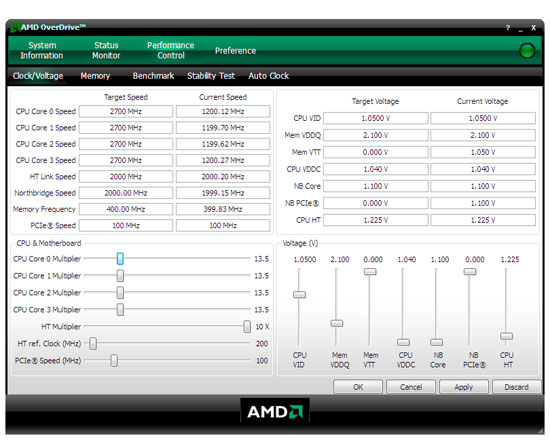
The application is a little slow to respond when making changes and it would be nice if there was a hotkey to bypass the application loading its last settings, but it's truly a beauty to work with and one of the best aspects of today's launch.
The Test
| CPU: | AMD Phenom 9900 (2.6GHz) AMD Phenom 9700 (2.4GHz) AMD Phenom 9600 (2.3GHz) AMD Phenom 9500 (2.2GHz) Intel Core 2 Quad Q9450 (2.66GHz/1333MHz) Intel Core 2 Quad Q6700 (2.66GHz/1066MHz) Intel Core 2 Quad Q6600 (2.40GHz/1066MHz) |
| Motherboard: | ASUS P5E3 Deluxe (X38) MSI K9A2 Platinum (790FX) |
| Chipset: | Intel X38 AMD 790FX |
| Chipset Drivers: | Intel 8.1.1.1010 (Intel) AMD 790FX Launch Drivers |
| Hard Disk: | Western Digital Raptor 150GB |
| Memory: | Corsair XMS2 DDR2-800 4-4-4-12 (1GB x 2) Corsair XMS3 DDR3-1066 7-7-7-20 (1GB x 2) |
| Video Card: | NVIDIA GeForce 8800 GTX |
| Video Drivers: | NVIDIA ForceWare 169.09 |
| Desktop Resolution: | 1920 x 1200 |
| OS: | Windows Vista Ultimate 32-bit |
Originally published at https://www.anandtech.com/show/2378 (Wayback Machine).