
abit IP35-Pro: Houston, We Have a Winner
- Posted in
- Motherboards
Audio Encoding Performance
We will utilize iTunes 7.4 for our audio encoding tests, as it is one of the most utilized audio applications available due to the immense popularity of the iPod.
Our first task was to figure out what test CD to utilize. We needed one that contained a significant number of tracks and had over 600MB of data in order to stress our platforms. As in previous articles, we are using an INXS Greatest Hits CD for testing, which contains 16 tracks totaling 606MB of songs. Our next two tests have us utilizing iTunes to convert our WAV files into ACC or MP3 compatible formats. We utilize 320kbps or 256kbps and variable bit rate options for both tests.
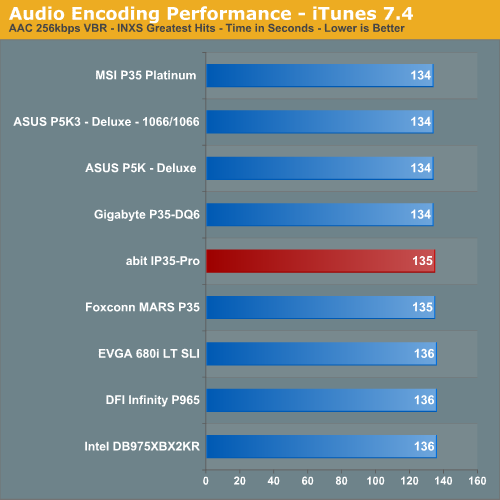
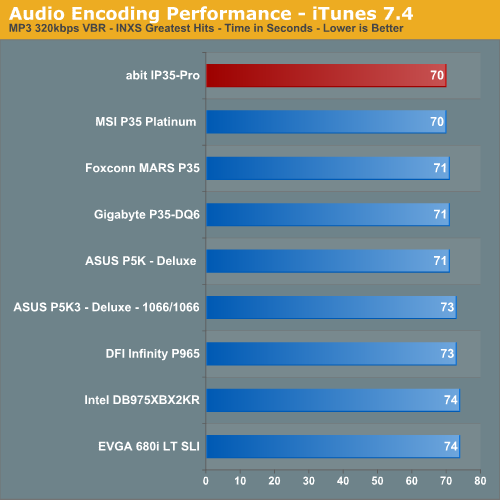
We usually see iTunes favoring a system with excellent CPU throughput and these tests indicate the abit board is up to speed in this area. However, if it is not apparent by now, all of the P35 boards generally score within 2% of each other.
File Compression Performance
In order to save space on our hard drives and provide another CPU crunching utility, we utilize WinRAR 3.70 to perform some compression tests. WinRAR now fully supports multithreaded operations, making it more interesting for those with dual-core or multi-processor systems. Our test folder contains 444 files, 10 subfolders, and 602MB worth of data. We use WinRAR's default settings and defragment our hard drive before each test.
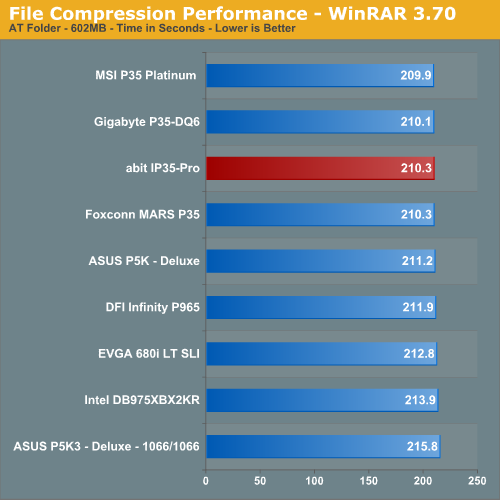
Once again we see the abit board performing well in a test that stresses overall memory latencies and CPU/Memory throughput. The abit board finishes four-tenths of second behind the MSI board. The nature of file compression is such that memory is accessed almost constantly in a very random fashion, so page misses requiring additional time as memory banks are swapped is common.
Rendering Performance
We are using the Cinebench 10 benchmark as it will heavily stress the CPU subsystem while performing graphics modeling and rendering. Cinebench 10 features two different benchmarks with one test utilizing a single core and the second test showcasing the power of multiple cores in rendering the benchmark image. We utilize the standard multi-core benchmark and default settings.
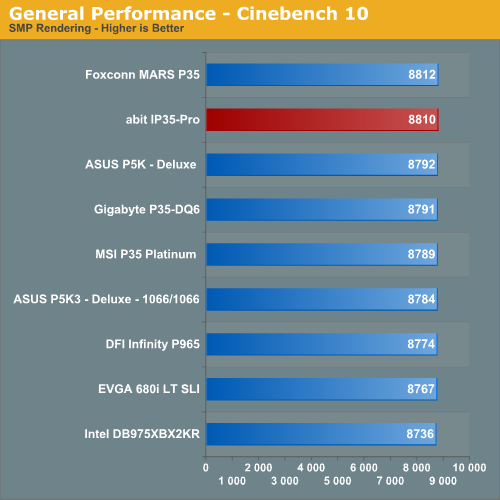
The abit IP35-Pro board performs extremely well in this CPU intensive test and finishes a close second to the Foxconn MARS.
We will utilize iTunes 7.4 for our audio encoding tests, as it is one of the most utilized audio applications available due to the immense popularity of the iPod.
Our first task was to figure out what test CD to utilize. We needed one that contained a significant number of tracks and had over 600MB of data in order to stress our platforms. As in previous articles, we are using an INXS Greatest Hits CD for testing, which contains 16 tracks totaling 606MB of songs. Our next two tests have us utilizing iTunes to convert our WAV files into ACC or MP3 compatible formats. We utilize 320kbps or 256kbps and variable bit rate options for both tests.
We usually see iTunes favoring a system with excellent CPU throughput and these tests indicate the abit board is up to speed in this area. However, if it is not apparent by now, all of the P35 boards generally score within 2% of each other.
File Compression Performance
In order to save space on our hard drives and provide another CPU crunching utility, we utilize WinRAR 3.70 to perform some compression tests. WinRAR now fully supports multithreaded operations, making it more interesting for those with dual-core or multi-processor systems. Our test folder contains 444 files, 10 subfolders, and 602MB worth of data. We use WinRAR's default settings and defragment our hard drive before each test.
Once again we see the abit board performing well in a test that stresses overall memory latencies and CPU/Memory throughput. The abit board finishes four-tenths of second behind the MSI board. The nature of file compression is such that memory is accessed almost constantly in a very random fashion, so page misses requiring additional time as memory banks are swapped is common.
Rendering Performance
We are using the Cinebench 10 benchmark as it will heavily stress the CPU subsystem while performing graphics modeling and rendering. Cinebench 10 features two different benchmarks with one test utilizing a single core and the second test showcasing the power of multiple cores in rendering the benchmark image. We utilize the standard multi-core benchmark and default settings.
The abit IP35-Pro board performs extremely well in this CPU intensive test and finishes a close second to the Foxconn MARS.
Originally published at https://www.anandtech.com/show/2367 (Wayback Machine).