
NVIDIA GeForce 8800 GT: The Only Card That Matters
- Posted in
- GPUs
Out with the Old, In with the New: 8800 GT vs. 7950 GT and 1950 XT
Many gamers are likely still rocking either GeForce 7 or Radeon X1k based hardware. We understand that gamers don't have a continuous $250 fund in order to upgrade their graphics card whenever something new comes out. A good many of us have been waiting (and not so patiently) for a DX10 class graphics card in the $200 - $250 range. The 8800 GTS 320MB has been a great option for those who could afford it, but the 8600 GTS and 2600 XT really haven't delivered anything close to the kind of performance we wanted for the price.
We don't expect many people to "upgrade" to an 8800 GT from an 8800 GTS 320MB, we do expect those who spent at least $250+ on a previous generation DX9 class card to be interested in moving up to a current generation product. In order to paint a good picture of what gamers with older hardware can expect, we decided to pick only a couple reference points. While we could have tested everything out there, we felt that looking at the absolute fasted DX9 class card available (the Radeon X1950 XTX) and a card that offered good performance at between $250 and $300 (the GeForce 7950 GT) would give us a fairly complete picture of what to expect.
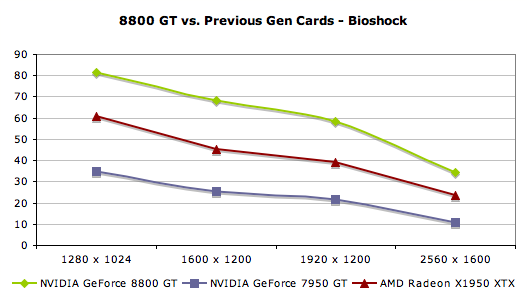
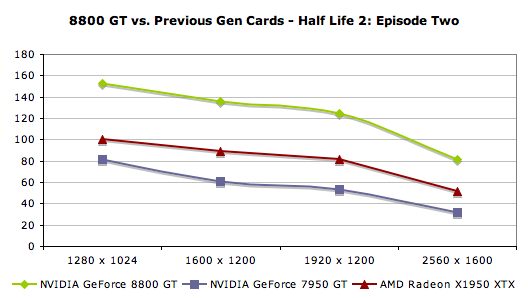
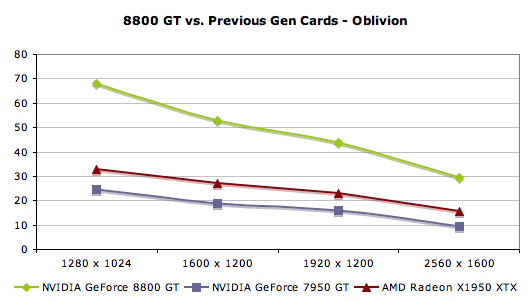
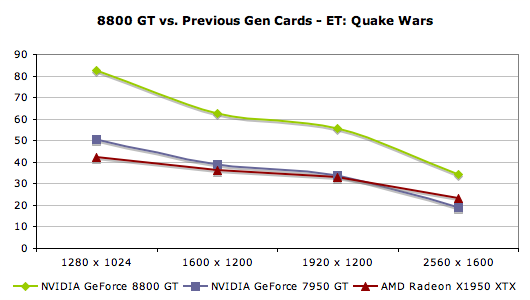
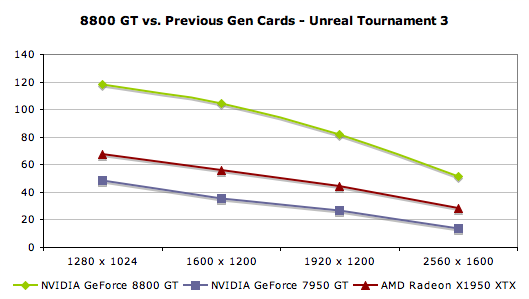
The reason this really makes sense, as we will show in a second, is that the 8800 GT absolutely blows away every DX9 class part out there. The only thing we really need to show is what kind of performance improvement you can expect depending on the type of hardware you own. If you own the best possible previous generation card, you get a very good performance improvement at most resolutions. If you own a previous generation card from the same price segment, you can expect a huge improvement in performance across the board. That said, feast your eyes on what everyone who hasn't upgraded yet can look forward to (in addition to all the added features of the GeForce 8 Series).
Many gamers are likely still rocking either GeForce 7 or Radeon X1k based hardware. We understand that gamers don't have a continuous $250 fund in order to upgrade their graphics card whenever something new comes out. A good many of us have been waiting (and not so patiently) for a DX10 class graphics card in the $200 - $250 range. The 8800 GTS 320MB has been a great option for those who could afford it, but the 8600 GTS and 2600 XT really haven't delivered anything close to the kind of performance we wanted for the price.
We don't expect many people to "upgrade" to an 8800 GT from an 8800 GTS 320MB, we do expect those who spent at least $250+ on a previous generation DX9 class card to be interested in moving up to a current generation product. In order to paint a good picture of what gamers with older hardware can expect, we decided to pick only a couple reference points. While we could have tested everything out there, we felt that looking at the absolute fasted DX9 class card available (the Radeon X1950 XTX) and a card that offered good performance at between $250 and $300 (the GeForce 7950 GT) would give us a fairly complete picture of what to expect.
The reason this really makes sense, as we will show in a second, is that the 8800 GT absolutely blows away every DX9 class part out there. The only thing we really need to show is what kind of performance improvement you can expect depending on the type of hardware you own. If you own the best possible previous generation card, you get a very good performance improvement at most resolutions. If you own a previous generation card from the same price segment, you can expect a huge improvement in performance across the board. That said, feast your eyes on what everyone who hasn't upgraded yet can look forward to (in addition to all the added features of the GeForce 8 Series).
Originally published at https://www.anandtech.com/show/2365 (Wayback Machine).