
TRENDnet TEW-633GR: 802.11n Draft 2.0 to the Rescue
- Posted in
- Networking
Test Results
One impressive result from this router is that it did not experience measurable performance degradation in mixed mode operation. The same could be said about its server to client and client to server performance as the results were nearly identical in each test. Based upon this information, we will not show these results until our next router review that will include compatibility testing between adapter cards.
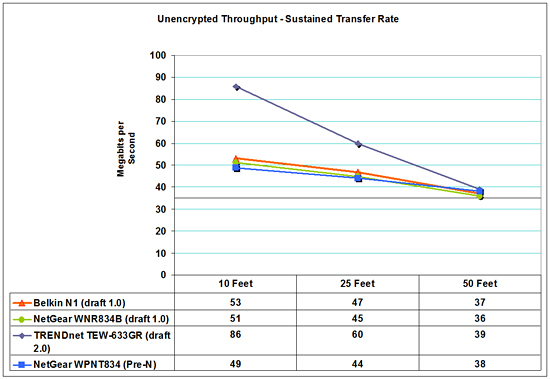
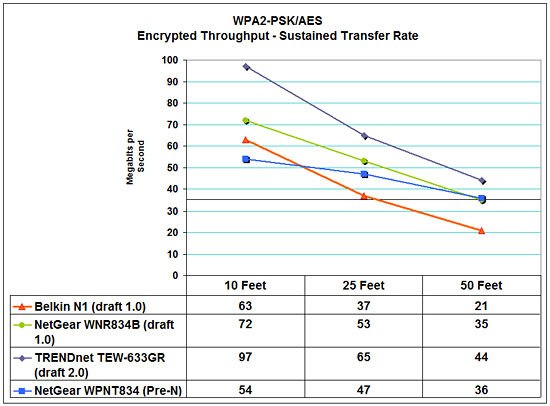
Surprisingly, the router provided consistently higher transfer rates with the use of AES encryption than without, suggesting there definitely is a slight compression advantage to be gained when using the WPA2-PSK protocol with the latest 802.11n draft 2.0 specifications. At these speeds, transferring a 1GB test file to the NAS or the notebook took around two minutes and twenty one seconds.
Utilizing our standard encryption settings, this data transfer rate equates to about 65Mbps on average for the TRENDnet router at 25 feet. This is well below the stated "theoretical" maximum of 300Mbps (reported link speed at time of testing was 243Mbps). This may seem quite low, but these speeds are consistent with expected throughput averages under our test conditions. However, the TRENDnet router still performed up 36% quicker than our original 802.11n draft 1 units. We have experienced sustained transfer rates up to 105Mbps with this router at a 10 foot distance, clear line of sight, and no electrical interference - finally allowing Wi-Fi networking to at least match 100 Mbit Ethernet (in a best-case scenario). One final item worth noting is that the typical 802.11g network connection can usually sustain a maximum of around 24-26 Mbps in best-case conditions - as little as one fourth the speed of Draft-N 2.0.
One impressive result from this router is that it did not experience measurable performance degradation in mixed mode operation. The same could be said about its server to client and client to server performance as the results were nearly identical in each test. Based upon this information, we will not show these results until our next router review that will include compatibility testing between adapter cards.
Surprisingly, the router provided consistently higher transfer rates with the use of AES encryption than without, suggesting there definitely is a slight compression advantage to be gained when using the WPA2-PSK protocol with the latest 802.11n draft 2.0 specifications. At these speeds, transferring a 1GB test file to the NAS or the notebook took around two minutes and twenty one seconds.
Utilizing our standard encryption settings, this data transfer rate equates to about 65Mbps on average for the TRENDnet router at 25 feet. This is well below the stated "theoretical" maximum of 300Mbps (reported link speed at time of testing was 243Mbps). This may seem quite low, but these speeds are consistent with expected throughput averages under our test conditions. However, the TRENDnet router still performed up 36% quicker than our original 802.11n draft 1 units. We have experienced sustained transfer rates up to 105Mbps with this router at a 10 foot distance, clear line of sight, and no electrical interference - finally allowing Wi-Fi networking to at least match 100 Mbit Ethernet (in a best-case scenario). One final item worth noting is that the typical 802.11g network connection can usually sustain a maximum of around 24-26 Mbps in best-case conditions - as little as one fourth the speed of Draft-N 2.0.
Originally published at https://www.anandtech.com/show/2361 (Wayback Machine).