
Foxconn MARS: Lab Update
- Posted in
- Motherboards
Quick Thoughts
The P06 production release BIOS has not really changed the base performance of the board that we experienced with the P03 BIOS. There were some minor improvements that ranged from lower voltage requirements to improved memory and benchmark performance, but we still do not have our 2x2GB or 4x2GB memory configurations working correctly. Foxconn's original statement about the P03 BIOS being representative of the performance we will see from the retail boards and BIOS was right on target. Believe it or not, that is something we rarely see around the labs at this time.
We usually see two patterns develop with the BIOS releases. The first one is a beta that performs incredibly well but has some rough edges or missing features. We normally see performance drop measurably at time of release in order to meet compatibility requirements in this case. The other case is that we see BIOS releases that make you wonder if the board is even worth testing, but eventually the performance and compatibility improves to a point where a release is deemed acceptable.
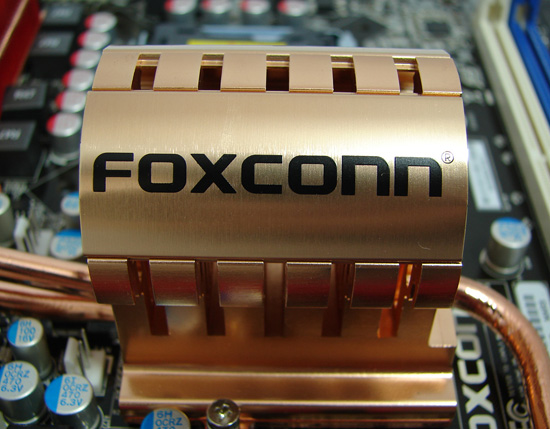
Of course, "acceptable" has different interpretations by manufacturer and ultimately the user has to deal with these differences of opinions. Our goal in the near future is to provide an in-depth look at compatibility, both software and hardware, for each board we test and to move away from granting accolades based on minor performance differences. This is especially true when comparing like chipsets, so the focus will be on platform comparisons, compatibility, features, user experiences, and support while delving deeper into memory, audio, network, and storage performance where applicable. Overclocking performance will be looked at in several different ways depending upon the board so expect to see heavy water-cooling and dual stage cascade results next month on the upper-end enthusiast boards.
Now that we are past that little diatribe, our opinion of the MARS board has not really changed that much after working with the production release BIOS. We are more confident of Foxconn's progress in the mid-range enthusiast sector but have not seen an out of the park hit, yet. The Foxconn MARS board is a very competitive offering that competes well with the abit IP35-Pro, ASUS P5K Deluxe, Gigabyte GA-P35-DQ6, and the MSI P35 Platinum but does not offer anything outstanding that would differentiate it from the crowd.
The MARS board offers basically the same feature set and support of of these other boards and in that context, it will find the current landscape to be extremely competitive. The board that we gravitated towards for a comparison against the MARS board is the abit IP35-Pro (review coming shortly). Looking at the two boards, we feel like Foxconn is going to need to drop their price (estimated MSRP is still $199.99) below that of the abit board while matching its performance and compatibility to garner buyer interest.
With that said, the MARS board is an excellent first step from Foxconn and should be a sturdy foundation to build upon for their next product release. If Foxconn is able to address the outstanding BIOS problems and provide a few of the requested improvements, then we have no issue recommending this board as an alternative choice in the P35 market.
The P06 production release BIOS has not really changed the base performance of the board that we experienced with the P03 BIOS. There were some minor improvements that ranged from lower voltage requirements to improved memory and benchmark performance, but we still do not have our 2x2GB or 4x2GB memory configurations working correctly. Foxconn's original statement about the P03 BIOS being representative of the performance we will see from the retail boards and BIOS was right on target. Believe it or not, that is something we rarely see around the labs at this time.
We usually see two patterns develop with the BIOS releases. The first one is a beta that performs incredibly well but has some rough edges or missing features. We normally see performance drop measurably at time of release in order to meet compatibility requirements in this case. The other case is that we see BIOS releases that make you wonder if the board is even worth testing, but eventually the performance and compatibility improves to a point where a release is deemed acceptable.
Of course, "acceptable" has different interpretations by manufacturer and ultimately the user has to deal with these differences of opinions. Our goal in the near future is to provide an in-depth look at compatibility, both software and hardware, for each board we test and to move away from granting accolades based on minor performance differences. This is especially true when comparing like chipsets, so the focus will be on platform comparisons, compatibility, features, user experiences, and support while delving deeper into memory, audio, network, and storage performance where applicable. Overclocking performance will be looked at in several different ways depending upon the board so expect to see heavy water-cooling and dual stage cascade results next month on the upper-end enthusiast boards.
Now that we are past that little diatribe, our opinion of the MARS board has not really changed that much after working with the production release BIOS. We are more confident of Foxconn's progress in the mid-range enthusiast sector but have not seen an out of the park hit, yet. The Foxconn MARS board is a very competitive offering that competes well with the abit IP35-Pro, ASUS P5K Deluxe, Gigabyte GA-P35-DQ6, and the MSI P35 Platinum but does not offer anything outstanding that would differentiate it from the crowd.
The MARS board offers basically the same feature set and support of of these other boards and in that context, it will find the current landscape to be extremely competitive. The board that we gravitated towards for a comparison against the MARS board is the abit IP35-Pro (review coming shortly). Looking at the two boards, we feel like Foxconn is going to need to drop their price (estimated MSRP is still $199.99) below that of the abit board while matching its performance and compatibility to garner buyer interest.
With that said, the MARS board is an excellent first step from Foxconn and should be a sturdy foundation to build upon for their next product release. If Foxconn is able to address the outstanding BIOS problems and provide a few of the requested improvements, then we have no issue recommending this board as an alternative choice in the P35 market.
Originally published at https://www.anandtech.com/show/2344 (Wayback Machine).