
Midrange CPU Roundup: It's Time to Buy
- Posted in
- CPUs
Motherboards - Affordable and Integrated
The desktop chipset market has evolved over the past few years; it used to be that the bulk of mainstream chipsets were supplied by vendors like SiS and VIA, but now with mature chipsets from AMD and NVIDIA the landscape has changed considerably.
Motherboards with integrated graphics previously were often poor performers, plagued by terrible graphics drivers, but with AMD and NVIDIA running the game now things are different. The integrated graphics drivers are now based off of the same drivers that discrete GPUs use, so overall performance, compatibility and stability are much improved.
How Cheap Can You Go? Intel Chipset Comparison
One thing many users don't realize is that chipsets as much as two generations old can still be made to work with modern day processors. Manufacturers like MSI still offer 945G based motherboards but with Core 2 Duo support, the benefit being a much cheaper motherboard at the slight sacrifice of performance.
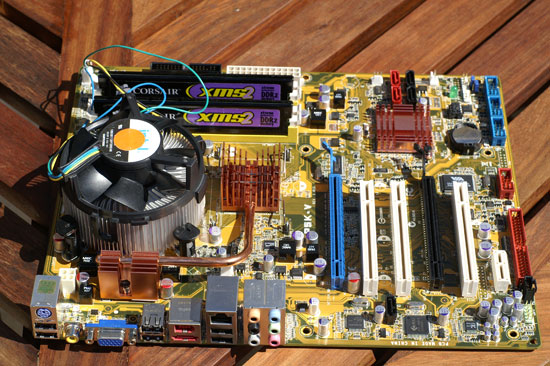
ASUS' P5K-V uses Intel's new G33 chipset
You can get an Intel G33 based motherboard for around $90 - $110, a G965 will cost you around $70 - $100, but you can find a 945G for somewhere around $60 - $70. At the time of publishing, Newegg even had an open box buy for $40.
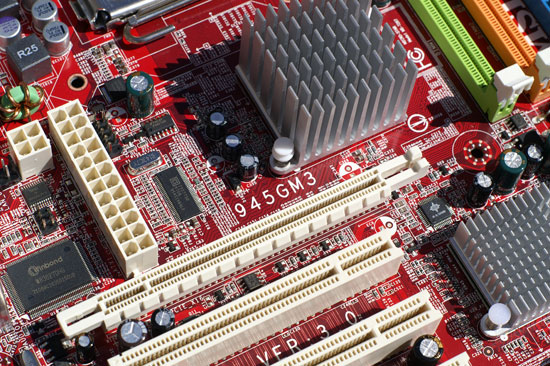
MSI is still shipping 945G based motherboards with Conroe support
The question is, how much performance do you give up by going with an older chipset? The focus of today's article is mostly CPU performance but let's look at a few general purpose benchmarks. The Intel chipset results are extremely self explanatory:
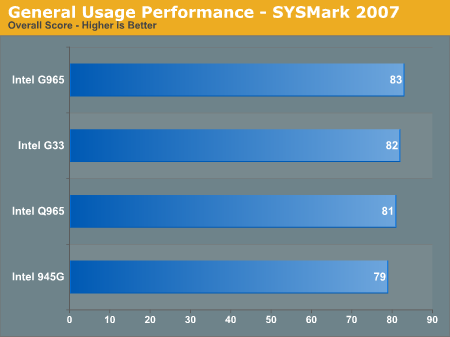
There are minor performance differences between the chipsets, mostly because memory and chipset technology hasn't changed dramatically over the past two generations. There have been significant improvements in Intel's integrated graphics, but if you're building a headless machine or something where you don't need a minimum level of 3D graphics performance then any of these Intel chipsets will work just fine. The 945G falls behind the most because the fastest memory we can use in it is DDR2-667, whereas all of the other chipsets officially support DDR2-800. If you're building a cheap second system or a fileserver though, the performance difference honestly doesn't matter.
The desktop chipset market has evolved over the past few years; it used to be that the bulk of mainstream chipsets were supplied by vendors like SiS and VIA, but now with mature chipsets from AMD and NVIDIA the landscape has changed considerably.
Motherboards with integrated graphics previously were often poor performers, plagued by terrible graphics drivers, but with AMD and NVIDIA running the game now things are different. The integrated graphics drivers are now based off of the same drivers that discrete GPUs use, so overall performance, compatibility and stability are much improved.
How Cheap Can You Go? Intel Chipset Comparison
One thing many users don't realize is that chipsets as much as two generations old can still be made to work with modern day processors. Manufacturers like MSI still offer 945G based motherboards but with Core 2 Duo support, the benefit being a much cheaper motherboard at the slight sacrifice of performance.
ASUS' P5K-V uses Intel's new G33 chipset
You can get an Intel G33 based motherboard for around $90 - $110, a G965 will cost you around $70 - $100, but you can find a 945G for somewhere around $60 - $70. At the time of publishing, Newegg even had an open box buy for $40.
MSI is still shipping 945G based motherboards with Conroe support
The question is, how much performance do you give up by going with an older chipset? The focus of today's article is mostly CPU performance but let's look at a few general purpose benchmarks. The Intel chipset results are extremely self explanatory:
There are minor performance differences between the chipsets, mostly because memory and chipset technology hasn't changed dramatically over the past two generations. There have been significant improvements in Intel's integrated graphics, but if you're building a headless machine or something where you don't need a minimum level of 3D graphics performance then any of these Intel chipsets will work just fine. The 945G falls behind the most because the fastest memory we can use in it is DDR2-667, whereas all of the other chipsets officially support DDR2-800. If you're building a cheap second system or a fileserver though, the performance difference honestly doesn't matter.
Originally published at https://www.anandtech.com/show/2340 (Wayback Machine).