
AMD's Opteron hits 3.2GHz
- Posted in
- IT Computing
A Closer Look at AMD's Newest Offering
AMD thus brings four new CPUs into the server space:
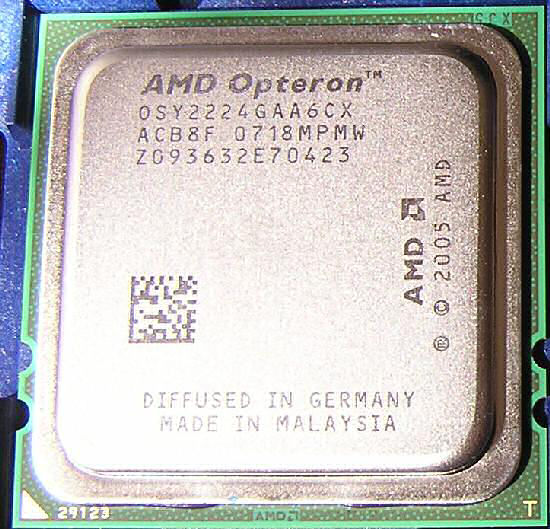
The Opteron 2224 package
To position AMD's new Opteron 2224 offering we take a look at the most interesting Intel and AMD CPUs at the current date.
So basically, AMD's 120W Dual core 3.2GHz Opteron has to prove that it is a worthy competitor to two Intel offerings:
This means that the software only has to make use of two CPU cores (eight cores needs four instances), which is a lot easier than making use of all eight cores in a single instance. This kind of "multi instance" benchmarking may reflect the way quite a few people and businesses use their servers, but at the same time such benchmarks can paint a picture that is far too optimistic for those people who are only running one application on their server.
Secondly, it might seem like a dual Opteron 2224 needs 80W more, but the reality is different. Intel's Northbridge consumes up to 20W more, and each FB-DIMM needs about 5W more than the DDR modules the AMD platform uses. So the difference is not as big as it might seem at first, something we have shown in a previous article. The AMD CPUs also scale back to 1GHz when running at idle, while the Intel CPUs run at 1.6 or 2GHz when idle. As a result the AMD platforms can consume less power when idle or at lower loads.
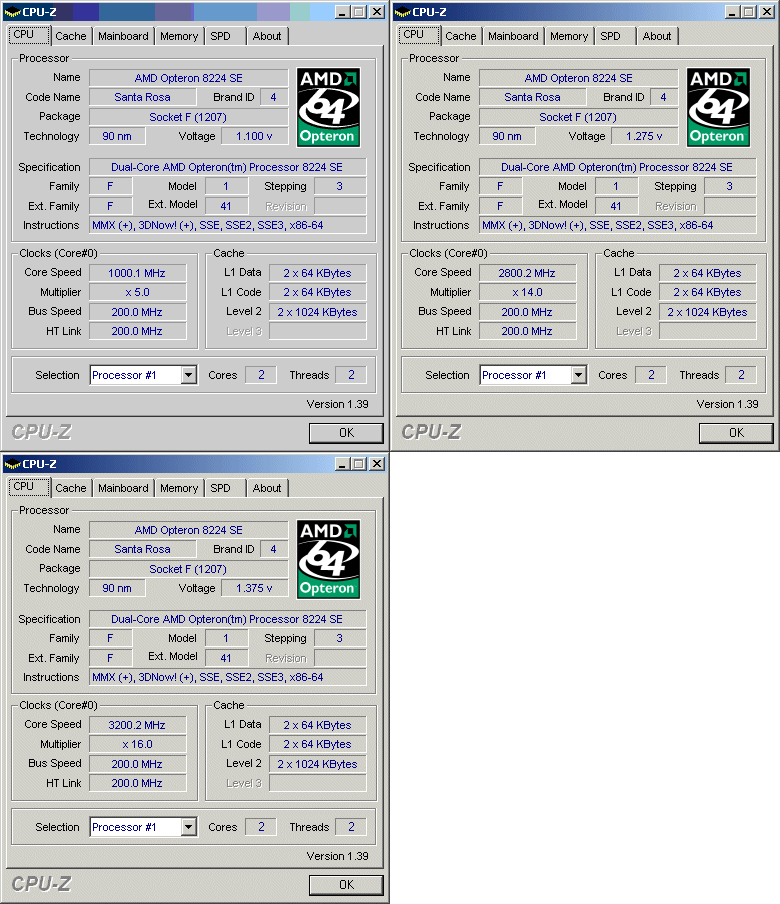
The Opteron runs now at 3.2GHz
As you can see in the animated gif above, the CPU is capable of scaling back to 1GHz and 1.1V. It can also run at 2.8GHz at 1.275V, and it needs 1.375V to run at 3.2GHz. PowerNow! enables it to run at any frequency between 1.6GHz to 2.8GHz in steps of 200MHz. Keep this in mind when we look at some power figures later on.
AMD thus brings four new CPUs into the server space:
- A 3.2GHz Opteron which consumes at most 120W, in dual and quad/octal socket versions
- A 3GHz Opteron 8222 and 2222 which used to consume up to 120W, but which are - thanks to process improvements - now limited to 95W
The Opteron 2224 package
To position AMD's new Opteron 2224 offering we take a look at the most interesting Intel and AMD CPUs at the current date.
| Intel Processor Overview | ||||||||
| Intel CPU | Clock | Codename | L2 | L3 | FSB | Mem bandwidth | TDP | Price |
| Dual NetBurst CPUs | ||||||||
| Xeon MP 7140M | 3.4GHz | Tulsa | 2x1MB | 16MB | 200MHz Quad | 6.4 GB/s | 150W | $1,980 |
| Xeon MP 7130M | 3.2GHz | Tulsa | 2x1MB | 8MB | 200MHz Quad | 6.4 GB/s | 150W | $1,391 |
| Xeon MP 7120M | 3GHz | Tulsa | 2x1MB | 4MB | 200MHz Quad | 6.4 GB/s | 95W | $1,117 |
| Quad Core CPUs | ||||||||
| Xeon E5355 | 2.66GHz | Clovertown | 2x4MB | - | 333MHz Quad | 21 GB/s | 120W | $1,172 |
| Xeon E5345 | 2.33GHz | Clovertown | 2x4MB | - | 333MHz Quad | 21 GB/s | 80W | $851 |
| Xeon E5320 | 1.86GHz | Clovertown | 2x4MB | - | 266MHz Quad | 17 GB/s | 80W | $690 |
| Dual Core CPUs | ||||||||
| Xeon DP 5160 | 3GHz | Woodcrest | 4MB | - | 333MHz Quad | 21 GB/s | 80W | $851 |
| Xeon DP 5150 | 2.66GHz | Woodcrest | 4MB | - | 333MHz Quad | 21 GB/s | 65W | $690 |
| Xeon DP 5148 | 2.33GHz | Woodcrest | 4MB | - | 333MHz Quad | 21 GB/s | 40W | $519 |
| AMD Processor Overview | ||||||||
| AMD CPU | Clock | Codename | L2 | L3 | HT | Mem bandwidth | TDP | Price |
| Eight-Way CPUs | ||||||||
| Opteron 8224 SE | 3.2GHz | Santa Rosa | 2x1MB | - | 1000MHz DDR | 10.6 GB/s | 119W | $2,149 |
| Opteron 8222 | 3GHz | Santa Rosa | 2x1MB | - | 1000MHz DDR | 10.6 GB/s | 95W | $1,514 |
| Opteron 8220 | 2.8GHz | Santa Rosa | 2x1MB | - | 1000MHz DDR | 10.6 GB/s | 95W | $1,165 |
| Opteron 8218 | 2.6GHz | Santa Rosa | 2x1MB | - | 1000MHz DDR | 10.6 GB/s | 95W | $873 |
| Opteron 8218 HE | 2.6GHz | Santa Rosa | 2x1MB | - | 1000MHz DDR | 10.6 GB/s | 68W | $1,019 |
| Two-Way CPUs | ||||||||
| Opteron 2224 SE | 3.2GHz | Santa Rosa | 2x1MB | - | 1000MHz DDR | 10.6 GB/s | 119W | $873 |
| Opteron 2222 | 3GHz | Santa Rosa | 2x1MB | - | 1000MHz DDR | 10.6 GB/s | 95W | $698 |
| Opteron 2220 | 2.8GHz | Santa Rosa | 2x1MB | - | 1000MHz DDR | 10.6 GB/s | 95W | $523 |
| Opteron 2218 | 2.6GHz | Santa Rosa | 2x1MB | - | 1000MHz DDR | 10.6 GB/s | 95W | $377 |
| Opteron 2218 HE | 2.6GHz | Santa Rosa | 2x1MB | - | 1000MHz DDR | 10.6 GB/s | 68W | $450 |
So basically, AMD's 120W Dual core 3.2GHz Opteron has to prove that it is a worthy competitor to two Intel offerings:
- The dual core Xeon 5160 3GHz with a TDP of 80W
- The quad core Xeon 5345 2.33 with a TDP of 80W
This means that the software only has to make use of two CPU cores (eight cores needs four instances), which is a lot easier than making use of all eight cores in a single instance. This kind of "multi instance" benchmarking may reflect the way quite a few people and businesses use their servers, but at the same time such benchmarks can paint a picture that is far too optimistic for those people who are only running one application on their server.
Secondly, it might seem like a dual Opteron 2224 needs 80W more, but the reality is different. Intel's Northbridge consumes up to 20W more, and each FB-DIMM needs about 5W more than the DDR modules the AMD platform uses. So the difference is not as big as it might seem at first, something we have shown in a previous article. The AMD CPUs also scale back to 1GHz when running at idle, while the Intel CPUs run at 1.6 or 2GHz when idle. As a result the AMD platforms can consume less power when idle or at lower loads.
The Opteron runs now at 3.2GHz
As you can see in the animated gif above, the CPU is capable of scaling back to 1GHz and 1.1V. It can also run at 2.8GHz at 1.275V, and it needs 1.375V to run at 3.2GHz. PowerNow! enables it to run at any frequency between 1.6GHz to 2.8GHz in steps of 200MHz. Keep this in mind when we look at some power figures later on.
Originally published at https://www.anandtech.com/show/2294 (Wayback Machine).