
One Laptop Per Child: Charity, Prosperity, & Capitalism In The Developing World
- Posted in
- Laptops
AMD's Stake
As we've alluded to in the title, the OLPC is about charity, prosperity, and capitalism. The software is the charity, the end results of the program are the prosperity, and the companies backing the OLPC like AMD are the capitalism. AMD has made it clear in press and business reports how it intends to leverage the XO-1 and its own technologies for business purposes, so we'd like to touch on exactly what AMD's stake is in everything.
There are two real extremes in turning a profit in the computer chip industry. One is to sell a small number of high profit chips; this is the server industry, where AMD has not had the best of luck lately (though Opteron did pretty well back in Intel's NetBurst days). The other is to sell a large number of low profit chips, an area that is traditionally represented by AMD, though at times they have been victim to these low profits being a little too low.
While not in any way giving up on the high-end, AMD is also looking to capitalize on expanding their stake in the low-end, looking for new markets in that area instead of taking Intel on directly. The focal point of that desire is the AMD 50x15 program, an initiative to bring internet access to 50% of the world's population by 2015. Participating in the OLPC program is one such way to reach that goal, but the OLPC program will never ship enough laptops on its own to reach that goal, never mind that as a non-profit program AMD will not be making any money on the XO-1.
However, much of the first 50% is composed of developing societies that have rapidly growing economies, improving electricity coverage, and an expanding middle class. In other words, there are a lot of people finally entering financial situations where they have the kind of income to afford luxury goods like computers. Over the past two years, and again reiterated in their Q2'07 financial report and even by Hector Ruiz himself on CNBC, AMD has stated their intentions to claim a large piece of the computer market that is forming in these societies as one of their profitable enterprises.
Getting into these markets requires computers priced similar to the XO-1, which is why AMD believes they have an advantage over Intel in this pursuit. The XO-1 is a roadmap for how to build such a computer today, and AMD intends to follow it after their first effort, the Personal Internet Communicator, failed to take off. Thanks to the XO-1 AMD can already build a computer to meet their immediate goals, and we'd imagine they're looking forward to Quanta's XO-1 variant going on sale.
AMD's story doesn't end there, as reaching their 2015 goal will also require new technology. As far as the $100 price target is concerned, the holy grail is a complete x86 system-on-chip as a SoC minimizes the number of parts that need to be manufactured and the electronics needed to connect them. Their current Geode processor is close to this in design, but is heavily lacking in performance due to its decade-old design. AMD has decided not to try to further upgrade the Geode and instead build a new SoC x86 processor, culminating in Fusion.
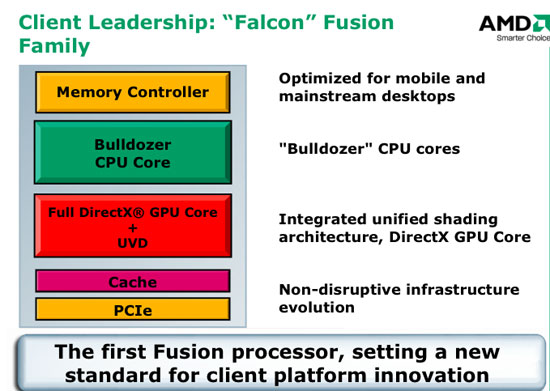
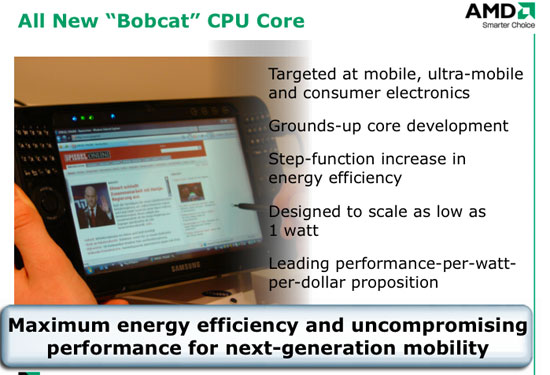
As we saw last week in AMD's Analyst Day presentation, AMD announced Bobcat, their ultra-low-power ultra-simple x86 processor intended for mobile devices. When put in a Fusion design with a proper low-power graphics core and Northbridge, a Fusion Bobcat will be capable of power usage similar to the current Geode, but with far better performance in all areas. This is critical for entering the mass market in developing nations, as users will want to use more mainstream software than the Geode can handle.
Keep in mind, none of this is to vilify AMD. Capitalism is a very powerful force to drive and spread progress. AMD's 50x15 goal is extremely lofty and not everything is in their hands, but from what we've seen with their technology they're going to be able to create the chips they need to reach their goal. This ultimately results in many students and children benefiting today from the XO-1, many more people tomorrow from Fusion Bobcat, and then yet again more in the future when Fusion Bobcat finds its way into the successor to the XO-1. It's only a question of whether or not AMD can make the kinds of profit they're shooting for from this project that remains to be seen.
Originally published at https://www.anandtech.com/show/2292 (Wayback Machine).