
Low Power Server CPU Shoot-out
- Posted in
- IT Computing
Benchmarking Low Voltage
In our last review we tested with Power Management features turned off, and also with them turned on. Since this article is focused on low power parts, and the industry is mostly focused on Performance/Watt, we decided we would only report results with all Power Management features enabled.
To configure our servers with all Power Management features on, we perform the following:
On Intel
In the BIOS ensure that Thermal Management is On/Enabled, C1 Enhanced Mode is On/Enabled, and EIST Support is On/Enabled.
On AMD
In the BIOS ensure that PowerNow is On/Enabled. Additionally, you must install the Processor Driver, from AMD, in your OS.
For both platforms you must also set the Power Options in Control Panel to "Server Balanced Processor Power and Performance".
We wanted to measure the impact that the Power Management features had on a system at idle. The following graph shows the results.
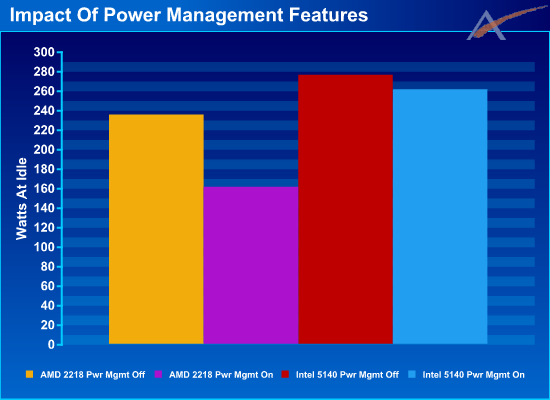
With all Power Management features turned on, the AMD system uses 31% less power at idle than with the Power Management Features turned off. The Intel system on the other hand only uses 5% less with all Power Management features turned on, and this is still 62% more power than the AMD system.
More on this later; first we want to explore the benefit on system power that the low power parts have. With all Power Management features turned on we recorded idle power usage for the same clocked parts for the regular and low power parts.
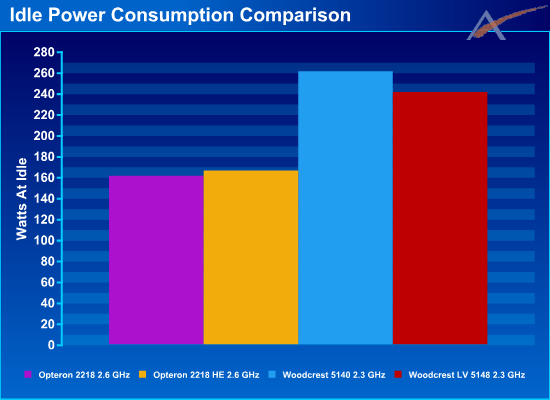
In the case of AMD, the low power parts actually consume 5 more watts, 2.5 watts/socket. We verified this a few times, and each time the results were consistent. We discussed this with AMD, and they were more concerned with the power consumption results under load, which we will get to in a few slides.
In the case of Intel, the low power parts use 20 watts less, 10 watts/socket. Again, this is at idle.
At the system level, the best savings at idle is only 8%. Is that consistent with what we will see under load? We will look at that shortly to find out.
During the testing, we often speculate about where all the power goes. We attempted to find out by measuring power consumption of the entire system at idle, then removing a component and re-measuring the power consumption. The difference in power can be attributed to the removed component. This is not a perfect way to determine component power requirements, but it does provide some general guidance as to where all of the power goes. The results are very interesting:
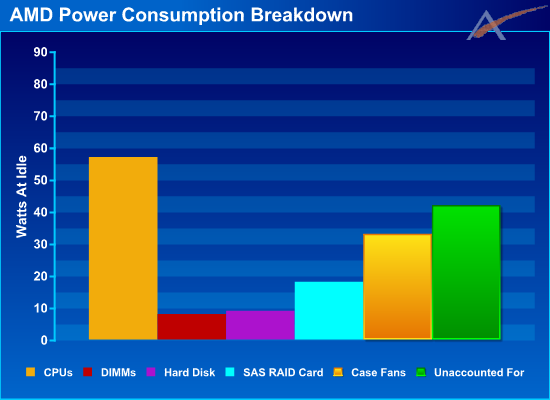
In the AMD system we see that the bulk of the power is consumed by the idle CPUs. Overlooking the "Unaccounted For", the next biggest consumer is the 5 case fans, followed by the SAS RAID Card. The "Unaccounted For" is everything which is not listed, including the inefficiency of the power supply and the motherboard and chipset.
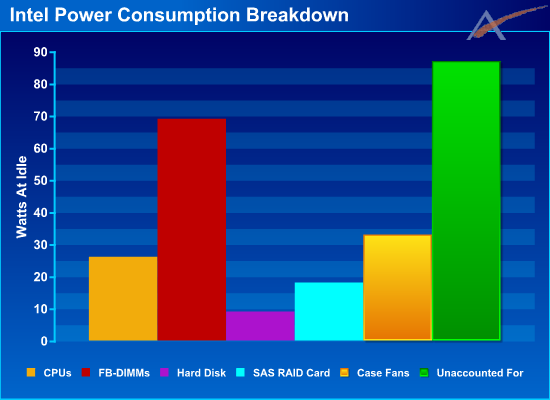
In the Intel system we see that the CPUs require significantly less power than the AMD CPUs, 54% less to be exact. On the other hand the FB-DIMMs require 862% more power than the AMD DIMMs. (Yikes!) Also, the "Unaccounted For" is twice as much on the Intel system as the AMD system. Keep in mind both of these systems have identical power supplies, so the efficiency is roughly the same.
Choosing the contenders
In previous articles, we've been asked to explain why we chose the parts we did for an article. For this article we used the highest clocked low power parts from both Intel and AMD, and equally clocked regular power parts for comparison. With equally clocked parts, it allows us to see that there is virtually no performance difference between low voltage parts and regular voltage parts. It also allows us to clearly determine the power savings of low power processors.
In our last review we tested with Power Management features turned off, and also with them turned on. Since this article is focused on low power parts, and the industry is mostly focused on Performance/Watt, we decided we would only report results with all Power Management features enabled.
To configure our servers with all Power Management features on, we perform the following:
On Intel
In the BIOS ensure that Thermal Management is On/Enabled, C1 Enhanced Mode is On/Enabled, and EIST Support is On/Enabled.
On AMD
In the BIOS ensure that PowerNow is On/Enabled. Additionally, you must install the Processor Driver, from AMD, in your OS.
For both platforms you must also set the Power Options in Control Panel to "Server Balanced Processor Power and Performance".
We wanted to measure the impact that the Power Management features had on a system at idle. The following graph shows the results.
With all Power Management features turned on, the AMD system uses 31% less power at idle than with the Power Management Features turned off. The Intel system on the other hand only uses 5% less with all Power Management features turned on, and this is still 62% more power than the AMD system.
More on this later; first we want to explore the benefit on system power that the low power parts have. With all Power Management features turned on we recorded idle power usage for the same clocked parts for the regular and low power parts.
In the case of AMD, the low power parts actually consume 5 more watts, 2.5 watts/socket. We verified this a few times, and each time the results were consistent. We discussed this with AMD, and they were more concerned with the power consumption results under load, which we will get to in a few slides.
In the case of Intel, the low power parts use 20 watts less, 10 watts/socket. Again, this is at idle.
At the system level, the best savings at idle is only 8%. Is that consistent with what we will see under load? We will look at that shortly to find out.
During the testing, we often speculate about where all the power goes. We attempted to find out by measuring power consumption of the entire system at idle, then removing a component and re-measuring the power consumption. The difference in power can be attributed to the removed component. This is not a perfect way to determine component power requirements, but it does provide some general guidance as to where all of the power goes. The results are very interesting:
In the AMD system we see that the bulk of the power is consumed by the idle CPUs. Overlooking the "Unaccounted For", the next biggest consumer is the 5 case fans, followed by the SAS RAID Card. The "Unaccounted For" is everything which is not listed, including the inefficiency of the power supply and the motherboard and chipset.
In the Intel system we see that the CPUs require significantly less power than the AMD CPUs, 54% less to be exact. On the other hand the FB-DIMMs require 862% more power than the AMD DIMMs. (Yikes!) Also, the "Unaccounted For" is twice as much on the Intel system as the AMD system. Keep in mind both of these systems have identical power supplies, so the efficiency is roughly the same.
Choosing the contenders
In previous articles, we've been asked to explain why we chose the parts we did for an article. For this article we used the highest clocked low power parts from both Intel and AMD, and equally clocked regular power parts for comparison. With equally clocked parts, it allows us to see that there is virtually no performance difference between low voltage parts and regular voltage parts. It also allows us to clearly determine the power savings of low power processors.
Originally published at https://www.anandtech.com/show/2277 (Wayback Machine).