
Intel Core 2 Extreme QX6850 and Massive Price Cuts
- Posted in
- CPUs
Do Four Cores Need a 1333MHz FSB?
AMD likes to call Intel's quad-core "fake" due to the fact that the chips themselves are composed of two independent dual-core die on a single package. Intel has used this multi-die package approach ever since the dual-core days in order to get CPUs to market quicker and do so at a lower cost. While Intel will eventually move to a single die quad-core design, its current designs are made up of two individual dual-core die.
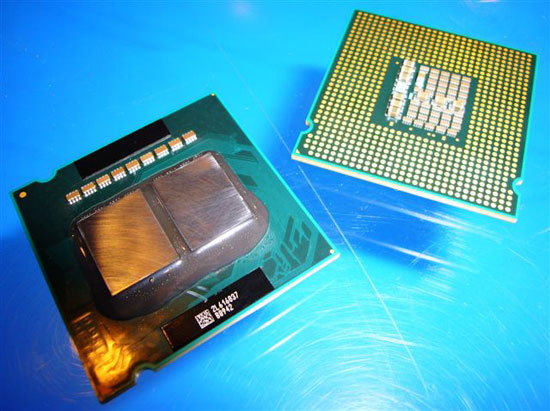
The problem with Intel's approach is that all traffic from one pair of cores to the next has to go over the FSB, whereas AMD's quad-core Barcelona design places all four cores behind a shared L3 cache. With a single socket quad-core chip, FSB bandwidth is already at a premium given that four cores have to share the same amount of FSB bandwidth that two cores do in a dual-core system. In theory, Intel's quad-core CPUs could stand to benefit more from a 1333MHz FSB than their dual-core counterparts. You may remember from our review of the Core 2 Duo E6750 that the 1333MHz FSB only accounted for an average performance improvement of 1.9% over the 1066MHz FSB, but would things change with four cores running on the other end of that FSB?
To find out we compared the Core 2 Extreme QX6850 to the Core 2 Extreme QX6800, the former running at 3.0GHz on a 1333MHz FSB and the latter 2.93GHz/1066MHz. There is a 2.3% increase in clock speed that the QX6850 enjoys over the QX6800, but we can easily take that into account when looking at the margin of victory in our tests.
The chart below shows the performance increase the QX6850 sees over the QX6800 across our entire suite of benchmarks:
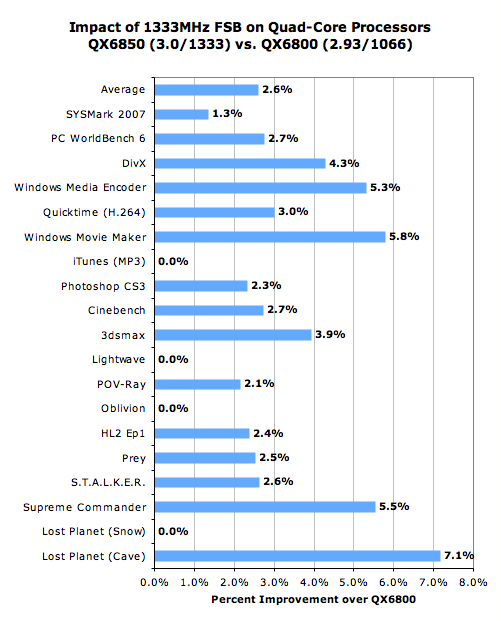
The faster FSB appears to do a little more with the quad-core QX6850 than we saw on the dual core E6750. The performance advantage is not tremendous, amounting to little more than low single-digit percentage point advantages across the board. Taking into account the ~2.2% increase in clock speed that accompanies the QX6850, an average of around a 2% increase in performance is what we'd attribute to the faster FSB.
By no means is it earth shattering or necessary for that point, at least not at these clock speeds. However, given the direction Intel is going in, if you're building a new system today you'll obviously want to opt for a 1333MHz FSB processor. Current quad-core owners shouldn't feel pressure to upgrade, the faster FSB does very little for performance.
Originally published at https://www.anandtech.com/show/2276 (Wayback Machine).