
Real World DirectX 10 Performance: It Ain't Pretty
- Posted in
- GPUs
Company of Heroes
While Company of Heroes was first out of the gate with a DirectX 10 version, Relic didn't simply recompile their DX9 code for DX10; Company of Heroes was planned for DX10 from the start before there was any hardware available to test with. We are told that it's quite difficult to develop a game when going only by the specifications of the API. Apparently Relic was very aggressive in their use of DX10 specific features and had to scale back their effort to better fit the actual hardware that ended up hitting the street.
In spite of the fact that Microsoft requires support for specific features in order to be certified as a DX10 part, requiring a minimum level of performance for features is not part of the deal. This certainly made it hard for early adopters to produce workable code before the arrival of hardware, as developers had no idea which features would run fastest and most efficiently.
In the end, a lot of the DX10 specific features included in CoH had to be rewritten in a way that could have been implemented on DX9 as well. That's not to say that DX10 exclusive features aren't there (they do make use of geometry shaders in new effects); it's just that doing things in a way similar to how they are currently done offers better performance and consistency between hardware platforms. Let's take a look at some of what has been added in with the DX10 version.
The lighting model has been upgraded to be completely per pixel with softer and more shadows. All lights can cast shadows, making night scenes more detailed than on the DX9 version. These shadows are created by generating cube maps on the fly from each light source and using a combination of instancing and geometry shading to create the effect.
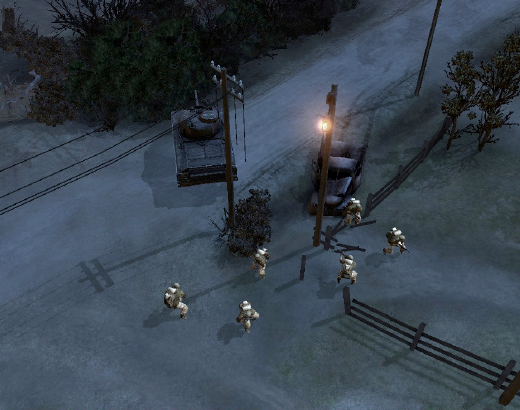
Company of Heroes DirectX 9
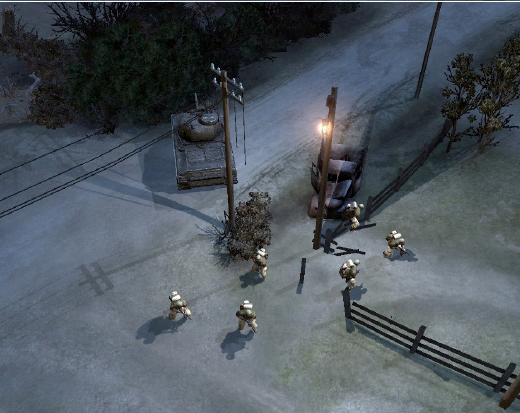
Company of Heroes DirectX 10
There is more debris and grass around levels to add detail to terrain. Rather than textures, actual geometry is used (through instancing and geometry shaders) to create procedurally generated "litter" like rocks and short grass.
Triple buffering is enabled by default, but has been disabled (along with vsync) for our tests.
We discovered that our cards with 256MB of RAM or less had trouble running with 4xAA and DirectX 10. Apparently this is a known issue with CoH on 32-bit Vista running out of addressable memory. Relic says the solution is to switch to the 64-bit version of the OS, which we haven't had time to test out quite yet.
DirectX 9 Tests
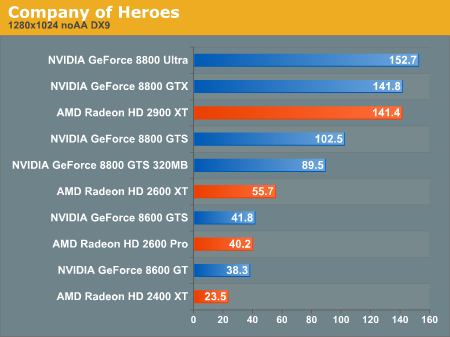
Company of Heroes DX9 Performance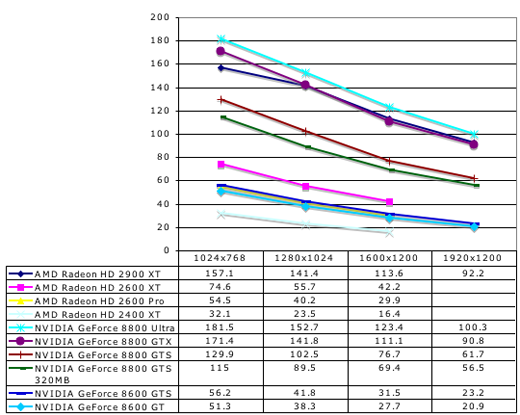
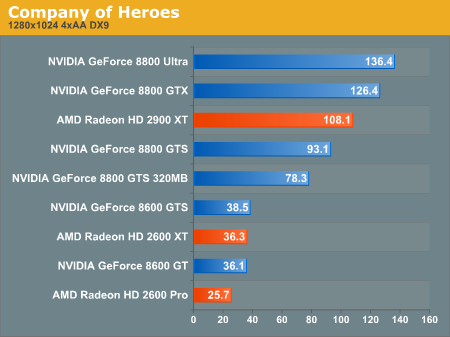
Company of Heroes 4xAA DX9 Performance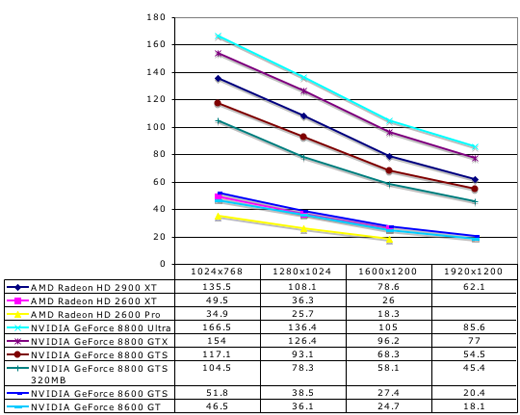
Under DX9, the Radeon HD 2900 XT performs quite well when running Company of Heroes. The card is able to keep up with the 8800 GTX here. In spite of a little heavier hit from enabling 4xAA, the 2900 XT still manages to best it's 8800 GTS competition. But the story changes when we move to DX10.
DirectX 10 Tests
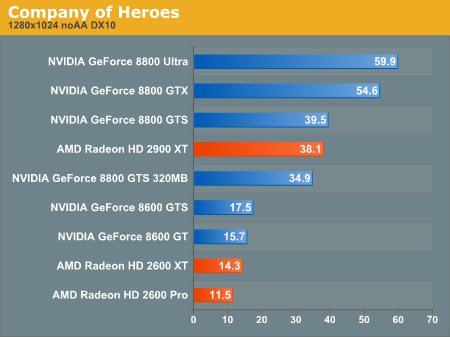
Company of Heroes DX10 Performance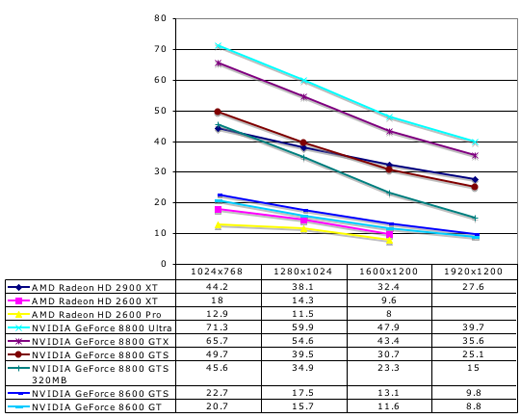
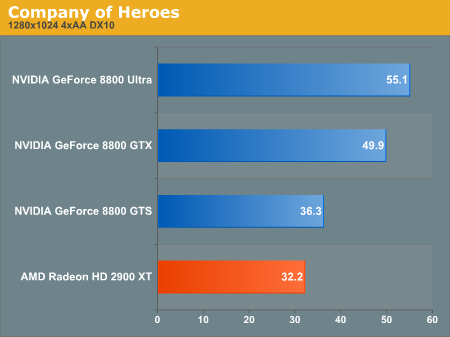
Company of Heroes 4xAA DX10 Performance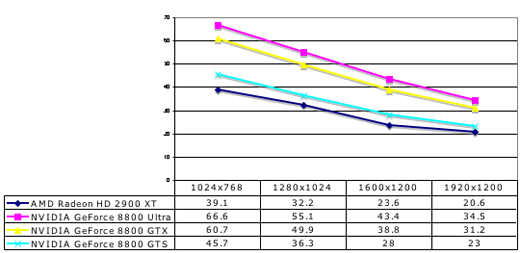
When running with all the DX10 features enabled, the HD 2900 XT falls to just below the performance of the GeForce 8800 GTS. Once again, the low-end NVIDIA and AMD cards are unable to run at playable framerates under DX10, though the NVIDIA cards do lead AMD.
Enabling 4xAA further hurts the 2900 XT relative to the rest of the pack. We will try to stick with Windows Vista x64 in the future in order to run numbers with this game on hardware with less RAM.
While Company of Heroes was first out of the gate with a DirectX 10 version, Relic didn't simply recompile their DX9 code for DX10; Company of Heroes was planned for DX10 from the start before there was any hardware available to test with. We are told that it's quite difficult to develop a game when going only by the specifications of the API. Apparently Relic was very aggressive in their use of DX10 specific features and had to scale back their effort to better fit the actual hardware that ended up hitting the street.
In spite of the fact that Microsoft requires support for specific features in order to be certified as a DX10 part, requiring a minimum level of performance for features is not part of the deal. This certainly made it hard for early adopters to produce workable code before the arrival of hardware, as developers had no idea which features would run fastest and most efficiently.
In the end, a lot of the DX10 specific features included in CoH had to be rewritten in a way that could have been implemented on DX9 as well. That's not to say that DX10 exclusive features aren't there (they do make use of geometry shaders in new effects); it's just that doing things in a way similar to how they are currently done offers better performance and consistency between hardware platforms. Let's take a look at some of what has been added in with the DX10 version.
The lighting model has been upgraded to be completely per pixel with softer and more shadows. All lights can cast shadows, making night scenes more detailed than on the DX9 version. These shadows are created by generating cube maps on the fly from each light source and using a combination of instancing and geometry shading to create the effect.
Company of Heroes DirectX 9
Company of Heroes DirectX 10
There is more debris and grass around levels to add detail to terrain. Rather than textures, actual geometry is used (through instancing and geometry shaders) to create procedurally generated "litter" like rocks and short grass.
Triple buffering is enabled by default, but has been disabled (along with vsync) for our tests.
We discovered that our cards with 256MB of RAM or less had trouble running with 4xAA and DirectX 10. Apparently this is a known issue with CoH on 32-bit Vista running out of addressable memory. Relic says the solution is to switch to the 64-bit version of the OS, which we haven't had time to test out quite yet.
DirectX 9 Tests
Under DX9, the Radeon HD 2900 XT performs quite well when running Company of Heroes. The card is able to keep up with the 8800 GTX here. In spite of a little heavier hit from enabling 4xAA, the 2900 XT still manages to best it's 8800 GTS competition. But the story changes when we move to DX10.
DirectX 10 Tests
When running with all the DX10 features enabled, the HD 2900 XT falls to just below the performance of the GeForce 8800 GTS. Once again, the low-end NVIDIA and AMD cards are unable to run at playable framerates under DX10, though the NVIDIA cards do lead AMD.
Enabling 4xAA further hurts the 2900 XT relative to the rest of the pack. We will try to stick with Windows Vista x64 in the future in order to run numbers with this game on hardware with less RAM.
Originally published at https://www.anandtech.com/show/2267 (Wayback Machine).