
More Mainstream DX10: AMD's 2400 and 2600 Series
- Posted in
- GPUs
The Test and Power
We will only be looking at DX9 performance under Windows XP today. This is still the platform of choice for gamers, and thus very important to examine. This doesn't mean we are ignoring DX10. We have a follow-up article on DX10 performance coming down the pipe next week. Here we'll take a look at how these cards stack up against the currently available DX10 games and demos.
We are also planning to look at UVD vs. PureVideo in a follow up article. Video decode is an important feature of these cards and we are interested in seeing how NVIDIA and AMD hardware stacks up against each other. Please stay tuned for this article as well.
For this series of tests, we used the following setup:
Performance Test Configuration:
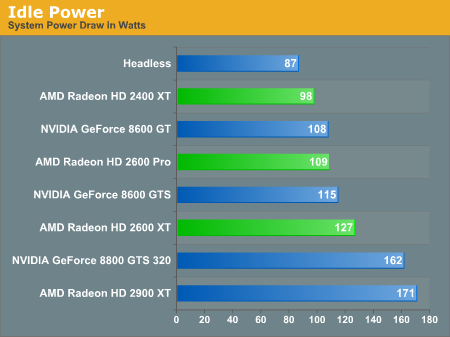
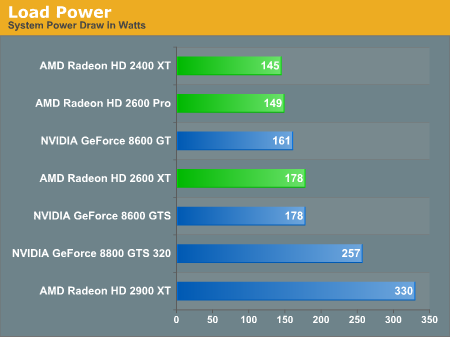
As for power, the 65nm AMD hardware shows rather unimpressive results. At idle, both the 8600 GTS and 8600 GT draw less power than the 2600 XT and 2600 Pro respectively. Under load we see the AMD parts become more competitive in terms of low power. Not even 65nm can help push the 2600 XT past the 8600 GTS in terms of power draw though.
As for our game tests, first we'll take a look at how only the new AMD HD series parts stack up against NVIDIA's 8 series competitors. Following that we'll break down test by game and show performance verses previous and current generation hardware.
We will only be looking at DX9 performance under Windows XP today. This is still the platform of choice for gamers, and thus very important to examine. This doesn't mean we are ignoring DX10. We have a follow-up article on DX10 performance coming down the pipe next week. Here we'll take a look at how these cards stack up against the currently available DX10 games and demos.
We are also planning to look at UVD vs. PureVideo in a follow up article. Video decode is an important feature of these cards and we are interested in seeing how NVIDIA and AMD hardware stacks up against each other. Please stay tuned for this article as well.
For this series of tests, we used the following setup:
Performance Test Configuration:
| CPU: | Intel Core 2 Extreme X6800 (2.93GHz/4MB) |
| Motherboard: | ASUS P5W-DH |
| Chipset: | Intel 975X |
| Chipset Drivers: | Intel 8.2.0.1014 |
| Hard Disk: | Seagate 7200.7 160GB SATA |
| Memory: | Corsair XMS2 DDR2-800 4-4-4-12 (1GB x 2) |
| Video Card: | Various |
| Video Drivers: | ATI Catalyst 8.38.9.1-rc2 NVIDIA ForceWare 158.22 |
| Desktop Resolution: | 1280 x 800 - 32-bit @ 60Hz |
| OS: | Windows XP Professional SP2 |
As for power, the 65nm AMD hardware shows rather unimpressive results. At idle, both the 8600 GTS and 8600 GT draw less power than the 2600 XT and 2600 Pro respectively. Under load we see the AMD parts become more competitive in terms of low power. Not even 65nm can help push the 2600 XT past the 8600 GTS in terms of power draw though.
As for our game tests, first we'll take a look at how only the new AMD HD series parts stack up against NVIDIA's 8 series competitors. Following that we'll break down test by game and show performance verses previous and current generation hardware.
Originally published at https://www.anandtech.com/show/2261 (Wayback Machine).