
AnandTech Power Supply Test Methodology
- Posted in
- Cases/Cooling/PSUs
The Testing Environment
There is one flaw in testing power supplies with programmable loads and while trying to test the sound pressure levels at the same time. Because the programmable loads get very loud there is no chance to even hear the power supply on the test stand. In order to make accurate measurements of the noise levels we needed a way to separate the test unit and the programmable loads. Our solution was to build a very thick box around the unit.
We concluded that a five-layer box with a total thickness of 6" (15cm) containing two layers of wood and three layers or special foam would suffice. It is designed as a box within a box. The inner box does not touch any part of the outer box, making it difficult for acoustic noise to pass through in the form of vibration. Each box is isolated on both sides with a layer of heavy foam which is normally used to isolate engines. In the inside we have an additional layer of 4" (10cm) thick pyramidal foam on every side of the box to eliminate the acoustic waves coming from the test object.
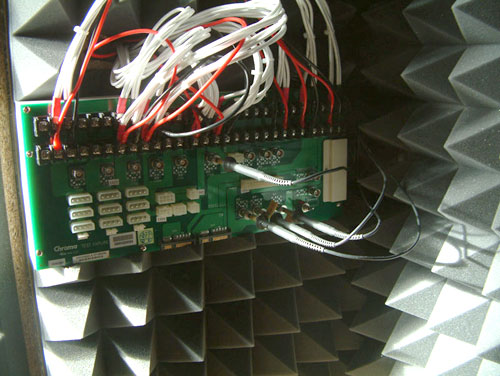
To have a completely closed system we installed the printed circuit board to which the connectors of the power supply will be attached inside the anechoic room/box. In other box designs you would need to put all the cables through the wall. Unfortunately that would result in the inside of the box not being totally isolated anymore. Our design keeps everything which needs to be connected inside of the box and maintains isolation.
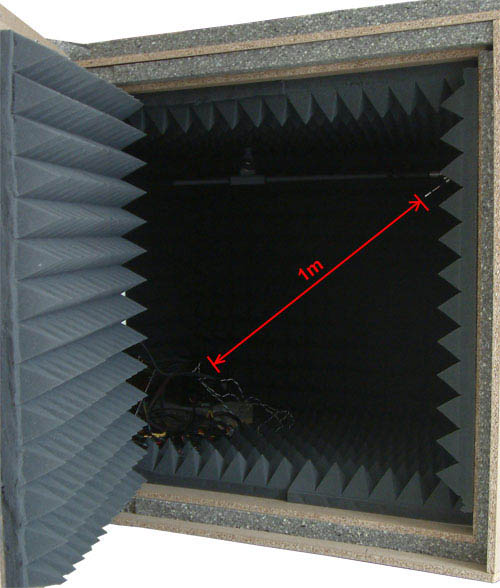
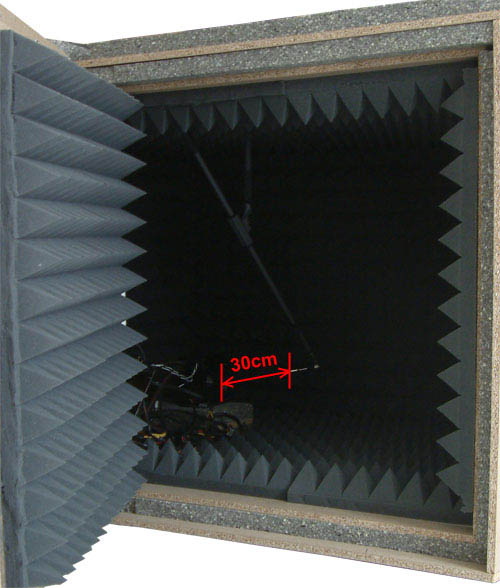
The microphone hangs on a movable stand which is connected to the roof of the box. With this we can move the microphone around in the box to the position of choice. We measure each unit from two different positions. The first is from 1m distance in conformity with normal measurements. The second position is 30cm in front of the power supply at an angle where the airflow does not interfere with the actual noise measurements.
There is one flaw in testing power supplies with programmable loads and while trying to test the sound pressure levels at the same time. Because the programmable loads get very loud there is no chance to even hear the power supply on the test stand. In order to make accurate measurements of the noise levels we needed a way to separate the test unit and the programmable loads. Our solution was to build a very thick box around the unit.
We concluded that a five-layer box with a total thickness of 6" (15cm) containing two layers of wood and three layers or special foam would suffice. It is designed as a box within a box. The inner box does not touch any part of the outer box, making it difficult for acoustic noise to pass through in the form of vibration. Each box is isolated on both sides with a layer of heavy foam which is normally used to isolate engines. In the inside we have an additional layer of 4" (10cm) thick pyramidal foam on every side of the box to eliminate the acoustic waves coming from the test object.
To have a completely closed system we installed the printed circuit board to which the connectors of the power supply will be attached inside the anechoic room/box. In other box designs you would need to put all the cables through the wall. Unfortunately that would result in the inside of the box not being totally isolated anymore. Our design keeps everything which needs to be connected inside of the box and maintains isolation.
The microphone hangs on a movable stand which is connected to the roof of the box. With this we can move the microphone around in the box to the position of choice. We measure each unit from two different positions. The first is from 1m distance in conformity with normal measurements. The second position is 30cm in front of the power supply at an angle where the airflow does not interfere with the actual noise measurements.
Originally published at https://www.anandtech.com/show/2259 (Wayback Machine).